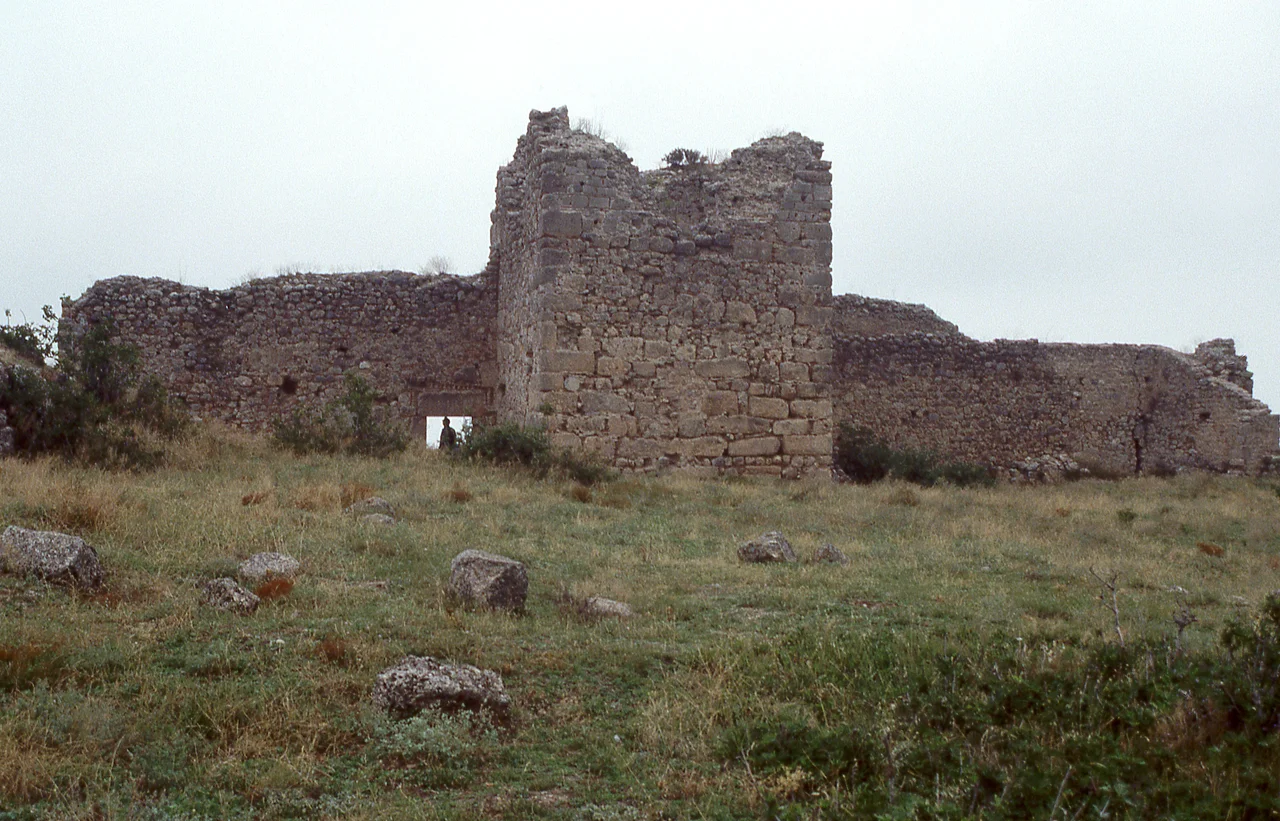

Mendenitsa
When the knights of the Fourth Crusade carved up the Byzantine world in 1204, one of them was handed a job as old as Greek warfare itself: guard the pass of Thermopylae. His name was Guido Pallavicini, an Italian lord, and the fief he received became the Marquisate of Bodonitsa. To hold it, he built a castle on a hill above the village now called Mendenitsa, on the northern slopes of Mount Kallidromon, about six kilometers from the spot where Leonidas had died seventeen centuries earlier. The castle's broken walls still crown the hill — and woven into their lower courses, ancient blocks of cut stone hint that this rock had been fortified long before any Frenchman arrived.
A Castle on the Gate
The strategic value of the site never changed. Thermopylae was the doorway between northern and southern Greece, and whoever held the heights above it controlled the traffic of armies. Pallavicini placed his castle on what may have been the acropolis of the ancient city of Pharygai, and the builders did not start from scratch — they reused the massive rectangular blocks of the older fortress, still visible at the base of the walls, easily told apart from the rougher medieval masonry stacked above them. The original grant, the Chronicle of the Morea records, came from Boniface of Montferrat, the crusader King of Thessalonica. But Bodonitsa was quickly cut off from the north and became the lonely frontier post of the Latin states of southern Greece.
A Bishop Flees the Coast
Bodonitsa was not only a fortress; it became a refuge for the church. After 1204 the Bishopric of Thermopylae fell under Roman Catholic control, but the coast was no safe seat. Two successive bishops were killed in pirate raids — a reminder that the medieval Aegean was a sea of predators. In 1209 the bishop abandoned the exposed shore and moved inland to the protection of Bodonitsa's walls. By the early fourteenth century the diocese carried the castle's name in its title, the eglise de la Bondenice, and a separate Greek Orthodox see endured alongside it. Two faiths, two hierarchies, sheltered behind the same stones above the same ancient pass.
Two Centuries of Borrowed Time
Surviving as a tiny Latin march surrounded by enemies took constant maneuvering. The marquisate married into Venetian interests through the Triarchy of Negroponte, and that connection saved it more than once. When the mercenary Catalan Company shattered the Frankish nobility at the Battle of Halmyros in 1311 — the marquess Albert Pallavicini fell there among the flower of Greek knighthood — Bodonitsa survived by becoming a Venetian protectorate and paying tribute to its new Catalan overlords. It endured raids by the Aydinid Turks under Umur Bey in 1332. It even passed, in 1335, to a Venetian dynasty, the Zorzi, after a headstrong marchioness asked Venice to choose her a husband, then fell out with the man and threw him out of the castle. His son ruled on regardless.
The Siege That Ended It
The reckoning came from the south and east. In 1394 the Ottoman sultan Bayezid I swept across Greece, and Bodonitsa — spared at first, perhaps for its Venetian ties — agreed to pay tribute. Bayezid's death after the Battle of Ankara in 1402 bought a brief reprieve, but the marquess Jacob Zorzi could read the signs: in 1408 he sent many of his people and their animals to safety across the water at Karystos. In 1410 the Ottomans invaded the marquisate and laid siege to the castle. It held out until 20 June 1414, when the walls were stormed and the stronghold razed. The exiled Zorzi family went on claiming the title for decades, but the two-hundred-year experiment of a French castle guarding the Hot Gates was over.
What the Hill Holds
Climb to the ruin today and the centuries stack up under your feet. Two concentric rings of wall survive: a broadly oval outer circuit roughly 240 meters long, and within it a tighter, more elongated inner enclosure about 130 meters across at its longest. A cross wall with a central tower and a single gate seals off the inner keep at the northern end — the best-preserved piece, with walls up to two and a half meters thick still standing tall. In the lower courses, the great squared blocks of antiquity carry the medieval masonry above them, ancient Greece literally bearing the weight of crusader Europe. Below stretches the pass that explains all of it: the reason Slavs settled here, the reason a knight built here, the reason an empire bothered to tear it down.
From the Air
Mendenitsa and its castle sit near 38.75°N, 22.62°E, on the northern slopes of Mount Kallidromon in Phthiotis, about six kilometers southeast of Thermopylae. From the air, the ruined hilltop fortress overlooks the coastal corridor along the Malian Gulf; the wider Spercheios valley and the city of Lamia lie to the northwest. A viewing altitude of 4,000–7,000 feet shows the castle hill in relation to the pass it was built to guard, with the rugged Kallidromon ridge rising behind it. Nearest airport is Nea Anchialos (LGBL) to the north-northeast; Athens (LGAV) is roughly 115 nm to the south. The hilltop is most striking in raking morning or evening light.
Nearby Stories
- Siege of Negroponte (1470) 6.4 km away
- Distomo Massacre 7 km away
- Church of the Nativity of the Theotokos, Limni 9.9 km away
- Battle of Artemisium 10 km away
- Panagia Varnakova Monastery 16 km away
- Almyros 19 km away
- Karpenisi 35 km away
- Karditsa 43 km away