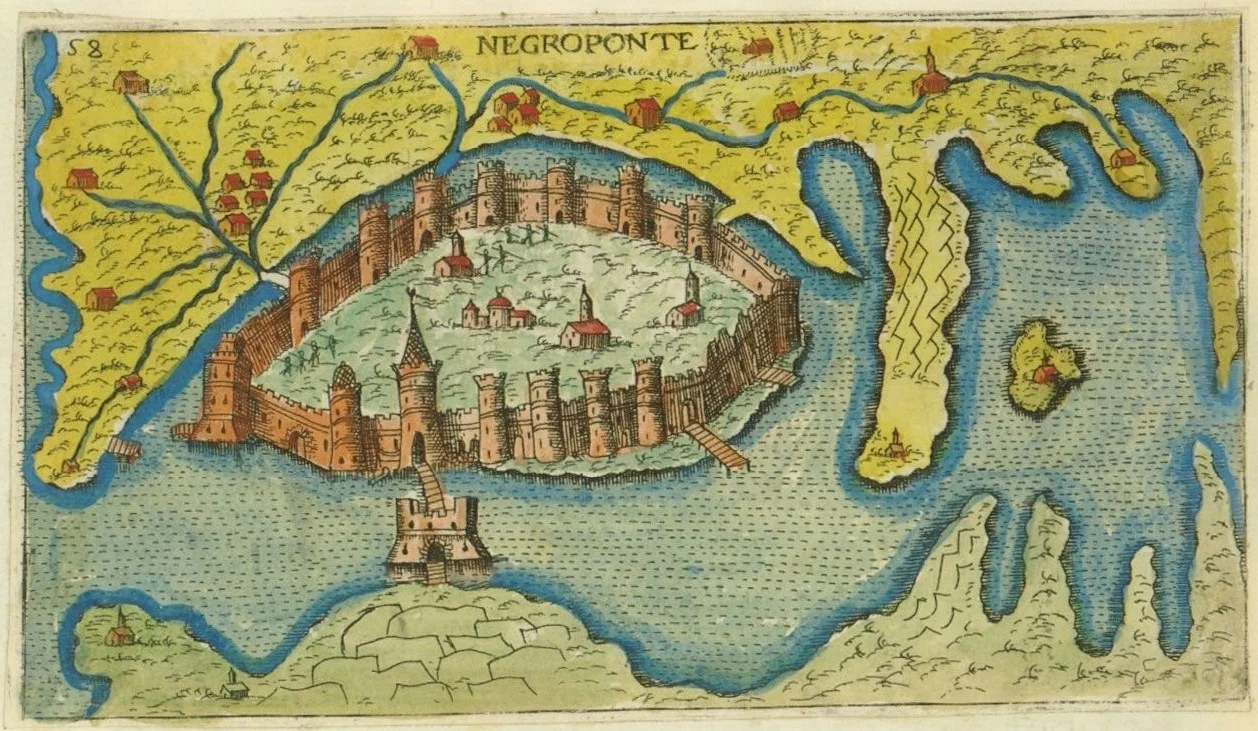

Siege of Negroponte (1470)
Of the roughly six thousand people who defended the Venetian city of Negroponte, only thirty are known to have reached Venice again: fifteen women, twelve children, and three men. That arithmetic of loss is the truest record of what happened here in July 1470, on the island the Greeks called Euboea and the Venetians knew as the bright jewel of their Aegean empire. For nearly a month, the fortress at Chalcis held against the largest army its conqueror had assembled since Constantinople. Then it did not.
A Feint Toward Rhodes
The campaign began as a deception. Mehmed II, the sultan who had taken Constantinople seventeen years earlier, let it be understood that his fleet would sail against Rhodes. Instead, a great armada under Mahmud Pasha set out from Gallipoli in 1470, and the true target was the long Venetian island that guarded the sea-lanes of central Greece. The fortress sat at Chalcis, where the Euripus strait pinches so narrow that a bridge could span it. Venice had held Negroponte for centuries; it was a capital, not an outpost, and its loss would unstitch Venetian power across the eastern Mediterranean. Mehmed meant exactly that.
Sea and Land Closed Tight
On June 14, the Ottoman fleet forced the narrow channel. Mehmed himself arrived overland with an army that contemporaries numbered at seventy thousand, gathered his ships against the shore, and bridged the strait in three days so that cannon could be hauled across by horse. One sea-approach remained open, where defenders could rake passing ships, so the Ottomans repeated a trick from Constantinople and dragged vessels overland to seal it. The walls were formidable, raised from chipped stone bound with lime and mortar, fronted by a deep ditch on the beach. Against them the besiegers massed mortars and cannon and bombarded the stone until, despite frantic repairs by the garrison, the breaches came.
The Relief That Failed
Venice sent help, but sent the wrong man. The relief force fell to Nicolò Canal, remembered cruelly as "a man of letters rather than a fighter, a learned man readier to read books than direct the affairs of the sea." His fleet could not break the blockade in time. When the Venetians tried to destroy the bridge and land soldiers, a sea battle erupted in the harbor and ended in Ottoman victory; several captains, among them Zuan Longo and Zuan Tran, were killed and their ships lost. Canal withdrew to plead for more aid that never came. He would be tried, fined, stripped of rank, and exiled to Portogruaro for the failure.
Taken by the Sword
The final assault came in the dark before dawn on Wednesday, July 11, 1470, and ground on until morning. The city fell the next day. Because Negroponte had refused to surrender, it was taken "by the sword," and by the custom of the age its people paid the full price of that refusal. The men were killed, the women and children enslaved, the captured soldiers executed. Among the dead was the bailo, Paolo Erizzo, the garrison's commander. A famous legend holds that he was sawn in half; the more sober testimony of Giovanni Maria Angiolello, a prisoner who was there, records simply that Erizzo fell in the first onslaught, defending a bastion called the Bourkos. Many of the lurid tales told afterward were invention. The suffering they were built upon was not.
What the Survivors Carried
Word of Negroponte's fall traveled west like a second shockwave from Constantinople, and it taught a grim lesson that other cities learned by heart: places like Athens would later choose surrender over a siege, because a city taken by storm was a city erased. Some who fled the slaughter went north and founded a settlement called Psachna on the Messapios river, a small village then, a town of consequence now. The fortress walls of Chalcis still trace the harbor, and the strait still narrows under its bridge. The thirty who reached Venice carried home the memory of everyone who did not.
From the Air
Negroponte is Chalcis (modern Chalkida) on the island of Euboea, at 38.47°N, 23.27°E, where the narrow Euripus strait separates the island from the Greek mainland. The strait and its bridge are the unmistakable landmark from the air. Best viewed at 3,000-5,000 ft. Athens International (LGAV) lies roughly 40 nm to the south; Nea Anchialos (LGBL) is to the north. Clear summer skies over the Euboean Gulf give long visibility along the coast.
Nearby Stories
- Saint Nicholas Galatakis Monastery 5 km away
- Mount Helicon 6.6 km away
- Battle of Marathon 7 km away
- Battle of Vasilika 9.4 km away
- Panagia Gorgoepikoos Monastery, Mandra 12 km away
- Euboea 13 km away
- Sicyon 22 km away
- Skyros 58 km away