
Sicyon
Painters learned to paint here. Sculptors learned to sculpt here. For several centuries, if you wanted to master the visual arts in the ancient Greek world, you came to Sicyon — a modest city on a triangular plateau above the Corinthian Gulf, about 3 kilometres from the shore, surrounded by olive groves and orchards. It was not the largest city in Greece, not the most powerful, not the most famous. And yet from this quietly prosperous plateau poured a stream of artists so influential that the city became, in the words of ancient writers, the very capital of Greek art.
The City on the Plateau
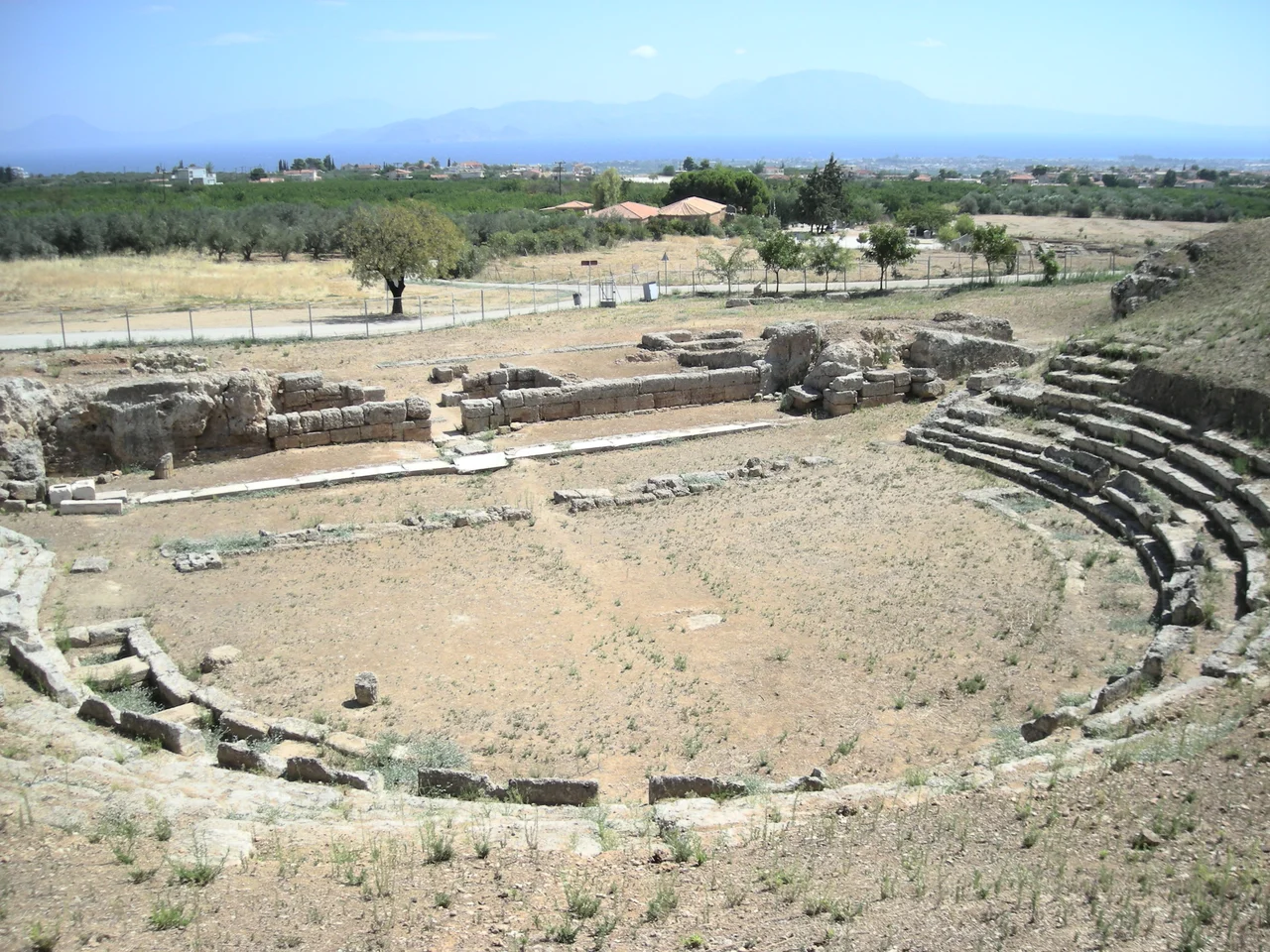
Sicyon occupied a low triangular rise between Corinth and Achaea in the northern Peloponnese, looking out across a fertile coastal plain toward the blue waters of the Corinthian Gulf. The position was defensible without being dramatic — not a cliff-top citadel like Corinth's Acrocorinth, but a broad, workable table of land suited to temples, gymnasiums, theatres, and the workshops where artists spent their lives. The ancient theatre still survives in partial form today, alongside the remains of Doric temples and the foundations of what was once a thriving urban center. A village called Vasiliko stood on the site for centuries before being renamed Sikyona in 1920, reclaiming its ancient identity. Mythology connected the plateau to the deepest layers of Greek cosmology: the city was traditionally identified with Mecone, described by the poet Callimachus as 'the seat of the gods' — the very place where Zeus, Poseidon, and Hades cast lots to divide the world between them.
The School That Shaped Western Art
What Sicyon produced in painters and sculptors between the 7th and 3rd centuries BC is staggering. Butades of Sicyon is credited in ancient tradition with inventing portrait relief sculpture — pressing a face into clay and firing it in the kiln. Canachus created celebrated statues of Apollo that were carried off by the Persians and returned only after Alexander's conquests. Then came the great flowering of the 4th century BC: Eupompus founded a school of painting so influential that later generations divided all Greek painting into schools named partly after him. His student Pamphilus raised painting to the status of a liberal art, arguing that no proper education was complete without it — a radical claim that eventually led Greek cities to make drawing compulsory in schools. Pamphilus's most famous student was Apelles, painter to Alexander the Great and the most celebrated painter of antiquity, though Apelles himself came from Ionia. The sculptor Lysippos worked here through the same era, becoming Alexander's personal court sculptor and producing works of such originality — elongated proportions, figures caught in motion — that he transformed the entire tradition of bronze sculpture.
Tyrants, Democracy, and the Sacred War
Sicyon's political life was as eventful as its artistic life. Around 655 BC, a dynasty of tyrants called the Orthagorids seized power — a family whose grip on the city lasted for a hundred years, an exceptional tenure even by the standards of Greek tyranny. The most notable of them, Cleisthenes of Sicyon (not to be confused with the Athenian reformer of the same name), won the chariot race at the Pythian Games of 582 BC and used his prestige to reorganize the city's social structure, replacing Dorian tribal names with mocking substitutes and installing the worship of Dionysus in place of older cults. He had earlier led the First Sacred War on behalf of Delphi — a conflict fought around 595–585 BC — burnishing Sicyon's reputation across the Greek world. By the 3rd century BC the city had become a democracy, and it was in this later era that Aratus of Sicyon — born 271 BC, died 213 BC — rose to lead the Achaean League, the federation of Peloponnesian cities that tried to resist Macedonian dominance and eventually sought the unlikely alliance of the Spartans against their old Macedonian rulers.
Conquest upon Conquest
After Rome destroyed Corinth in 146 BC, Sicyon absorbed Corinth's religious festivals — including the Isthmian Games — for a time, a recognition of its continued prestige. But the city's importance dwindled through the Roman period, and the medieval centuries brought little stability. By 1369, many villages near Vasiliko had been abandoned because of raids by Turkish pirates operating in the Corinthian Gulf. The territory passed through the hands of Italian banking families — the Acciaioli of Florence, who built a commercial empire across the Aegean — and then through Byzantine despots and, finally, Ottoman conquest in 1458, two years before the Ottomans completed the takeover of the entire Peloponnese. What had been one of the most culturally brilliant cities of the ancient Greek world became, by the 19th century, what the Encyclopaedia Britannica of 1911 called simply 'insignificant.'
What Remains
The ruins of Sicyon are not spectacular by the standards of Olympia or Delphi — no intact colonnades, no roof still standing. But the site repays a visit. The ancient theatre, carved into the hillside, retains its curved cavea. The remains of a large Doric temple give a sense of civic ambition. A small museum holds finds from the excavations: ceramics, architectural fragments, votive objects. And the air over the plateau carries something of the city's peculiar history — the paradox of a modest place that somehow generated, for several centuries, an extraordinary proportion of the ancient world's most influential artists. The name of Lysippos still appears in art history textbooks. The school of Pamphilus still gets credit for the institutionalization of drawing as an art form. Sicyon taught the ancient world to look.
From the Air
Sicyon sits at approximately 37.984°N, 22.711°E on a low plateau in the northern Peloponnese, about 3 km inland from the Corinthian Gulf. At 3,000–5,000 feet, the plateau top is visible as a broad flat area west of modern Corinth, with the blue expanse of the Gulf stretching to the north. The nearest major airport is Athens International (LGAV), approximately 80 km to the east. Approach from the north over the Gulf for the best view of the coastal plain below the plateau.
Nearby Stories
- Battle of Kalavryta 3.8 km away
- Medeon (Phocis) 5.1 km away
- Tomb of Clytemnestra 9.8 km away
- Archaeological Museum of Thebes 10 km away
- Aigosthena 10 km away
- Agistri 17 km away
- Barony of Akova 19 km away
- Panagia Varnakova Monastery 23 km away