
Archaeological Museum of Thebes
Thebes was a city of myth long before it was a city of museums. This was the home of Oedipus and the seven-gated walls, the birthplace of the god Dionysus, the rival that once challenged Athens and Sparta for the soul of Greece. Most of that ancient city now lies buried beneath the modern town. But in a building at its edge, the things the earth gave back are gathered, room by lit room, into one of the finest regional collections in all of Greece.
From Barracks to Galleries
The museum's story begins in 1894, when military barracks on this site were cleared out and turned into exhibition rooms for the flood of archaeological finds coming up out of Boeotia. The makeshift arrangement gave way in 1905 to a purpose-built structure funded by the Archaeological Society at Athens, and then, more than a century later, to the airy modern building that reopened in 2015 after years of radical reconstruction and expansion. Each rebuilding reflected a simple problem of abundance: the ground around Thebes kept yielding more than any single room could hold. The collection it houses ranges across the whole sweep of Boeotian history, from prehistory through the Mycenaean palaces to classical, Hellenistic, and Roman times.
Voices in Clay
Among the museum's most remarkable holdings are the clay tablets inscribed in Linear B, the earliest written form of Greek, pressed into wet clay by palace scribes more than three thousand years ago and accidentally fired, and so preserved, when the Mycenaean citadel of Thebes burned. These are not poetry or history but inventories, records of wool and livestock and offerings to the gods, the bureaucratic memory of a Bronze Age kingdom. Around them stand other survivals of that lost world: the painted larnakes, terracotta coffins from nearby Tanagra, decorated with scenes of mourners, a man with an antelope, and the leaping figures of a bull dance, fragile pictures of how the Mycenaeans imagined death and the world beyond it.
The Mysteries of the Kabeirion
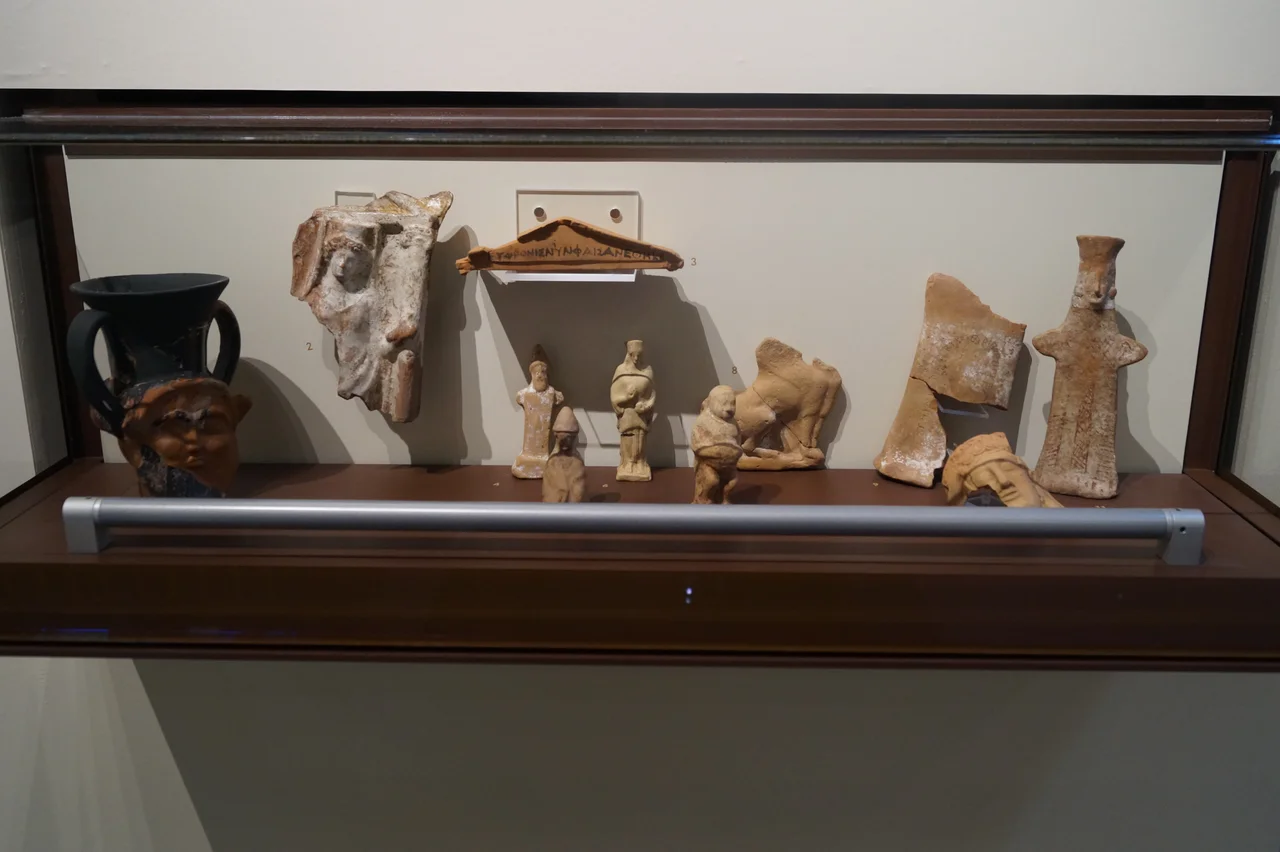
A short distance from Thebes lay the Kabeirion, a sanctuary devoted to the Kabeiroi, mysterious deities whose secret rites drew worshippers for centuries. The museum holds the strange and wonderful pottery made for that cult: black-figure drinking cups and kantharoi painted with squat, caricatured figures, grotesque and comic, utterly unlike the idealized bodies of classical Athenian vases. We do not fully understand what happened in the Kabeirion's rites, which were deliberately kept secret, but these cups, used and dedicated by the people who took part, are among the most vivid traces of one of ancient Greece's hidden religions, humor and reverence mixed together in painted clay.
A Thousand Years on Display
Walk the galleries and the centuries unspool. An archaic kouros, the rigid, faintly smiling stone youth of the sort that crowded Boeotian sanctuaries, keeps company with finely painted vases of dancers and satyrs, with terracotta figurines, with finds from the Cave of the Leibethrid Nymphs. Near the end comes something more intimate: an encaustic portrait of a young man named Theodoros, his likeness painted in colored wax on his marble gravestone in the first century BC, inscribed with a single word of farewell. He gazes out across two thousand years, a real person from a city of legends, reminding visitors that behind every myth of Thebes there were people who lived, worshipped, and were mourned in the soil of Boeotia.
From the Air
Located at 38.32°N, 23.32°E in the city of Thebes (Thiva), on the inland plain of Boeotia northwest of Athens. Look for the modern town set on its low acropolis amid surrounding farmland, with Lake Yliki to the north and the mountains of Boeotia beyond. Nearest major airport is Athens International (LGAV), roughly 70 km southeast; Nea Anchialos (LGBL) lies to the north and may be closer depending on routing. Best viewed from 3,000 to 5,000 feet in clear weather.
Nearby Stories
- Saint Nicholas Galatakis Monastery 5 km away
- Mount Helicon 6.6 km away
- Battle of Marathon 7 km away
- Battle of Vasilika 9.4 km away
- Panagia Gorgoepikoos Monastery, Mandra 12 km away
- Euboea 13 km away
- Sicyon 22 km away
- Skyros 58 km away