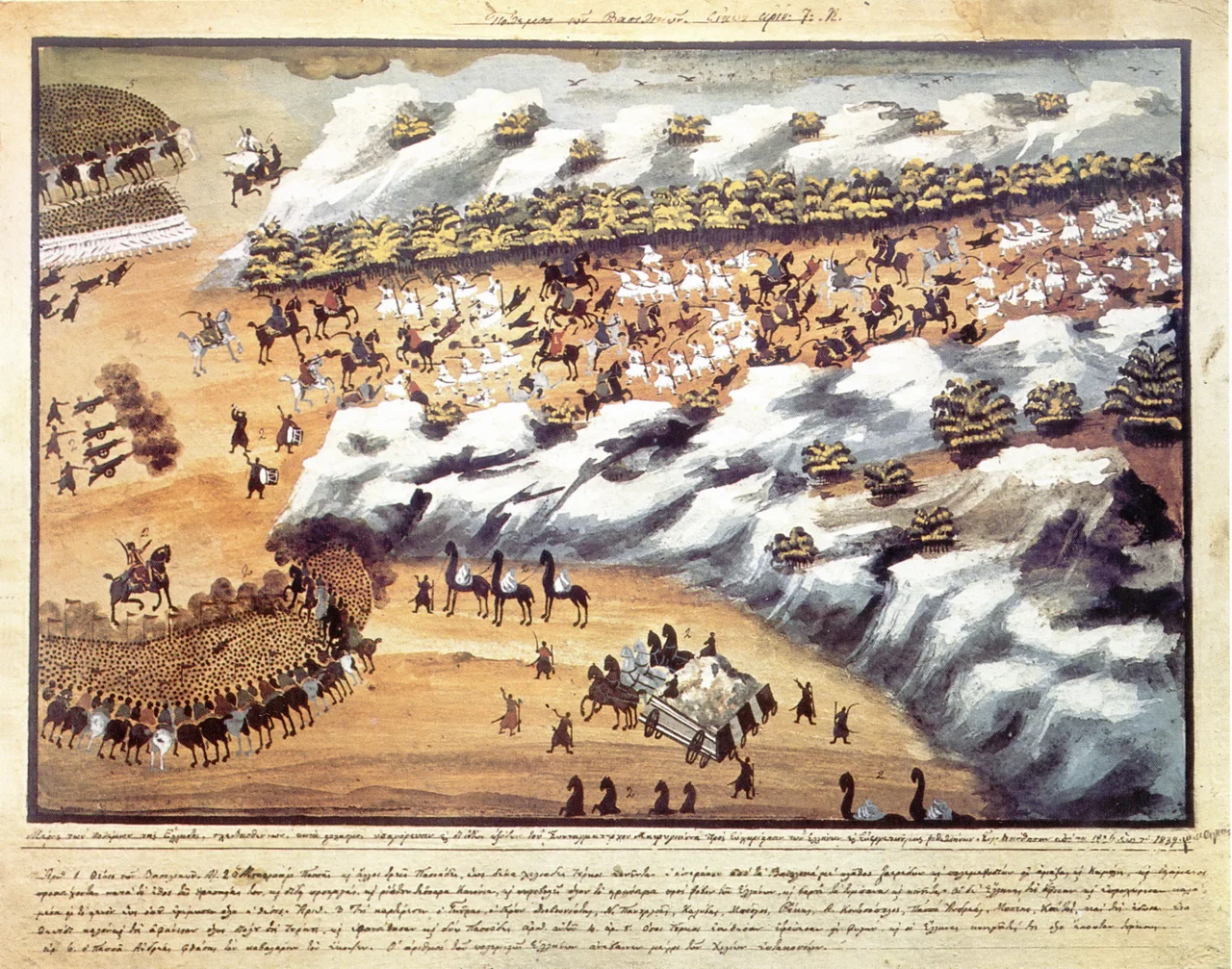

Battle of Vasilika
It was a rumor that won the battle. On 7 September 1821, a Greek band crouched in the rocks above the village of Vasilika, watching an Ottoman army of thousands try to squeeze through a long, narrow path below them. The Greeks fired their muskets, then did something muskets-and-then-retreat warfare did not usually allow: they charged. What drove them down the slope was word — true or not — that Odysseas Androutsos, the most feared captain in eastern central Greece, was riding to join them. The Ottomans broke. And the road into the Peloponnese, where the heart of the Greek revolution was fighting for its life, stayed closed.
A Revolution in the Balance
The Greek War of Independence was only months old, and far from won. Earlier that year, at the Battle of Alamana, the Ottomans had crushed a Greek force and opened the route into eastern central Greece and toward the Morea — the Peloponnese — beyond. Now an army of between five and eight thousand men under Behram Pasha was marching south with two aims: to stamp out the rebellion in the central mainland, and to relieve the great Ottoman fortress of Tripolitsa, which Greek fighters had under siege. If that army got through, the most important Greek operation of the war could collapse.
The Trap at Vasilika
To stop a column that large, the revolutionaries did not need to match it — they needed to catch it where it could not deploy. The captains Yannis Gouras and Ioannis Dyovouniotis gathered their men at Vasilika, a desolate village in Phthiotis where the road funneled into a long and narrow defile. It was the same logic that had made nearby Thermopylae famous for two thousand years: choose the ground, and numbers stop mattering. On 7 September the Ottoman troops pushed into the pass, the Greeks opened fire, and the fight turned vicious in the close country where cavalry and mass could not be brought to bear.
The Name That Broke the Line
Then came the rumor. Word spread through the Greek ranks that Odysseas Androutsos — a klepht captain whose reputation alone could unsettle an enemy — was approaching to reinforce them. Emboldened, the Greeks stopped trading volleys and stormed forward into a frontal assault. The Ottomans, already pinned in the defile, suffered heavy losses and gave way. They fell back toward the city of Lamia, abandoning much of their baggage and leaving seven cannons behind on the field. To slow any pursuit, they tore down the bridge of Alamana behind them — destroying the same crossing that had marked their earlier victory.
Why Vasilika Mattered
A skirmish at an obscure village does not sound like a turning point, but its consequences were large. Behram Pasha's army — the main Ottoman thrust into central Greece — had been thrown back, and the Sublime Porte could not organize another campaign until 1822. That pause was everything. It gave the Greeks of the mainland time to regroup, and it kept the Ottoman army from crossing into the Peloponnese to lift the siege of Tripolitsa. When Tripolitsa fell to the Greeks weeks later, it was in part because no relief column ever arrived. The men in the rocks above Vasilika had bought the revolution the time it needed to take root.
The Quiet Battlefield
Vasilika today is a small place in the Phthiotis countryside, the kind of village that does not announce its history. But the terrain still tells the story. This is rumpled, mountain-shadowed land where roads have always been forced into narrow valleys, where a determined few could command a passage. It is no accident that so much of Greek history — the Persians, the Macedonians, the Ottomans — was decided within a short ride of here. The defile that swallowed Behram Pasha's army belongs to the same stubborn geography that made this corner of Greece a gate that every invader, in the end, had to fight to open.
From the Air
The battlefield lies near 38.71°N, 22.75°E, in the hill country of Phthiotis in north-central Greece, southeast of the city of Lamia. From the air, the surrounding terrain is a maze of ridgelines and narrow valleys draining toward the Malian Gulf and the broad Spercheios plain to the northwest; the pass of Thermopylae sits a short distance to the northwest along the coast. A viewing altitude of 5,000–8,000 feet reveals how the roads are funneled between the heights — the same constriction the Greek captains exploited. Nearest airport is Nea Anchialos (LGBL) to the north; Athens (LGAV) lies roughly 105 nm to the south. Expect clear visibility in dry Mediterranean weather.
Nearby Stories
- Siege of Negroponte (1470) 6.4 km away
- Distomo Massacre 7 km away
- Church of the Nativity of the Theotokos, Limni 9.9 km away
- Battle of Artemisium 10 km away
- Panagia Varnakova Monastery 16 km away
- Almyros 19 km away
- Karpenisi 35 km away
- Karditsa 43 km away