
Battle of Artemisium
The wreck happened before the battle did. A north-easterly storm the Greeks called a Hellesponter caught the Persian fleet on the open coast of Magnesia, smashing perhaps a third of Xerxes' twelve hundred ships against the cliffs in a two-day gale. Sailors who had crossed the Hellespont on Persia's celebrated pontoon bridges drowned in sight of mountains. By the time the surviving fleet reached the strait off northern Euboea in late August or early September of 480 BC, the Greeks waiting for them had already received their first gift from the gods.
The Two-Front Trap
Themistocles had sketched the strategy on a map that did not yet exist as a strategy. Hold the narrows on land at Thermopylae. Hold the narrows at sea off Cape Artemisium. Force the colossal Persian war machine through bottlenecks where numbers could not unfold. The Allied fleet of roughly 271 triremes - Athenian, Corinthian, Spartan, and a dozen others - beached their hulls on the headland's gravel and watched a fire-beacon flare on the island of Skiathos to announce that the enemy had arrived. Sparta's admiral Eurybiades held nominal command, a concession Athens made to keep the alliance from fracturing before the first oar dipped. The plan required both walls of the trap to hold. Either alone was useless.
Three Days in the Strait
On the first day the Allies waited as the Persians, still rebuilding from the storm, sent two hundred ships to circle Euboea and trap the Greek fleet from the south. A second tempest caught that detachment on the rocks of the island's eastern shore - a stretch of cliffs the Greeks called the Hollows - and shipwrecked nearly all of them. Encouraged, the Allies struck at dusk in a sudden lunge from a defensive crescent, their rams pointing outward, their sterns drawn in. They caught the Persians off guard and captured ships. The second day brought a tense pause as the storm-battered Persian fleet patched itself together. The third day was the real fight, and it lasted from morning to dusk. Egyptian marines, heavily armored in equipment Herodotus compared to Greek hoplites, vanquished five Greek ships. Athenians held the center. Both sides bled. When the Greeks counted their wrecks at sundown, the math was simple and terrible: roughly equal losses, but the smaller fleet could not afford to trade evenly.
The Liaison Boat
Abronichus arrived from Thermopylae in a single ship with a single message. The pass had fallen. Leonidas was dead. The land wall had broken. Without that anchor, the fleet's position meant nothing - the Persians could now march into central Greece by road and sweep around behind the strait at will. The Allies argued briefly, then withdrew under cover of darkness. They sailed for Salamis, where Athenians were already evacuating their city in advance of the army that would soon burn it. Themistocles left inscriptions carved on water-stops along the coast, addressed to the Ionian Greeks rowing in Persian ships, asking them to defect or at least to row badly. Some did. A few months later, in those same waters off Salamis, the Persian fleet would be destroyed. Artemisium was not a defeat. It was the first half of a longer answer.
What the Strait Holds Now
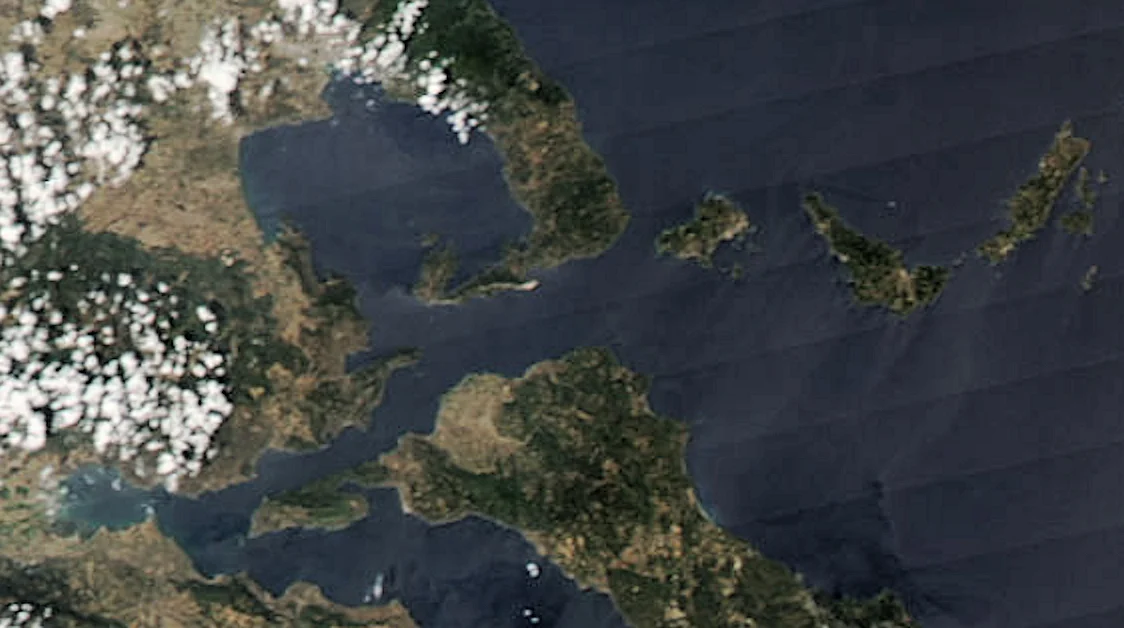
The cape juts from the northern tip of Euboea where the island swings closest to the Magnesian mainland, the channel between them narrow enough that a fishing skiff can cross in an afternoon. In 1928 Greek divers recovered a bronze statue of Zeus or Poseidon from the seabed near the cape - the famous Artemision Bronze, now in the National Archaeological Museum in Athens, eight feet of striding god frozen mid-throw. He was probably lost in a Roman shipwreck centuries after the battle, but he came up from the same waters where Persian and Greek triremes broke against each other. The shore today is quiet, with small beaches and the village of Pefki, and the wind that drove the Hellesponter still scours the channel every summer.
From the Air
Cape Artemisium sits at the northwestern tip of Euboea (Evia), Greece, at approximately 39.05N, 23.32E. Recommended viewing altitude 4,000-6,000 ft AGL to see both the cape and the Magnesian coast across the narrow strait. The nearest airports are Skiathos (LGSK) about 18 nm north, Volos/Nea Anchialos (LGBL) 30 nm northwest on the mainland, and Athens International (LGAV) 90 nm south. From altitude the strait reads as a narrow blue corridor between mountainous Euboea and the Magnesian peninsula; Skiathos and the smaller Sporades sit just north, marking the approach the Persian fleet made in 480 BC.
Nearby Stories
- Battle of Halmyros 5.4 km away
- Monastery of Saint David the Elder 8.4 km away
- Alonnisos 11 km away
- Opuntian Locris 14 km away
- Kymi, Greece 29 km away
- Tempi Train Crash 60 km away
- Battle of Potidaea 92 km away
- Battle of Athos 117 km away