
Battle of Halmyros
Walter of Brienne wrote his will at Lamia on 10 March 1311. Five days later he was dead, and so were most of the men whose names appeared as witnesses on the document. The Catalan Company of mercenaries had been hired to fight Walter's wars in Thessaly, conquered the region for him, and then refused to leave when he refused to pay them. The Duke of Athens decided to expel them by force. He had numerical superiority, the finest heavy cavalry in southern Greece, and a thousand years of feudal certainty that mounted knights crushed footmen. None of it mattered when the field of battle was a swamp.
Mercenaries Without a War
The Catalan Company was the residue of an older Mediterranean problem. They had fought as professional infantry for the Crown of Aragon during the War of the Sicilian Vespers, and when that war ended in 1302 they hired themselves out to the Byzantine Emperor Andronikos II to fight Turks in Anatolia. They were brutally effective, mutually hated their employer, and after a series of betrayals in 1305 the Company murdered the emperor's son Michael IX's brother-in-law, declared war on Byzantium, and pillaged their way west through Thrace and Macedonia. By 1309 they had run out of Byzantine territory to plunder and entered Thessaly with about 8,000 men. Walter of Brienne, the new Duke of Athens, knew the Company personally - he had fought against them in Italy, spoke Catalan, and held their respect. He hired them. They conquered Thessaly for him in a brutal campaign. He then refused to honor the contract.
Five Hundred Catalans Walk Out
Walter selected 200 of the best Catalan horsemen and 300 of their elite Almogavar infantry to keep in his service, paying them up to date and granting them land. The remaining 6,000-plus he ordered out of his territory empty-handed. The Catalans offered to settle peacefully if they could keep some of what they had taken; he refused. He assembled his army: the most prominent lords of Frankish Greece, a generation of crusader barons whose ancestors had carved up the Byzantine Empire after 1204 - Albert Pallavicini of Bodonitsa, Thomas of Salona, Boniface of Verona, George Ghisi, and dozens of others, with reinforcements from across the Frankish principalities. The Catalan Company chose its ground carefully on the plain of Halmyros in southern Thessaly, behind a marsh fed by a river they could divert. On the eve of the battle, the 500 Catalans in Walter's service came to him and asked permission to rejoin their old comrades. They would rather die with friends than live as betrayers. Walter gave permission, allegedly with contempt: they were welcome to die.
The Charge into the Mud
The chronicle accounts of the battle differ widely - the Florentine Giovanni Villani, the Catalan Ramon Muntaner, the Byzantine Nikephoros Gregoras, and the various versions of the Chronicle of the Morea give numbers that modern historians consider exaggerated and sometimes fictional. What is clear is what mattered. Walter formed his line with 200 knights 'with golden spurs' in the vanguard, his banner with him, infantry behind. He charged. The marsh closed around the horses. Heavy chargers carrying armored knights are the worst possible weight to put on soft ground, and the Almogavars - lightly armed swordsmen and javelin throwers, the spiritual ancestors of the Spanish tercios - waded through water that did not hold their enemies and dispatched the knights bogged down in their own armor. The Turkish auxiliary cavalry of the Catalan Company, who had taken up position separately on the eve of battle and feared treachery, watched the engagement begin and realized only as the Frankish line broke that the Catalans were genuinely fighting. They came down on the flank of Walter's army and finished it. Walter died on the field. So did almost the entire Frankish nobility of southern Greece. Modern historians suspect the marsh story may be partly literary - it echoes the more famous Battle of the Golden Spurs at Courtrai in 1302 - but the outcome cannot be argued: a feudal cavalry charge was destroyed by professional infantry.
The Catalan Duchy
What followed was perhaps the strangest political reorganization in medieval Greek history. The Catalan Company, leaderless after refusing the offer to be led by their captives, took over the Duchy of Athens by inheritance and conquest combined. They asked Boniface of Verona, one of the few surviving Frankish lords, to lead them; he declined; they chose Roger Deslaur instead. Many Catalans married the widows and daughters of the men they had killed at Halmyros. They ruled Attica and Boeotia from Thebes and later Athens for nearly 80 years, eventually under the protection of the Crown of Aragon, until they were finally displaced by the Navarrese Company and the Florentine Acciaioli family in the 1380s. Halmyros itself - the modern town in southern Thessaly that gives the battle its name - is a quiet agricultural center on the Pagasetic Gulf today, with the Othrys mountains rising to the south. The exact site of the battle in the marshy lowlands has never been securely identified. The chronicle saying that 700 knights died with golden spurs may be a flourish, but the Frankish aristocracy of Greece was destroyed in an afternoon, and Catalan was spoken in the streets of Athens for three generations.
From the Air
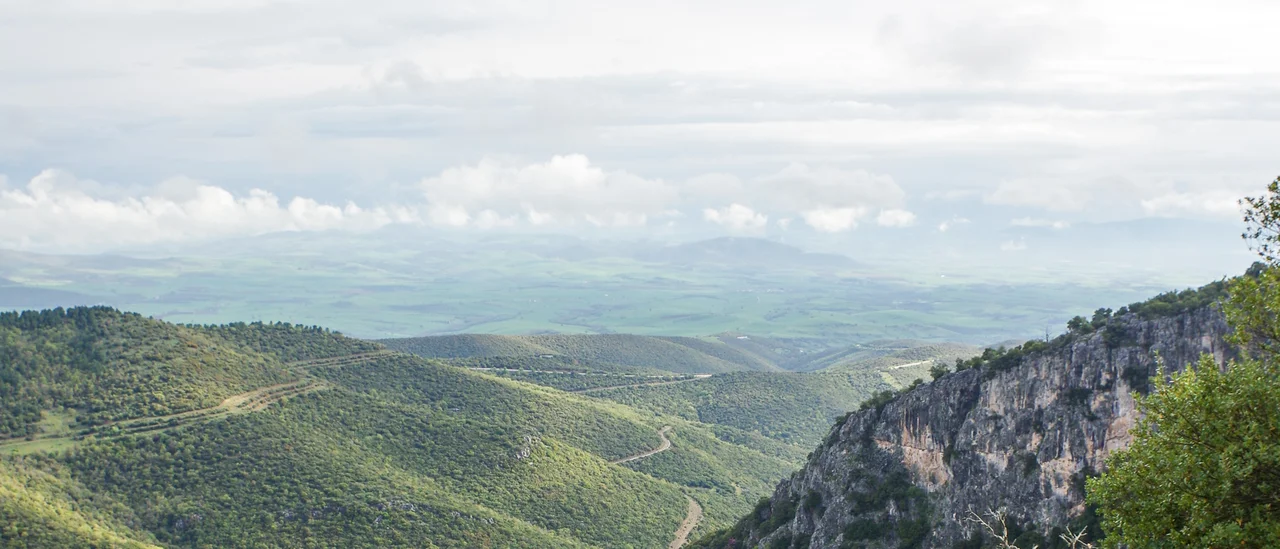
Halmyros (modern Almyros) lies in southern Thessaly, central Greece, at approximately 39.16N, 22.84E, on the western shore of the Pagasetic Gulf. The exact battlefield in the surrounding marshlands has not been securely located. Recommended viewing altitude 4,000-5,500 ft AGL. Nearest airports are Volos/Nea Anchialos (LGBL) 18 nm north and Larissa (LGLR) 35 nm north. From altitude the Pagasetic Gulf is unmistakable as a sheltered inlet of the Aegean; the Othrys mountains rise to the south of Halmyros, the plain of Thessaly opens to the north, and Mount Pelion is visible to the northeast across the gulf.
Nearby Stories
- Monastery of Saint David the Elder 6.8 km away
- Battle of Thermopylae (279 BC) 11 km away
- Battle of Artemisium 12 km away
- Greece 18 km away
- Prousou Monastery 44 km away
- Tempi Train Crash 54 km away
- Meteora: The Monasteries Built on Impossible Pillars 59 km away
- Battle of Potidaea 92 km away