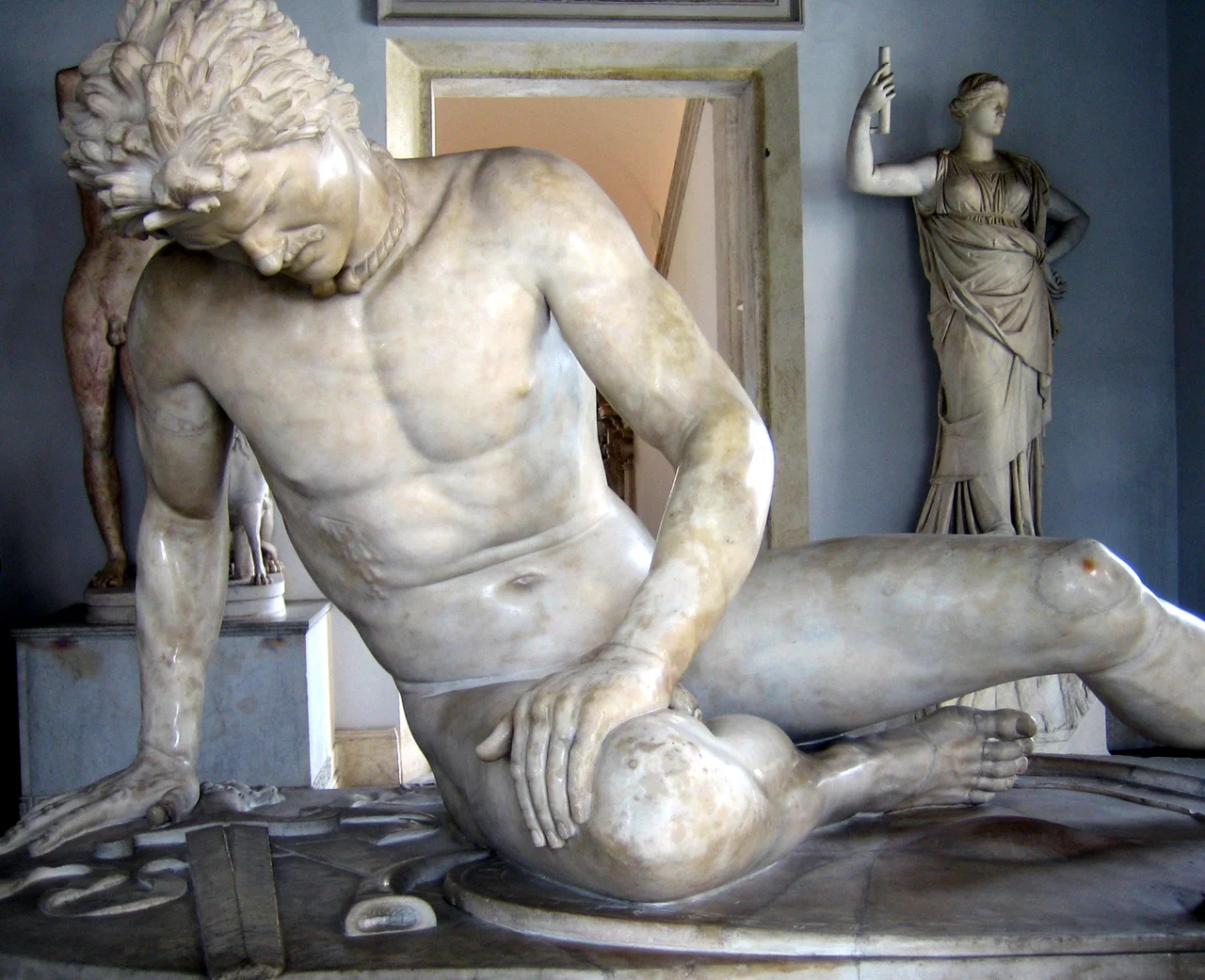

Battle of Thermopylae (279 BC)
By 279 BC, Greece had stopped imagining what would happen if a barbarian invasion came over the mountains. Alexander had been dead for forty-four years. His successors had carved up the world from the Adriatic to the Indus and had left the Greek mainland politically exhausted. So when 85,000 La Tene Celts came south through the Carpathian basin and into Pannonia, then through Macedonia - killing the Macedonian king Ptolemy Keraunos in a battle so decisive that the Macedonian throne went briefly empty - the cities of central Greece had to scramble for an answer none of them had rehearsed. They scratched together a coalition of Aetolians, Boeotians, Athenians, Phocians, and Locrians, and sent it to the same pass where Leonidas had died two centuries earlier.
The Army That Worried the Diadochi
The Gauls who reached Greece in 279 BC came from the La Tene cultural complex of central Europe - a mix of related but politically distinct peoples that the Greeks called Galatae. Their armies had been pressing southeast for fifty years, raiding into Illyria and Pannonia, settling where they could. In 280 BC the migration reached its peak. A force of perhaps 85,000 warriors - women, children, and supplies travelling with them - approached from Pannonia and split into three columns. Cerethrius led 20,000 men against the Thracians and Triballi to the east. Bolgios led another column against the Macedonians and killed King Ptolemy Keraunos in early 279 BC. The third column, the largest, was led by Brennus and Acichorius. After plundering Macedonia they came south through the passes into Thessaly. The Greek world had not faced an external invasion of this kind since the Persians, and there was no Sparta left to lead the resistance.
The Pass Held - For a Day
The Greek coalition took up positions at Thermopylae, where a Greek army has always taken up positions when there is a way south to be denied. The first Gaulish assault, against shield walls and prepared ground, was bloody. Brennus understood quickly that the pass would not be forced by frontal attack. So he did what every commander at Thermopylae has eventually done: he split the problem. He sent Acichorius with a substantial force south and west, into Aetolia itself, to attack the Aetolian homeland and force the Aetolian contingent to leave the line.
The Defence of Aetolia
Acichorius reached Aetolia and discovered something the Greeks understood about themselves: that an invading army has to win every fight, but a defending population only has to bleed it. The town of Kallion was overrun and destroyed, and what happened to its inhabitants is described by Pausanias in language that even ancient readers found difficult. The men were killed; the women and children suffered worse. The atrocity changed the war. The entire surviving population of Aetolia - the old men past military age, the women, the boys not yet enrolled in the phalanx - took the field. Pausanias is explicit on this point. They did not try to fight the Galatian sword at close quarters; the Aetolian sword was lighter and the Aetolians knew their own hill country. They ambushed the column at every pass and watering place. They picked off stragglers. They burned the camps at night. At Kokkalia the entire population fell on the column and broke it. By Pausanias' count, only half the men Acichorius had taken into Aetolia made it back to the main force, and the survivors brought sickness with them.
The Sack That Failed at Delphi
Brennus, with the depleted army, pushed south through the now-undefended Thermopylae pass and made for Delphi - the sanctuary of Apollo, the most prestigious religious site in Greece, the storehouse where every Greek city had been depositing offerings for six hundred years. The Phocians and the local Greeks intercepted him in the mountain country around the sanctuary. The accounts that survive describe a thunderstorm, rockfalls, and a Greek night attack on a disordered camp. Brennus was wounded - by some accounts mortally, by others grievously. The Galatian army broke and fled north, harried at every step. Brennus, depending on the source, took his own life with wine and a dagger. The remnants of his force struggled back to Macedonia, splintered, and dispersed. One group, led off the main column in 281 BC, was ferried across to Asia Minor by Nicomedes I of Bithynia and eventually settled in central Anatolia, where they gave their name to a region the Romans called Galatia and to the people St Paul wrote a letter to three centuries later.
What Aetolia Got For Saving Greece
The Aetolian League had been a peripheral confederation before 279 BC. After it, the Aetolians were the heroes of central Greece, and they had earned a real political voice. They erected a memorial portico at Delphi - the Western Portico, one of the largest buildings near the sanctuary - and decorated its base with depictions of captured Galatian armour. They were granted the right to attend the Amphictyonic Council, the religious body that administered Delphi, which had previously excluded them. The festival of the Soteria, the Salvation games, was reorganised in their honour and became a Panhellenic athletic festival held every five years. For about a century the League controlled Delphi itself. The Aetolians had walked into 279 BC as a confederation of mountain villages and walked out, by the end of the campaign, as one of the dominant Greek powers - because they had refused to abandon their pass, because their old men and women had taken up spears, and because a town called Kallion had paid the price that made the rest of the country fight.
From the Air
38.81N, 22.56E. The Thermopylae pass runs along the southern shore of the Malian Gulf below Mount Kallidromos. From 5,000-7,000 ft, the same pass is visible as in the 480 BC and 191 BC battles - long mountain ridge to the south of a coastal plain, modern E75 motorway following the ancient route. For this 279 BC campaign, the most dramatic terrain is to the southwest in Aetolia, the rugged mountain country of modern Aitoloakarnania - look for the high ridges around modern Karpenisi and the steep valleys where the Aetolian guerrilla actions broke Acichorius' column. Delphi, where Brennus was turned back, sits 50 km south of Thermopylae on the southern slopes of Mount Parnassus (2,457 m). Lamia (LGLM) is 22 km northwest. Athens International (LGAV) is 175 km southeast. Mount Parnassus is the most prominent landmark in the area, often snow-covered November through April.
Nearby Stories
- Siege of Negroponte (1470) 6.4 km away
- Distomo Massacre 7 km away
- Church of the Nativity of the Theotokos, Limni 9.9 km away
- Battle of Artemisium 10 km away
- Panagia Varnakova Monastery 16 km away
- Almyros 19 km away
- Karpenisi 35 km away
- Karditsa 43 km away