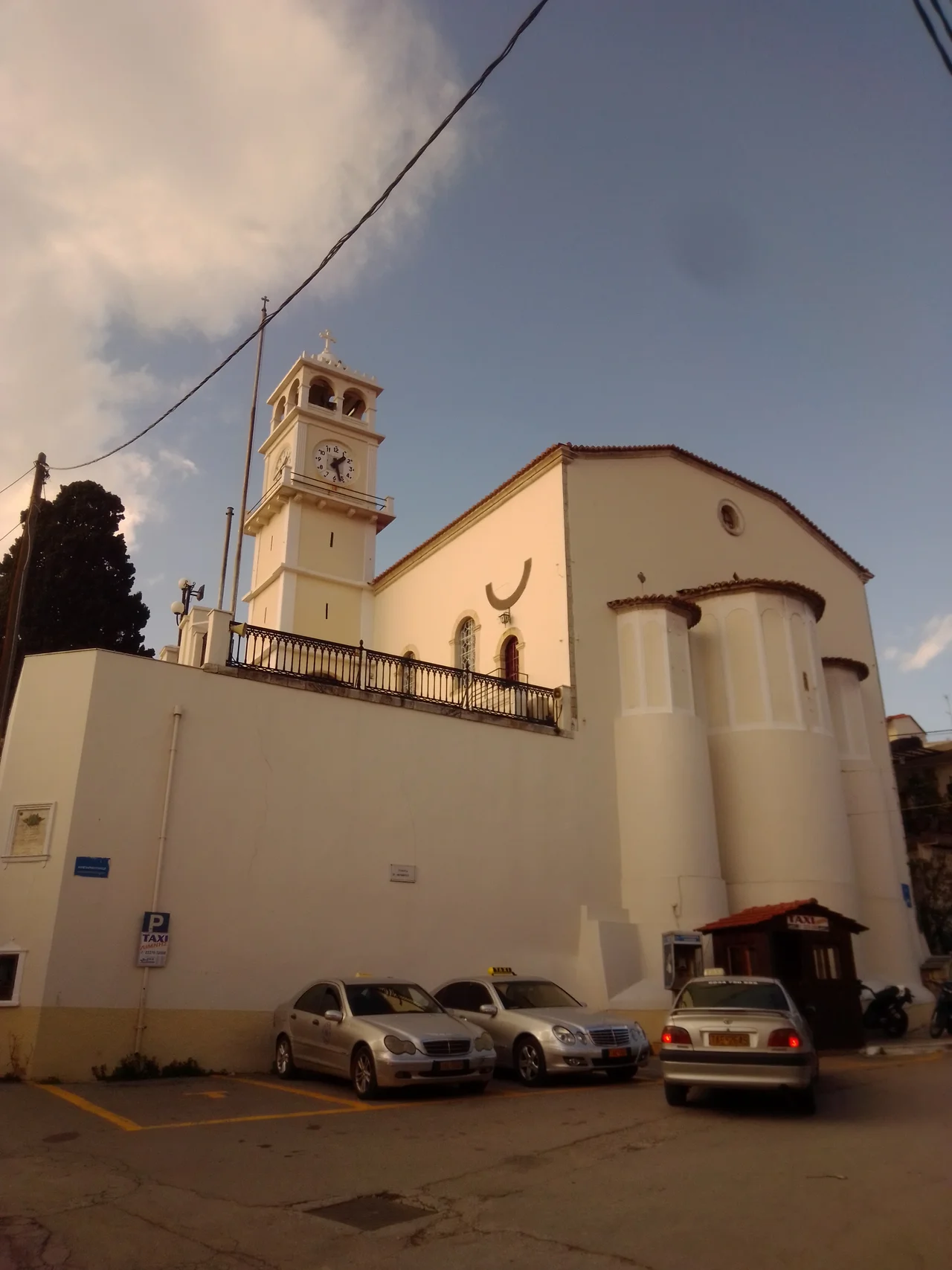

Church of the Nativity of the Theotokos, Limni
When the Ottoman troops of Yusuf Berkoftsali Pasha swept through northern Euboea in July 1823, they destroyed the parish church of Limni along with much of the town. What stands on that ground today was built by people who had just become free. Raised between 1837 and 1841 on the foundations of the church the Turks had razed, the Nativity of the Theotokos was financed entirely by the residents of Limni, and above all by its sea captains, putting up the church as a monument to survival in the first fragile years of an independent Greek state. Perched on a rock at the center of town, it can be seen from nearly everywhere in Limni.
A Faith That Moved With Its People
The story of this church is really the story of a community on the move. Between the ninth and tenth centuries, the inhabitants of ancient Elymnion built their first parish church on the hill called Panagia, north of present-day Limni, dedicating it to the Nativity of the Virgin. They worshipped there until the sixteenth century. Then, as Ottoman authorities allowed populations to relocate, the people came down from the hills of Kastrias and Panagia to settle permanently on the coast where Limni now stands. They built a new parish church on the very spot the present one occupies, and clustered their first houses around it. The church did not simply serve the town; it anchored it, the fixed point around which a community gathered and grew.
Destruction and a Fresh Start
The Greek War of Independence reached Limni with brutal force. In July 1823 the church was destroyed and the town devastated by Yusuf Berkoftsali Pasha's invasion of northern Euboea. Then the tide of history turned. The London Protocol of 1830 established the first independent Greek state, with Euboea inside its borders, and the people of Limni began returning home. Around 1832 and 1833 they threw up a small, rough temple on the ruins, but by 1837 it was judged unfit for a town now growing fast on shipping and farming. On 31 March 1837 the municipal council resolved to build a proper church on the old foundations, sized to match a swelling population, and funded entirely by the townspeople themselves.
Built by Captains
The new church reveals who held power in Limni as the modern town took shape. First to step forward with money were the captains and ship owners, making their debut in the town's social life as an organized professional class, the men whose vessels were turning a recovering coastal village into a maritime center. By 1840 they were financing the work through rented pastures, granted plots of land, and the lease of the community house, funneling the income toward completion. The project was finished at the end of 1841. Set on its rock above the harbor, 295 square meters of stone with a courtyard on two levels joined by a stair, the church stands as a record of the people who paid for it, the sailors who built a sanctuary out of their own prosperity and grief.
Treasures Behind Silver
Inside, the church guards relics and documents that fold centuries into a single room. A silver reliquary holds fragments associated with Saint Nicholas, Saint Barbara, and Saint Mamas, and a hand-shaped reliquary keeps parts said to belong to Saint Minas. There is a pillow reported to come from the chariot of Saint Christodoulos on Patmos. In wooden showcases along the aisles rest older marvels still: a handwritten, leather-bound music book from 1746, a Holy Gospel from 1754, a cloth antimensium dated 1871, and a Russian epitaph from the close of the nineteenth century. Recognized as a monument of modern Greek ecclesiastical architecture and granted special state protection, the church is as much an archive of devotion as a place of worship, every object a thread back into the long memory of Limni.
From the Air
The Church of the Nativity of the Theotokos sits at about 38.77 degrees N, 23.32 degrees E, in the town of Limni on the western coast of northern Euboea, facing the Gulf of Euboea toward the Greek mainland. The nearest sizable airport is Nea Anchialos National (ICAO: LGBL) to the north near Volos, with Athens International (ICAO: LGAV) to the south. From a viewing altitude of 2,500 to 4,500 feet, Limni reads as a compact coastal town backed by green hills; the church stands out atop its central rock, visible from most parts of town, with the narrow blue channel of the Euboean Gulf separating the island from the mainland to the west.
Nearby Stories
- Battle of Chaeronea (338 BC) 0.4 km away
- Ptoion 3.3 km away
- Battle of Artemisium 6.2 km away
- Opuntian Locris 8.9 km away
- Battle of Halmyros 15 km away
- Alonissos 21 km away
- Kymi, Greece 22 km away
- Helios Airways Flight 522 30 km away