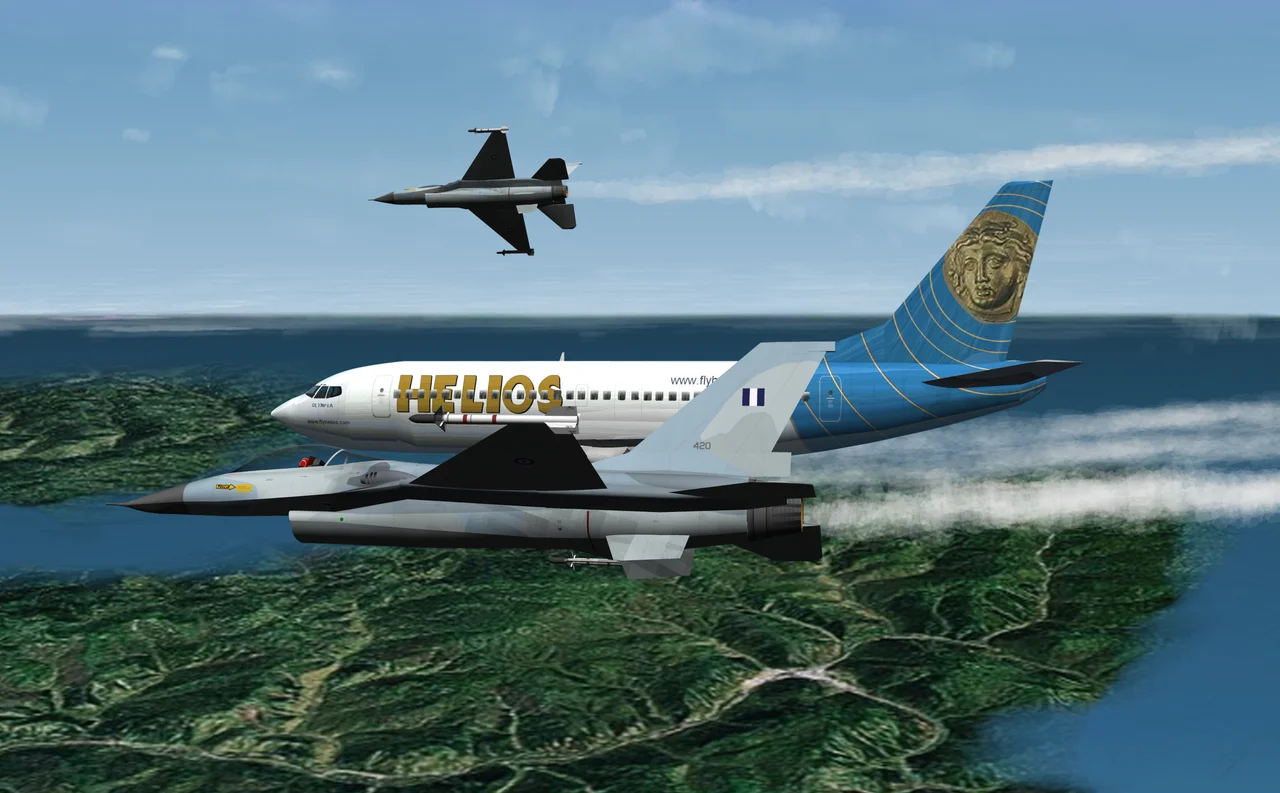

Helios Airways Flight 522
On the morning of 14 August 2005, a Boeing 737 named Olympia lifted off from Larnaca, Cyprus, carrying 121 people toward Prague by way of Athens. Among them were 22 children. Within minutes a warning horn sounded that the crew misread, and within the hour everyone aboard had slipped into unconsciousness as the cabin quietly lost its air. The aircraft climbed to its cruising altitude and flew on, holding its course on autopilot, a ghost flight crossing the Aegean with no one awake to guide it. It is the deadliest aviation accident in Greek history, and the people aboard deserve to be remembered as more than a number.
The People Aboard
Flight 522 was a holiday flight, the kind families take in August. Of the 121 lost, 103 passengers were Cypriot nationals, 12 were Greek, and 4 were Australian, alongside a crew drawn from Cyprus and Germany; the passengers included 93 adults and 22 children. The captain, a veteran who had flown for 35 years, had once piloted for the East German airline Interflug and had logged some 16,900 hours. The first officer, Pampos Charalambous, was a 51-year-old Cypriot who had flown for Helios for five years. The chief flight attendant that day, Louisa Vouteri, a 32-year-old Greek living in Cyprus, had taken the shift only because a colleague had fallen ill. These were ordinary people on an ordinary route, which is part of what makes the loss so hard to hold.
The Switch and the Silence
The cause, when investigators traced it, was devastatingly small. Before the flight, a ground engineer had set the cabin pressurization system to manual to run a test, and most likely never returned it to auto. During their checks, the crew did not catch it. As the 737 climbed, the cabin never pressurized; the warning horn that sounded at 12,040 feet was identical to a takeoff-configuration alarm, and the pilots, already growing hypoxic, reported it as an air-conditioning problem. Greece's accident board laid out the chain plainly: the manual setting went unrecognized, the true problem unidentified, the crew incapacitated by hypoxia, the fuel eventually starved, and the ground met. There was no malice in any of it, only a series of human failures that lined up, one after another, with terrible precision.
The Man Who Tried
One person stayed awake. Andreas Prodromou, a flight attendant who held a UK commercial pilot's licence, reached the cockpit using a portable oxygen supply that lasted far longer than the passengers' twelve-minute masks. When Greek F-16s intercepted the drifting jet near Athens, their pilots saw him in the cockpit, the first officer slumped beside him, the captain's seat empty. Prodromou had never trained on the 737. He sent maydays that no one heard, because the radio was still tuned to Larnaca and he could not find the Athens frequency. Evidence suggests he tried to wake the pilots and his girlfriend, all by then in deep comas. When the left engine flamed out from fuel exhaustion, then the right, the aircraft came down in the hills near Grammatiko just before 12:04. He could not save them, but he did not stop trying.
What Was Left Behind
The aftermath stretched across years and two countries. Helios Airways was shut down by the Cypriot government the following year, and lawsuits followed against the airline and Boeing. Courts in Cyprus and Greece tried, acquitted, and retried various defendants in a legal saga that the victims' families would describe, even seventeen years later, as justice never truly served. Out of the wreckage came at least one safeguard: in 2011 the FAA ordered older Boeing 737s fitted with separate, clearer warning lights to distinguish a pressurization fault from a configuration error, so that no crew would again mistake the one for the other. It is a small monument, written in regulation rather than stone, to 121 people who never reached Athens.
From the Air
Flight 522 came down in the hills near Grammatiko in East Attica, close to 38.231 degrees N, 23.971 degrees E, roughly 40 km northeast of central Athens. The crash site lies in the same upland country as the ancient fortress of Ramnous and the plain of Marathon. Nearest major airport, and the flight's intended stopover, is Athens International (LGAV), about 25 km to the south. The terrain is dry, scrubby ridgeline that bakes in the August heat.
Nearby Stories
- German Submarine U-565 2.2 km away
- Castle of Cuppa 6.7 km away
- Zoodochos Pigi Church, Dervenosalesi 7.6 km away
- Brauron 9.1 km away
- Anthedon (Boeotia) 9.2 km away
- Battle of Andros (1790) 26 km away
- Andros 32 km away
- Aegean Sea 60 km away