
Battle of Chaeronea (338 BC)
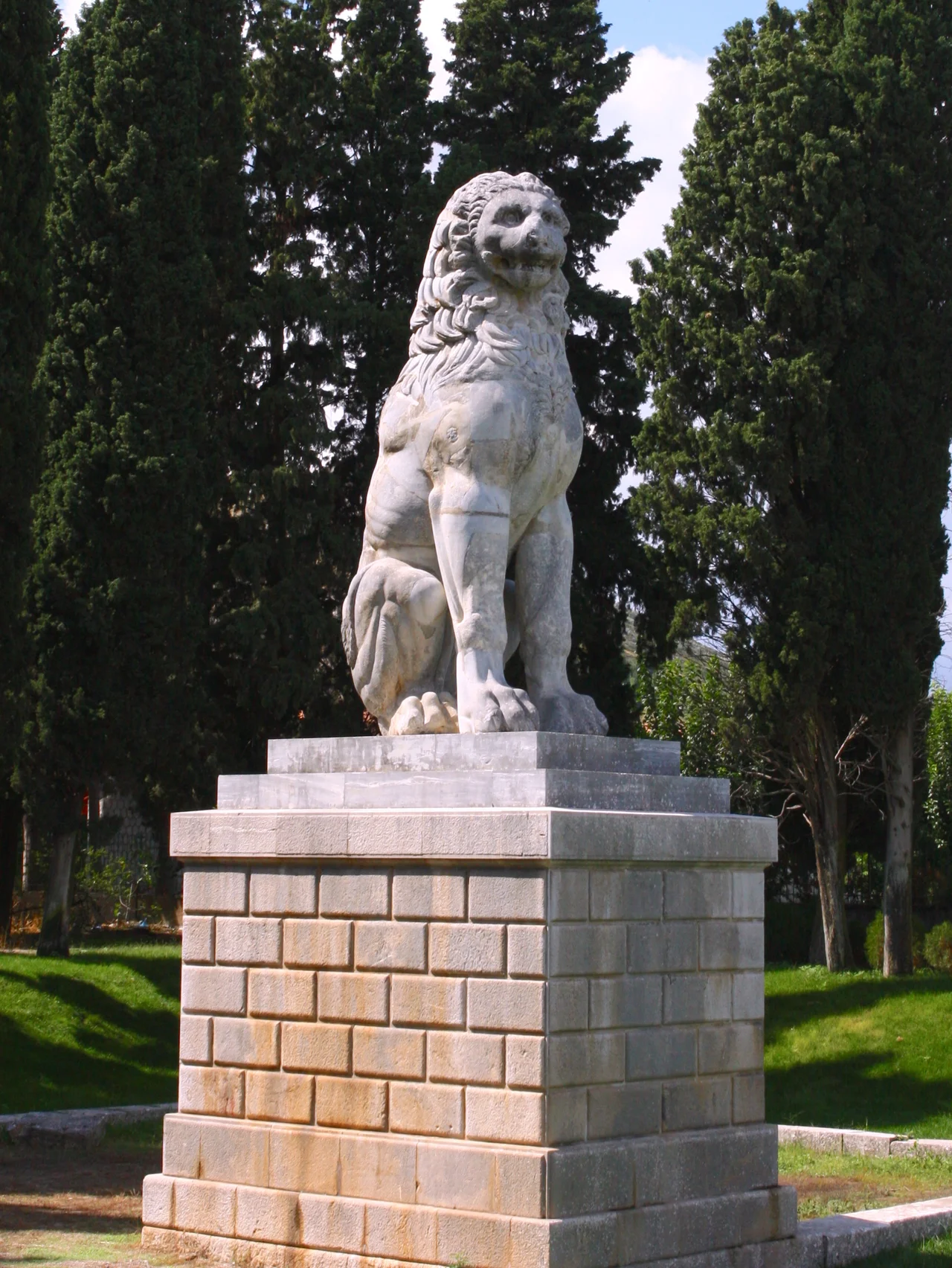
The lion still sits in a field outside the village. It is twelve feet tall, carved from local limestone, its mane stylized into thick rings, its eyes hollow. Beneath it, archaeologists in 1879 found 254 skeletons laid out in seven neat rows, every one a man between his early twenties and his mid-thirties. They were the Sacred Band of Thebes - one hundred and fifty pairs of lovers who had vowed to die together rather than abandon each other - and they had kept that vow on the morning of 2 August (or thereabouts), 338 BC, against a Macedonian charge led by an eighteen-year-old prince.
The Long Walk South
Philip II had spent twenty-one years turning a backwater hill kingdom into the dominant power of the Aegean world, and the Greek city-states had spent most of those years arguing about him. Demosthenes of Athens called him a tyrant in speech after speech, and the Athenian assembly listened. By 339 BC, Philip's patience was exhausted. He marched south at the head of a professional army of pikemen drilled in the new sarissa formation - eighteen-foot spears in tight phalanxes that no traditional hoplite line had yet found a way to break. The southern Greeks scrambled to assemble against him: Athens and Thebes, lifelong enemies, set aside three centuries of mutual loathing on Demosthenes' urgent counsel. Philip described the alliance with sour amusement: he had united Greece by being someone everyone hated more than each other.
The Allied Line at Dawn
The two armies met on a narrow plain near Chaeronea, in Boeotia, with a stream on one flank and a low hill on the other. The Allied force was roughly thirty-five thousand men. The right wing belonged to the Thebans, anchored by the Sacred Band on the very end of the line. The left wing was Athenian, with Demosthenes himself standing in the ranks as a hoplite - he would not be a coward in a war he had argued for. Philip took the Macedonian right, opposite the Athenians. He gave his eighteen-year-old son Alexander command of the left, opposite the Thebans, with experienced officers at his shoulder. It was the boy's first major battle. He had not yet earned the name the world would later give him.
The Pivot
The details of what happened next are sparse - ancient sources for Chaeronea are unusually thin - but the modern reconstruction goes something like this. Philip's right wing fought aggressively, then deliberately gave ground, withdrawing in a measured retreat that drew the Athenian wing forward in eager pursuit. As the Athenians advanced, the entire allied line rotated to follow them, and a gap opened in the center between the Athenians and the Thebans. Alexander saw it and charged. His unit - probably a heavy infantry force, possibly companion cavalry, scholars still argue - punched into the gap and rolled up the Theban flank. The Sacred Band held. Three hundred men formed a circle and fought until every one of them was dead or unconscious. More than a thousand Athenians died, two thousand were taken prisoner. The Thebans died in similar numbers. Demosthenes, who had survived everything his rhetoric demanded, fled the field.
The Lion's Inscription
Plutarch wrote that when Philip walked over the field after the battle and saw the bodies of the Sacred Band still in their formation, still holding their shields and weapons, he wept and said: 'Perish miserably anyone who suspects these men of doing or suffering anything shameful.' Philip founded the League of Corinth that winter, bound every southern Greek state to Macedon, and was elected commander of a planned pan-Hellenic invasion of Persia. He was assassinated two years later before he could lead it. His son Alexander did. The Lion of Chaeronea was raised over the Sacred Band's grave by their countrymen, knocked over by Roman soldiers, smashed during the Greek War of Independence, and reassembled in 1902. It still stands today on the road between Athens and Lamia, in the small modern village of Chaironeia, watching the highway traffic. The fields around it are quiet. The plain looks exactly as it did.
From the Air
Chaeronea (modern Chaironeia) lies in Boeotia, central Greece, at approximately 38.495N, 22.85E. The battlefield occupies the plain between the village and Mount Thurion. Recommended viewing altitude 3,500-5,000 ft AGL. Nearest airports are Athens International (LGAV) 60 nm southeast and Tanagra (LGTG) 35 nm east. From altitude the plain is unmistakable: a flat agricultural valley flanked by limestone ridges, the Cephissus river running along its edge. The Lion of Chaeronea monument is visible as a small enclosure beside the highway through the village.
Nearby Stories
- Battle of Vasilika 7.9 km away
- Siege of Negroponte (1470) 8.5 km away
- Battle of Kalavryta 13 km away
- Church of the Nativity of the Theotokos, Limni 14 km away
- Pellene 16 km away
- Panagia Varnakova Monastery 18 km away
- Megara 21 km away
- Karpenisi 41 km away