
Ptoion
A foreign envoy once climbed this mountain to ask the future, and the god answered him in a language no Greek in the room could understand. The Thebans who stood as witnesses were stunned, until the visitor revealed the words were Carian, his own mother tongue. The story, told by Herodotus, captures what made the sanctuary of Apollo Ptoios extraordinary: even the god seemed to know who was listening.
The Mountain and Its Lake
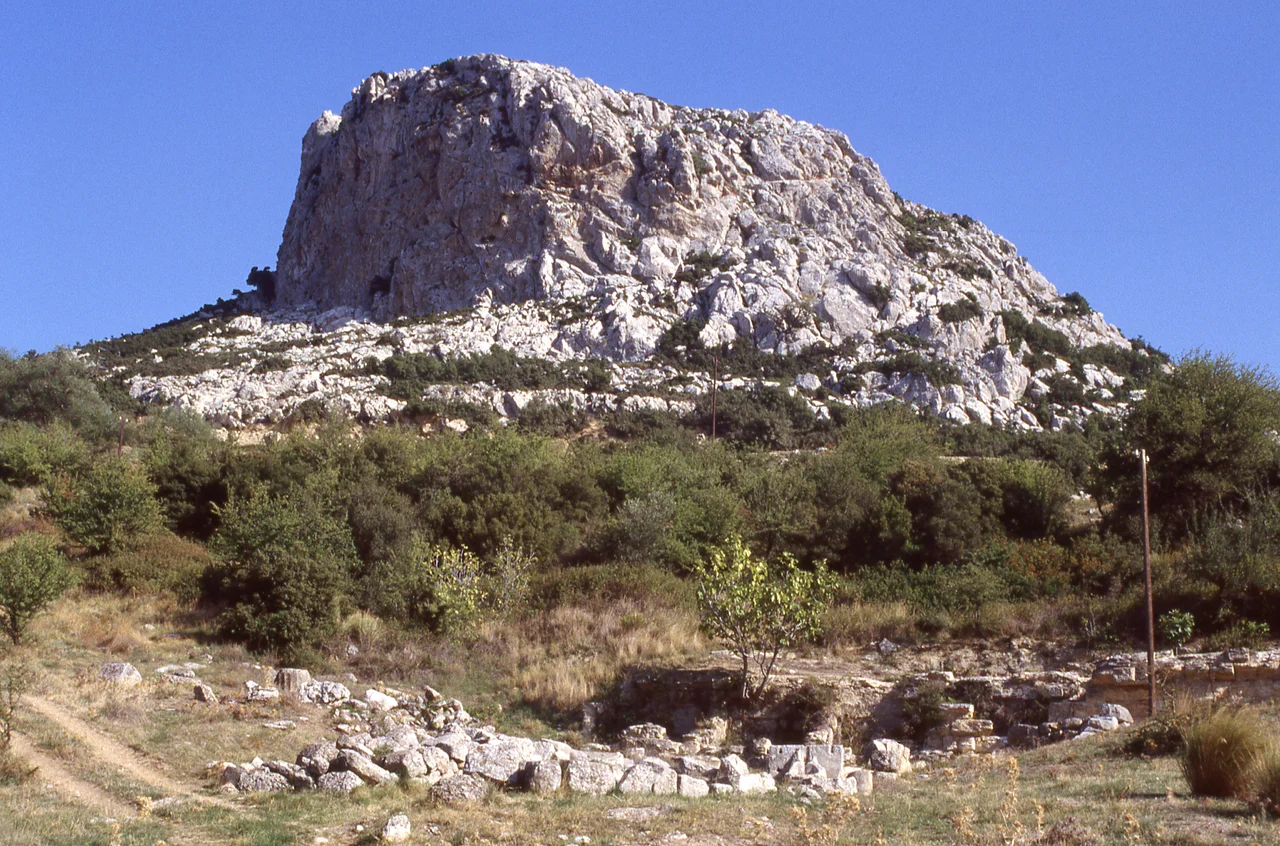
The Ptoion is a chain of mountains in northeastern Boeotia, running from Akraiphia in the west, beside what was once Lake Copais, eastward to the Gulf of Euboea. It rises to 725 meters at Agia Pelagia in the west and 781 meters at Petalas in the east, never towering but everywhere commanding. In antiquity the great Copaic lake spread below it, a body of water later drained away, so the sanctuary looked out over a vanished sea of reeds and water birds. People had lived on these slopes a very long time; archaeologists have found the remains of a Neolithic and Helladic settlement and a Mycenaean fortress here, though both had been abandoned long before the oracle rose to fame.
From Hero to God
The sanctuary that mattered stood three kilometers northeast of Akraiphia, and it did not begin with Apollo at all. The geographer Pausanias records that the oracle first belonged to Ptoios, a local hero said to be the son of Athamas and Themisto, who gave both the mountain and the cult their name. Over time Apollo displaced him, taking Ptoios as a local epithet, while the older hero kept a smaller shrine of his own nearby on a hill called the Kastraki, a place that shows signs of worship from the seventh century BC into the fourth. The transformation from local spirit to Olympian god is the deep history of Greek religion in miniature, played out on one Boeotian hillside.
An Oracle of the First Rank
Before the Persian Wars, the Ptoion ranked among the most important oracles in Greece, consulted by cities and individuals seeking the will of the god. The most famous visit was the strangest. The Persian general Mardonius sent an agent named Mys to tour the oracles of Greece, and at the Ptoion the seer fell into prophecy not in Greek but in Carian, the native language of Mys himself, who calmly wrote the words down while the Theban witnesses looked on in confusion. The festival celebrated here, the Ptoia, lapsed for a time but was revived under the early Roman emperors as the Ptoia and Caesarea, surviving until the early third century AD before the old gods finally fell silent.
An Army of Stone Youths
What the pilgrims left behind makes the Ptoion unforgettable. Over the centuries, worshippers dedicated dozens upon dozens of kouroi, the archaic statues of standing nude young men, to Apollo here. In total the sanctuary has yielded at least ninety such figures, mostly in fragments, and the original number may have approached one hundred and twenty, an extraordinary concentration carved from local poros stone and from fine marble quarried on Paros and Naxos. These rigid, faintly smiling youths, arranged across three terraces among oracular tripods, now stand in the museums of Thebes and Athens. When the oracle went quiet, a Christian monastery rose in its place, called Agia Pelagia, which in Ottoman times climbed to the very summit of the mountain, the last in a long line of holy places to claim this high and watchful ground.
From the Air
Located at 38.48°N, 23.34°E, a mountain chain in northeastern Boeotia rising to 781 m at Petalas in the east and 725 m at Agia Pelagia in the west. The sanctuary site lies near Akraiphia at the western end, above the broad flat basin of the former Lake Copais. Look for the drained Copaic plain to the west and the Gulf of Euboea to the east. Nearest major airport is Athens International (LGAV), roughly 65 km southeast; Nea Anchialos (LGBL) lies to the north. Maintain safe terrain clearance and watch for mountain weather; best viewed from 4,000 to 6,000 feet.
Nearby Stories
- Saint Nicholas Galatakis Monastery 5 km away
- Mount Helicon 6.6 km away
- Battle of Marathon 7 km away
- Battle of Vasilika 9.4 km away
- Panagia Gorgoepikoos Monastery, Mandra 12 km away
- Euboea 13 km away
- Sicyon 22 km away
- Skyros 58 km away