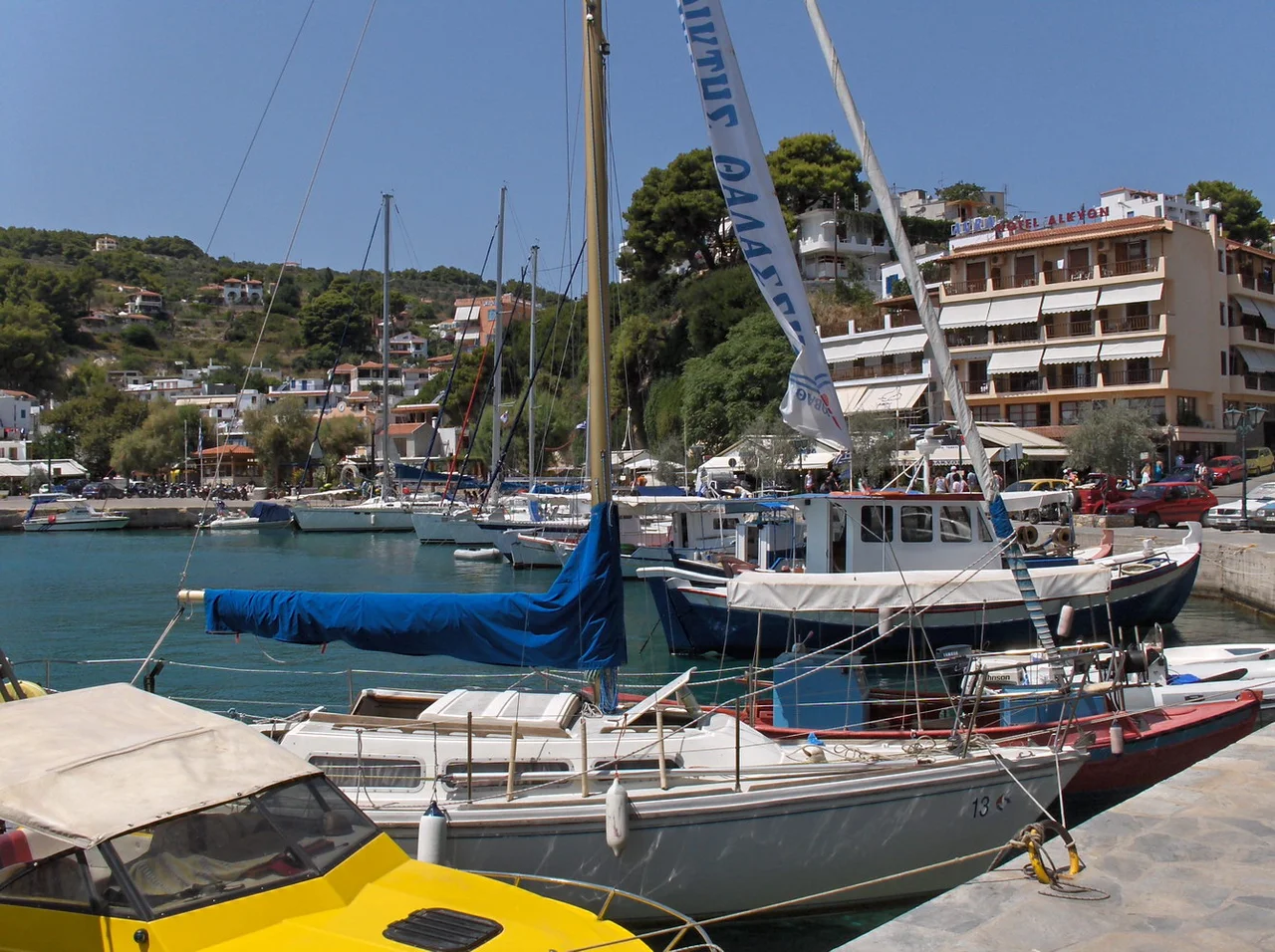

Alonissos
Most Greek islands sell themselves before you arrive. Alonissos barely bothers. It is the least-touristed island in the Sporades, a 64-square-kilometer ridge of limestone three kilometers east of Skopelos, and the first thing you learn is that the bus only runs in summer because the rest of the year it is busy doing the school run. There is no airport. To get here you take a ferry or hydrofoil from Volos or Agios Konstantinos on the mainland, or hop across from Skiathos and Skopelos, and you step off at Patitiri, the working port tucked into the island's southeast corner.
The Climb to Chora
From Patitiri, a well-marked footpath climbs the hill to Chora, the old village locals simply call the village. It takes about an hour on foot, steep in places, scenic the whole way. You can also pay five euros for a five-minute taxi, but walking is the point. Chora sits high on its hill, about two kilometers inland, whitewashed houses stacked along streets too narrow for cars. The light here does something to people. From the early glow bouncing off the old walls to the pink wash of late afternoon, the village rewards anyone who slows down, looks up, and lets the donkeys and mules pass on the cliffside paths.
Patitiri and the Working Harbor
Patitiri is not pretty in the postcard sense, and that honesty is its charm. Cruise ships dock here, the taxi rank sits opposite the Alkyon Hotel, and mopeds rented for ten to fifteen euros a day weave through streets cars cannot manage. Behind the town beach, past the bars and tavernas, steps climb to the Alonissos museum, billed as the largest privately owned museum in the Greek islands, with exhibits spread across three floors and a coffee shop at the top. Up in the Upper Old Town, the Traditional House Museum preserves how islanders actually lived. The interior roads, by contrast, dissolve quickly into dirt paths better suited to a moped than a car.
The Cleanest Water in the Aegean
The waters around Alonissos are considered the cleanest in the Aegean, and that is not a tourist-board boast. The sea here forms part of the National Marine Park of Alonnisos, a conservation zone created to protect the Mediterranean monk seal, one of the rarest marine mammals on Earth. There are sea caves where seals shelter, though they are far too shy to be seen, so do not expect a sighting. Boat tours from the port run to the smaller islands and to a sunken ancient shipwreck off Peristera, where you can swim above the cargo. Megali Ammos, an unspoiled beach on the northwest coast, is one of the loveliest stretches of an island where most beaches are pebble rather than sand.
At the Tavernas
Eating well on Alonissos is easy and cheap. Most restaurants serve only the day's catch, the style hearty rather than fussy, the portions generous. At Steni Vala, Kyria Tasia's lobster spaghetti has a reputation that outlives the season, and her sister's Soultana dessert waits in the coffee house next door. Away from the resort areas you can eat and drink well for around seven euros a head, washed down with local wine that is genuinely good and genuinely inexpensive. A meze at an ouzeri the locals use, fried calamari with chilled retsina at lunch, grilled fish dusted with island herbs over a charcoal fire if a local invites you to their home. Take that invitation. One word of caution: much of the island runs on collected rainwater, so assume the tap water is not for drinking unless someone tells you otherwise.
From the Air
Alonissos lies at 39.21°N, 23.91°E in the Northern Sporades, three kilometers east of Skopelos. The island reads from altitude as a long, narrow, pine-dark limestone ridge running southwest to northeast, roughly 20 km long but only 4.5 km at its widest. There is no airfield on the island; the nearest airport is Skiathos (LGSK), about 1.5 hours away by hydrofoil. Look for Patitiri's small harbor on the southeast coast and the hilltop white cluster of Chora above it. Summer brings the meltemi winds and long, clear, hot days; sea haze can soften the horizon on calm mornings.
Nearby Stories
- Skiathos Castle 12 km away
- Agia Anna (Evvia) 19 km away
- Skyros 42 km away
- Battle of Athos 64 km away
- Battle of Potidaea 75 km away
- Aegean Sea 84 km away
- Battle of Spartolos 106 km away
- Sigri (village) 107 km away