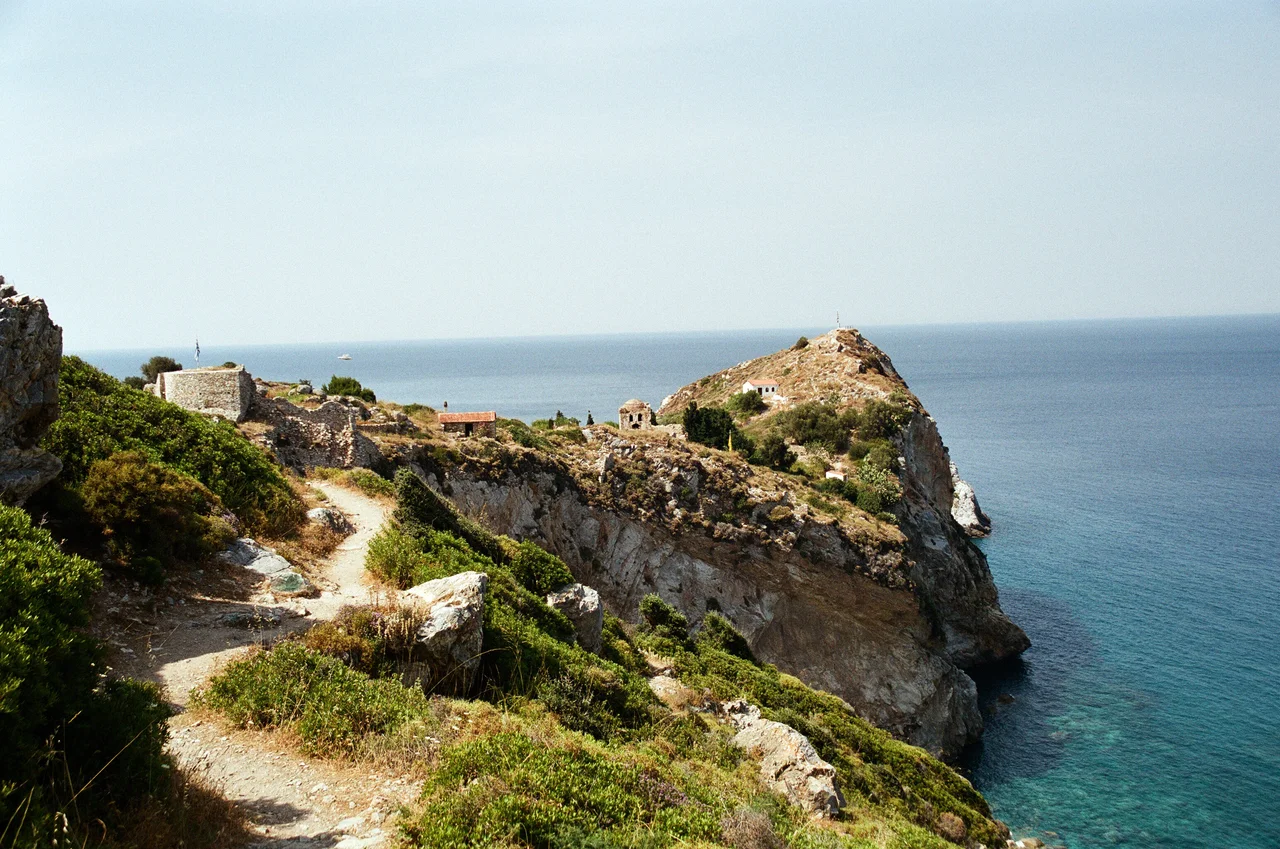

Skiathos Castle
Around 1360, the people of Skiathos made a hard calculation: the sea that fed them was killing them. Pirates raided the coastal town so relentlessly that the islanders abandoned it entirely and climbed to the most defensible place they could find - a rocky promontory at the island's northern tip, ringed on three sides by sheer cliffs dropping straight into the Aegean. They called it Kastro, the castle, and there they built an entire town and lived behind its single guarded gate for nearly five centuries.
A Town on a Knife-Edge
Kastro was a fortress because geography made it one. Cliffs guarded three sides, so the builders needed real walls only to the south, where the sole entrance was a narrow gate crossed by a wooden drawbridge and defended by a zematistra - a cauldron of boiling oil poised to pour down on anyone who tried to force it. Inside, between 500 and 1,500 people lived in houses packed tight against one another. There were 20 churches across four parishes, a chancellery, and cisterns dug to catch the rain, because a town under siege needs water more than almost anything. This was not a garrison; it was the whole of Skiathos, an entire society folded onto a rock.
Conquerors at the Gate
Safety was always relative. Kastro stayed in Byzantine hands until the Fall of Constantinople in 1453, after which the Republic of Venice took over - and Venetian rule proved harsh enough that the inhabitants rebelled against their governor Vicenzo Baffo in 1518. It also failed to keep out the Ottomans. When the admiral Hayreddin Barbarossa besieged the castle in 1538, the townspeople killed their Venetian governor and opened the gate, hoping for mercy. They received none: the Ottomans killed many and carried others off into slavery. The fortress changed hands again and again - the Venetian commander Francesco Morosini seized it in 1660, executing some and forcing others to row in his galleys. Each conquest fell hardest on the ordinary families inside the walls.
The Last Raid and the Long Silence
The final upheaval came with Greece's own war of liberation. During the Greek War of Independence, a faction of Greek rebels from Mount Olympus repeatedly raided the island, and on 14 July 1826 fighters under Tsamis Karatasos captured Kastro and looted it. Then, in 1829, as Skiathos became part of the new independent Greek state, the long siege of history finally lifted. The reason for the fortress vanished. With the pirates gone and the threat ended, the islanders did something their ancestors could never have imagined: they walked back down to the coast, re-occupying the ancient site where the town stands today, and left Kastro to the wind and the gulls.
What the Cliffs Kept
Kastro is abandoned now, a protected site of roofless walls and tumbled stone scattered across its promontory. But it never fully emptied of meaning. After the town moved away, two churches kept their congregations: St. Nicholas and the church of the Nativity, which had served as the local bishop's cathedral. In recent years, restorers have brought back more of the old town - the churches of St. Marina and St. Basil, two cisterns, the Ottoman-era mosque built for the small Turkish garrison, the gate complex with its drawbridge, and stretches of the walls themselves. To reach it still takes effort, on foot or by boat, which feels right. For five hundred years, getting to Kastro was supposed to be hard.
From the Air
Skiathos Castle (Kastro) occupies the island's northernmost promontory at 39.209 degrees N, 23.461 degrees E, a cliff-ringed headland jutting into the Aegean. The nearest airport is Skiathos 'Alexandros Papadiamantis' National (ICAO LGSK), about 7 km south-southeast near the island's eastern tip. From 1,500-2,500 ft, the site reads as a steep rocky point with scattered pale ruins and restored church roofs, isolated from the wooded interior. The exposed north coast is markedly more rugged than the developed south. Skopelos lies to the east. Summer meltemi winds hit this north-facing cliff hard - expect turbulence and gusts.
Nearby Stories
- Nea Anchialos 2.9 km away
- Larissa Cremaste 6.7 km away
- Alonnisos 8.5 km away
- Agia Anna (Evvia) 17 km away
- Tempi Train Crash 44 km away
- Kymi, Greece 47 km away
- Battle of Potidaea 72 km away
- Battle of Athos 105 km away