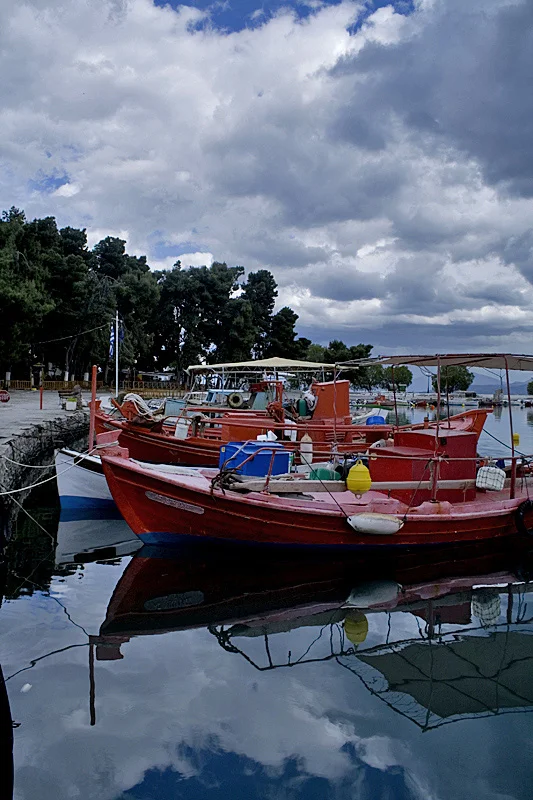

Nea Anchialos
The name means "New Anchialos," and the word "new" carries a quiet grief. In 1906, Greeks fled the Black Sea town of Anchialos, on what is now the Bulgarian coast, after anti-Greek riots tore through their community amid the Greek-Bulgarian struggle in Macedonia. They crossed the sea, found a shore on the Pagasetic Gulf, and started over. Rather than take a new name, they gave their new town the name of the home they had been driven from. Today Nea Anchialos is a relaxed seaside resort 18 km southeast of Volos, but its founding story is written into the very first word of its name.
Carrying a Home Across the Sea
The refugees who settled here in 1906 did not arrive at empty ground. They built above one of the oldest harbors in Thessaly, and they brought with them the knowledge that had sustained them on the Black Sea coast: vines, olives, and the patient craft of wine. That heritage still defines the town. The Agricultural Cooperative "Demeter" was founded in 1918 and has run continuously ever since, and Anchialos is known across Greece for its wines and its tsipouro, the local spirit. There is something fitting in it. A community uprooted from one coast put down roots on another, and made the new shore yield the same comforts as the old.
The Red Sand Shore
The coast here runs for some twenty kilometers, and its strangest gift is its color. Stretches of the beach are made of a distinctive reddish sand, prized locally for sand-baths said to ease the joints of those who suffer from rheumatism. Elsewhere the sand turns golden, broken by pebbles and low cliffs and the small bays and ports that notch the shoreline. Behind the town two low hills, Kokkinovrahos and Mavrorahi, rise to the west-northwest and frame the view out over the clear water of the gulf. The town itself is compact and walkable, laced with pedestrian streets, the kind of place where the sea is never more than a short stroll away.
Layers Under the Streets
Dig anywhere near Nea Anchialos and you strike antiquity. The town sits over the ancient city of Pyrasos, which Homer named in the Iliad's catalogue of ships and which Strabo called "well-harboured." Before the Macedonians founded Demetrias, Pyrasos was the main port on the Pagasetic Gulf. Inland lay its sister city, Phthiotic Thebes, and in Late Antiquity this became one of the great Early Christian centers of Roman Thessaly. The archaeological site spread across the modern town preserves the remains of nine basilicas, churches of the 5th and 6th centuries, several still showing the splendid floor mosaics that made them famous. The ruins of an ancient theatre and a Hellenistic stoa survive as well.
Tsipouro and the Long Evening
Nea Anchialos has perfected a particular ritual: the tsipouradiko. Along the waterfront near the port, these ouzeri serve small glasses of tsipouro alongside an endless parade of fish and seafood mezedes, little plates that keep arriving as long as you keep ordering. Greek evenings run late, dinner often starting well after nine, and here the rhythm suits the setting. You sit by the water as the light goes long over the gulf, the plates accumulate, and there is genuinely no need to hurry. The town is small enough that, as locals like to say, it runs like one big family; ask anyone for directions and you will be pointed the right way.
A Base for the Region
The town makes an easy gateway to some of Thessaly's finest sights. Just inland are the Neolithic settlements of Sesklo and Dimini, among the oldest villages in Europe, their finds displayed in the handsome Archaeological Museum of Volos. North rises Mount Pelion, the forested mountain of the centaurs in myth, dense with springs and stone villages. Farther west stand the monasteries of Meteora, perched impossibly atop their rock pillars. Offshore lies Skiathos. And the modern town keeps its own quiet landmark: the regional Nea Anchialos National Airport, only minutes from the center, a working reminder that this refugee town on an ancient harbor remains, as it always was, a place people arrive by sea and sky alike.
From the Air
Nea Anchialos lies at 39.28°N, 22.82°E, on the western shore of the Pagasetic Gulf about 18 km southeast of Volos. Nea Anchialos National Airport (LGBL) sits right beside the town, only minutes from the center, making this the natural arrival point for the whole region. From the air, look for the curving red-and-gold shoreline of the gulf, the two low hills behind the town, and the broad Thessalian plain opening inland to the west. Best viewed at low altitude in clear weather; summer brings haze and busy beaches, spring and autumn the clearest light.
Nearby Stories
- Greece 13 km away
- Larissa Cremaste 16 km away
- Monastery of Saint David the Elder 21 km away
- Karditsa 21 km away
- Skiathos Castle 24 km away
- Tempi Train Crash 36 km away
- Meteora: The Monasteries Built on Impossible Pillars 48 km away
- Battle of Potidaea 73 km away