
Opuntian Locris
Homer counted them by their ships. When he listed the Greek forces sailing for Troy, the eastern Locrians came in forty vessels, following a captain named Ajax — not the towering hero of the same name, but Ajax the son of Oïleus, swift, deadly with a spear, and destined to be remembered for a crime as much as for his courage. The land these men came from was Opuntian Locris: a slender ribbon of coast on the eastern flank of central Greece, running from the pass of Thermopylae down to the mouth of the Cephissus, squeezed between steep mountains and the sea.
A Sliver of Coast
Opuntian Locris was defined by its narrowness. Mountains ran close behind the shoreline the entire length of the region, leaving no room for any river of consequence — the largest, the Boagrius, was barely more than a seasonal torrent tumbling out of Mount Cnemis. Yet the land between rock and water was fertile, its valleys praised by ancient and modern travelers alike. Strangely, the Locrians did not even hold this coast in one piece: a thin wedge of neighboring Phocis, with its seaport of Daphnus, split their territory in two. Those living north of the gap were called Epicnemidii, after Mount Cnemis; those to the south were the Opuntii, named for Opus, their chief city.
The City of Opus
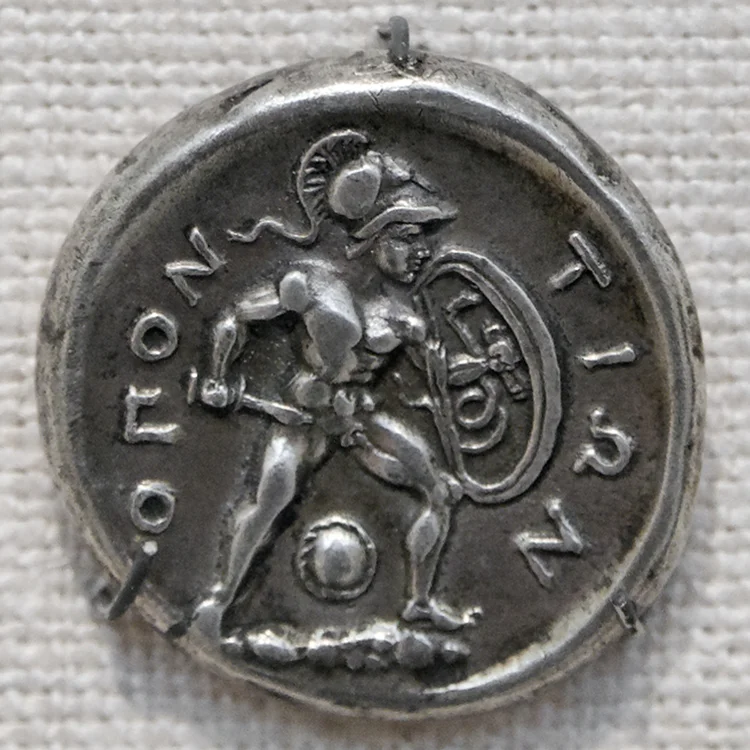
Opus gave the region its name and its identity. It stood at the head of the Opuntian Gulf, a wide, shallow bay with the small island of Atalanta lying just off the coast. Through the great ages of Greek history, the writers drew no firm line between the two branches of eastern Locrians — Homer, Herodotus, Thucydides, and Polybius all treated them as one people — and Opus was simply regarded as the metropolis of them all. The city even minted its own coinage, and some of those ancient Locrian coins survive today. One famous silver stater bears the image of the region's most legendary son, spear and shield raised: Ajax the Lesser.
Ajax the Lesser
Ajax, son of Oïleus, was the Locrians' Homeric hero — small in stature compared to the mighty Ajax of Salamis, but fast on his feet and feared as a fighter. His glory did not last. In the later tradition, it was this Ajax who committed the most notorious sacrilege of Troy's fall: dragging the Trojan princess Cassandra from the altar of Athena where she had sought sanctuary. The goddess never forgave it. The story made him a byword for impiety punished — proof to the Greeks that even a brave man's pride could call down ruin. That a single coastal strip produced both forty warships and a cautionary myth tells you how deeply this place was woven into the Greek imagination.
Beside Leonidas
The Opuntian Locrians' most concrete moment in history came at their own back door. When Xerxes' Persians invaded in 480 BC, Thermopylae — the pass that marked the northern edge of Locrian land — became the place where Greece chose to make its stand. The Locrians of Opus joined Leonidas there, fighting in the doomed defense of the Hot Gates, and they sent seven ships to the Greek fleet besides. Later, in the long civil war between Athens and Sparta, they took Sparta's side. For a small people pinned between mountain and sea, the great currents of Greek history were never far away — they ran right through the pass at the end of the road.
Reading the Land Today
The names have mostly faded into the modern map. Mount Cnemis is now called Talanda; the towns Homer recited — Kynos, Calliarus, Scarphe, Thronium — are sites for archaeologists rather than living places. The coast itself has shifted, as central Greece's restless geology keeps rearranging it; the ancient writers themselves noted a series of damaging earthquakes here around 426 BC. But the shape of the place persists. Stand on this shore and you still see the mountains crowding the water, the narrow fertile margin between, the gulf with its little island. It is the same compressed, strategic coast that launched Ajax's ships and answered Leonidas's call — a small country that history kept treating as a doorway.
From the Air
Opuntian Locris occupied the eastern coast of central Greece, centered roughly at 38.75°N, 22.75°E, stretching from Thermopylae in the northwest down toward the Boeotian border. From the air, look for the narrow coastal plain hemmed between the Kallidromon–Cnemis (Talanda) mountains and the North Euboean Gulf, with the shallow Opuntian Gulf and the small island of Atalanta marking the area of ancient Opus. A viewing altitude of 6,000–9,000 feet captures the full strip of coast and the wall of mountains behind it. Nearest airport is Nea Anchialos (LGBL) to the north; Athens (LGAV) lies roughly 95 nm to the south. The gulf and island show clearly in typical bright Aegean visibility.
Nearby Stories
- Siege of Negroponte (1470) 6.4 km away
- Distomo Massacre 7 km away
- Church of the Nativity of the Theotokos, Limni 9.9 km away
- Battle of Artemisium 10 km away
- Panagia Varnakova Monastery 16 km away
- Almyros 19 km away
- Karpenisi 35 km away
- Karditsa 43 km away