.jpg)
Barony of Akova
The Burgundian lords who built the fortress of Akova in the early thirteenth century did not leave the name to chance. They called it Mattegrifon — in Old French, roughly 'kill-Greek,' grifon being the term their language used for the Greeks. The name was a provocation carved into stone, planted in the mountains between Elis and Arcadia, overlooking the upper valley of the Alpheios river. For a century it stood as the capital of one of the most powerful baronies in the Frankish Peloponnese. Then inheritance law, feudal politics, a hostage in Constantinople, and a Majorcan prince who died in battle conspired to undo it.
The Twelve Baronies of the Morea
After the Fourth Crusade of 1204 diverted its energies from the Holy Land to Constantinople and then, in the years that followed, to the systematic conquest of Greece, the Frankish lords who carved up the Peloponnese organized their new territory into the Principality of Achaea. Within the Principality, twelve secular baronies formed the structural framework of Frankish power. Each barony was defined by the number of knight's fees attached to it — the land grants that funded armored cavalry.
Akova, along with the Barony of Patras, held the maximum: twenty-four knight's fees. This placed it among the two largest and most significant baronies in the Principality. The barony was established by the de Rosières family, of Burgundian origin, who built the fortress of Akova — the Mattegrifon — on the high ground of a region the Chronicle of the Morea called Mesarea, the territory between Elis and Arcadia. From that ridge, the barons controlled the Alpheios headwaters and the mountain passes connecting the western Peloponnese to the Arcadian interior.
Walter and the Empty Inheritance
The only clearly documented baron of the early period is Walter of Rosières, first recorded in 1228–30 in a list of feudal holders. According to the Chronicle of the Morea, Walter died childless. The historian Karl Hopf later proposed that two barons named Walter existed — father and son — to account for the gap between the Frankish conquest of 1209 and Walter's first recorded appearance nearly two decades later, but the evidence is circumstantial.
Walter's sole heir was his niece, Margaret of Passavant, daughter of his sister and John of Nully, Baron of Passavant. Her claim was legally secure in principle, but in practice she could not act on it: since 1262, Margaret had been held in Constantinople as a hostage to the Byzantine imperial court, a standard diplomatic arrangement for ensuring the good behavior of Peloponnesian lords. By the time she returned to the Principality, Achaean feudal law had already foreclosed her inheritance. The rule was strict — any heir had to press a claim within two years and two days of the last holder's death, or forfeit. Margaret had missed the window.
Prince William II of Villehardouin had confiscated the barony in her absence. The legal dispute that followed became one of the celebrated cases of Achaean feudal jurisprudence. In a parliament held at Glarentsa — probably in 1276 — the court found for the Prince. As a compromise, William ceded a third of the barony, eight knight's fees, to Margaret and her new husband, the influential John of Saint Omer. The fortress of Akova itself, along with the remainder, passed to William's youngest daughter, also named Margaret.
Margaret of Villehardouin and the Majorcan Gamble
Margaret of Villehardouin built on her inheritance steadily. In 1297 her sister, Princess Isabella, donated additional fiefs and castles to augment her holdings. As a direct descendant of the founding family of the Principality, Margaret believed she had a claim not just to Akova but to the Principality itself — or at least a portion of it — against the Angevin Kings of Naples, who had controlled Achaea since 1278.
To press that claim, in February 1314 she arranged the marriage of her only daughter, Isabel of Sabran, to Ferdinand of Majorca, passing her titles and dynastic ambitions to them. She then returned to Achaea to prepare the ground — and was promptly imprisoned by Nicholas le Maure, the Angevin Bailli of the Principality. Margaret of Villehardouin died in captivity in February or March of 1315.
Ferdinand of Majorca invaded Achaea to vindicate her claims and his wife's inheritance. He fought Louis of Burgundy for the Principality, but fell at the Battle of Manolada in July 1316. The Majorcan gamble had cost two lives and resolved nothing. The Barony of Akova was confiscated and absorbed into the princely domain.
The Byzantine Endgame
The barony that had survived dynastic collapse, legal dispute, and two deaths in the ruling family did not survive the broader collapse of Frankish power in the Peloponnese. Five years after Ferdinand's death, in 1320, the Byzantines under Andronikos Asen took Akova along with the castles of Karytaina, Polyphengos, and Saint George in Skorta. The fortress the Burgundians had named Mattegrifon — kill-Greek — passed to Greek hands.
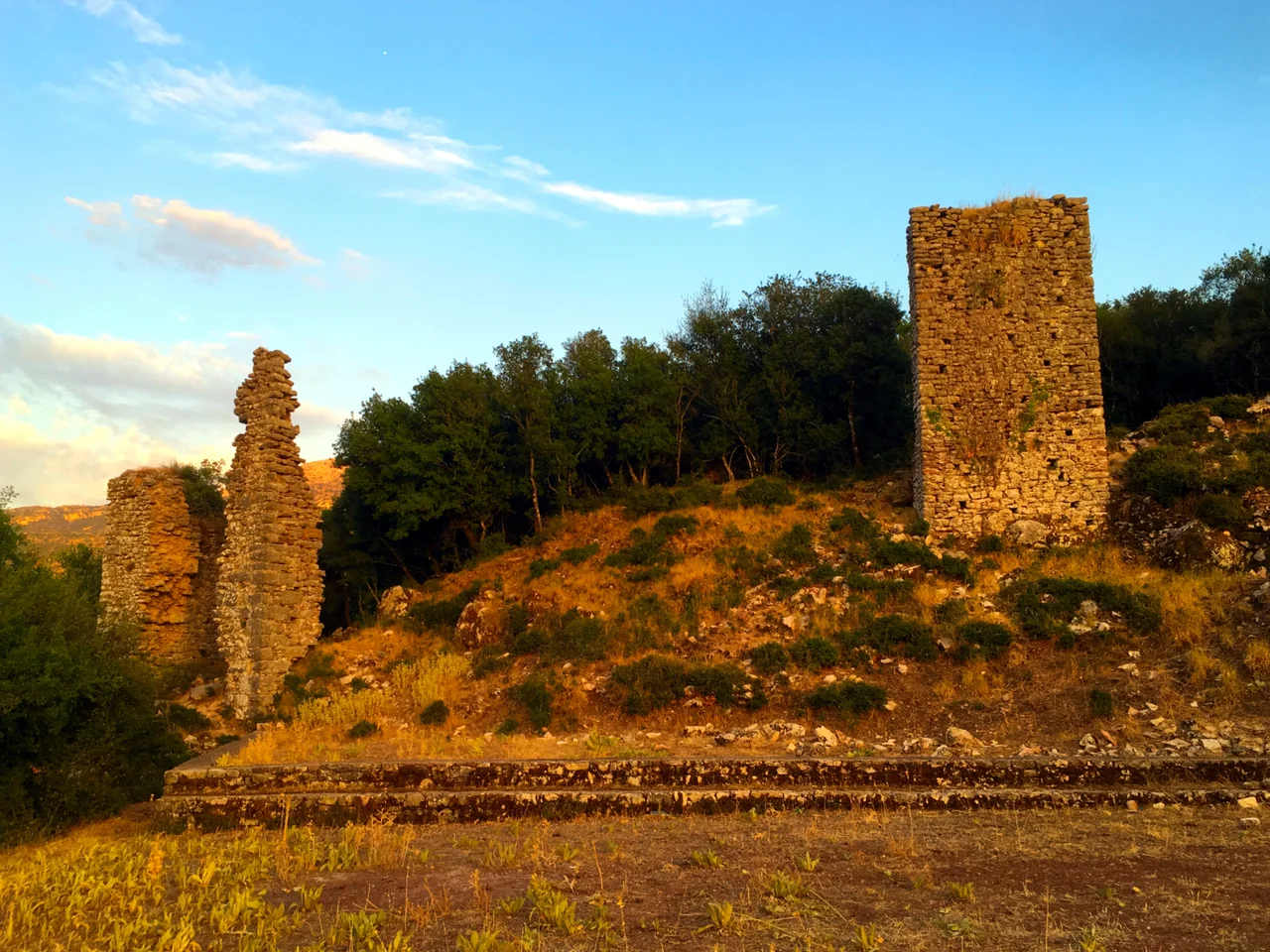
Today the ruins of Akova Castle stand near Vyziki in the Tropaia municipal unit, in the mountains of Gortynia in the eastern Peloponnese. The stones are largely what the Chronicle of the Morea describes: a highland fortress built for control, not comfort, overlooking terrain that three different civilizations considered worth fighting over. The name Mattegrifon is gone from local usage, replaced by Akova, the older Greek toponym that the fortress was built to dominate. The Greeks, in the end, kept their name.
From the Air
The site of Akova Castle lies at approximately 37.717°N, 21.950°E in the mountains of the Gortynia district in the eastern Peloponnese, near the village of Vyziki in the Tropaia municipal unit. At altitude, this is visibly high and rugged terrain — the ridge country between the upper Alpheios valley and the Arcadian plateau. The castle ruins sit on commanding high ground. Nearest major airport is LGKL (Kalamata International Airport), approximately 100 km to the southeast. Flying north from Kalamata, the Taygetos range gives way to the dissected mountain terrain of Gortynia; the Alpheios valley is the major drainage feature orienting navigation in this area. Best viewing altitude is 6,000–8,000 feet to appreciate the strategic position the Frankish barons chose.
Nearby Stories
- Battle of Saint George 4.1 km away
- Pellene 9.2 km away
- Panagia Skafidia Monastery 11 km away
- Agia Lavra 11 km away
- Battle of Manolada 12 km away
- Malevi Monastery 15 km away
- Heroon at Nemea 19 km away
- Strofades 44 km away