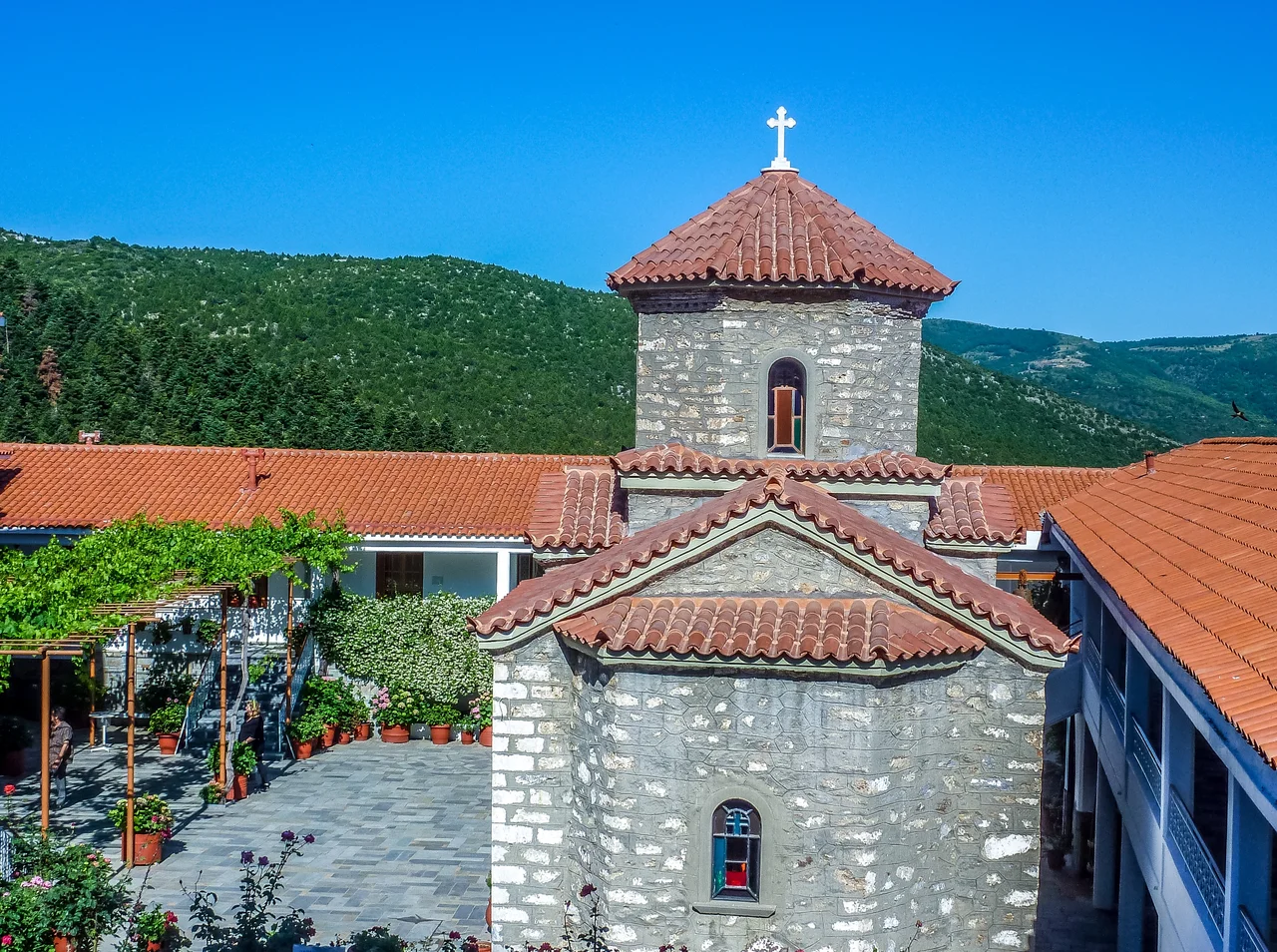

Malevi Monastery
A shepherd found the icon in the bushes. That is the story — set in the 10th century, according to tradition — of how the Malevi Monastery was reborn after a period when all its monks had starved to death in a winter so hard that rescue never came. The icon he discovered was of the Virgin Mary, fragrant in a way that could not be explained, and that discovery rekindled the religious community's commitment to the place. Whether the legend is literal or symbolic matters less than what followed: thirteen centuries of continuous, interrupted, resumed, burned, bombed, and rebuilt monastic life on the slopes of Mount Parnon in Arcadia.
Founded, Lost, and Refounded
The founding tradition of Malevi Monastery dates to 717 AD, placing it among the older monastic communities of the Peloponnese. The first monastery stood not where the current buildings are, but in a protected position in an area called 'the Canals' — a concealed location chosen specifically to avoid raids. The community eventually disappeared: the monks perished in a winter famine. The 10th-century shepherd's discovery of the icon in the undergrowth is the hinge moment between the first and second chapters of the monastery's life. The documentary record picks up more clearly in 1320, when a golden decree of the Byzantine emperor Andronikos II Palaiologos formally noted the monastery's existence. The miraculous icon — described as fragrant and attributed by tradition to Luke the Evangelist — was silvered around this same period, a sign of the icon's veneration. By 1609, the Turkish authorities granted permission to rebuild a dilapidated church at Platanos; by 1616, the monastery's second great founding was recorded formally, under Abbot Iosif Karatzas.
Burned and Bombed, Still Standing
The monastery has survived two deliberate destructions. On 8 May 1786, Ottoman troops set fire to it — retribution, according to local history, for a defeat inflicted by bands of outlaws associated with the Zacharias and Agiopetrites thieves, with Thanasis Karamelas and Antonakis Alevizos as the most prominent among them. During the Greek War of Independence, the monastery's abbot, Kallinikos Tsiamouris, joined the Filiki Eteria — the secret society organizing the independence movement — and served as a doctor to fighters including Dimitrios Ypsilantis. Ibrahim Pasha destroyed the monastery again in 1826. It was rebuilt. During the German occupation of World War II, the monastery was bombed because it housed a hospital serving the resistance fighters of Parnon. Each of these destructions left physical marks and historical ones; the community rebuilt each time, which is its own kind of statement. Today the monastery is a nunnery — converted in 1949 — with 14 nuns in residence.
The Icon at the Center
The fragrant icon of the Virgin Mary remains the monastery's defining object. It is classified as a myrrh-streaming icon in the Eastern Orthodox tradition — an icon from which a sweet-smelling oil or fragrance is said to emanate, taken as a sign of divine grace. The attribution to Luke the Evangelist is a tradition shared by a number of revered Orthodox icons; the Evangelist is said to have painted the first image of the Virgin from life. Whether or not the attribution is historically accurate, it locates the Malevi icon within the deepest layer of Orthodox iconographic tradition. The icon's silver covering, added in the early Byzantine period, is a protective and venerating gesture typical of especially precious icons. Pilgrims still come to Malevi Monastery to venerate it. The feast of the Presentation of the Virgin on August 23 is the monastery's principal celebration, and the church that celebrates it — the catholicon, built in the inscribed cruciform style with a dome — sits at the center of the complex.
Nine Hundred Meters Above the Plain
The monastery stands at 900 meters altitude on the slopes of Mount Parnon, 20 kilometers from Astros and 5 kilometers from the village of Agios Petros. The Xirokabi plateau nearby feeds the springs that become the Lepida Gorge's waterfalls lower on the mountain. The name Malevi derives from Malevos, the local name for the summit of Mount Parnon above. The complex today includes the main catholicon, newer cells and auxiliary buildings, and chapels dedicated to Agios Nilos, Agios Nektarios, and Agios Georgios. A Byzantine-style church dedicated to the Virgin has been added in the upper part of the courtyard. The setting is a mountain one — forested slopes, winter cold, spring wildflowers, views toward the eastern Peloponnese on clear days. For twelve centuries, in one form or another, someone has maintained a religious life in this place.
From the Air
Malevi Monastery is located at approximately 37.33°N, 22.58°E on the western slopes of Mount Parnon in Arcadia, at an altitude of about 900 meters. From the air, the Parnon massif appears as a broad forested ridge; the monastery buildings and their small courtyard are difficult to distinguish from altitude but can be identified by the access road winding up from Agios Petros to the south. The Xirokabi plateau and the upper reaches of the Lepida Gorge lie to the northeast. Recommended viewing altitude is 5,000–8,000 feet. The nearest major airport is LGKL (Kalamata International), approximately 75 km to the west. The monastery is most accessible and most scenic in spring and early autumn.
Nearby Stories
- Anthochori, Arcadia 2 km away
- Ancient Theatre of Argos 4.2 km away
- Hermione: The City at the Edge of the World 5.3 km away
- Kalamata Castle 5.6 km away
- Diocese of Amyclae 9.4 km away
- Agistri 15 km away
- Barony of Akova 21 km away
- SS Heraklion 86 km away