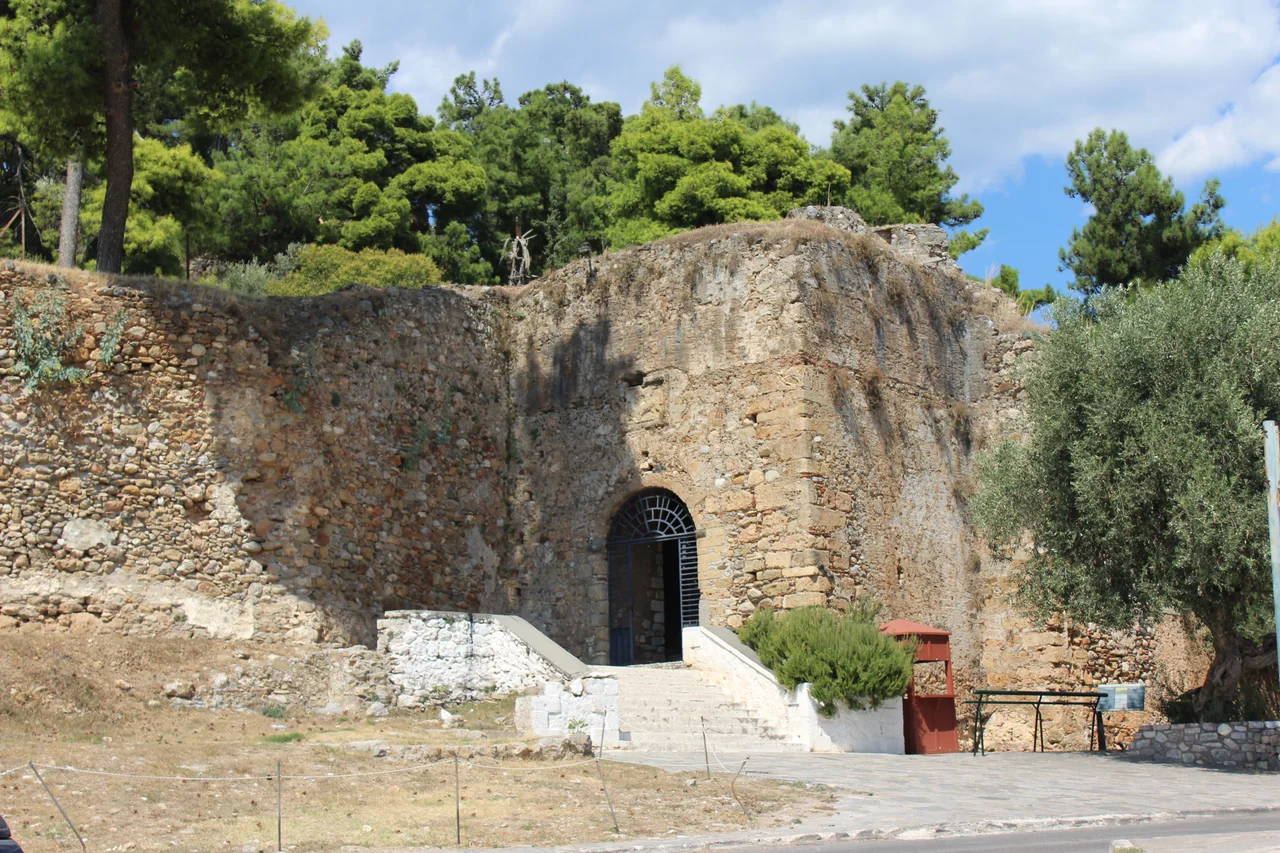

Kalamata Castle
There is a prisoner in the donjon of Kalamata Castle. He studies the wall. Outside his cell window, the drop to the courtyard is considerable, but a prisoner with patience and a rope can measure it. In 1293 or 1295 — medieval chronicles are imprecise — a captive from the local Slavic community did exactly that. He was released. He built a ladder of precisely the right height. That night, he and fifty companions climbed into the tower. The next morning, six hundred more arrived. The Frankish garrison was driven out.
From Acropolis to Monastery to Castle
The hilltop above Kalamata has been occupied for a very long time. The ancient city of Pharae stood here — mentioned by Homer, its acropolis now buried under medieval stonework. The Byzantine Empire built the first castle on that acropolis, but by the time Frankish Crusaders arrived in 1205 following the Fourth Crusade, the fortress had been converted into a monastery, its walls in poor condition. The monks offered brief resistance; the Crusaders were unimpressed. William of Champlitte and Geoffrey of Villehardouin took the town, and Kalamata became one of the twelve baronies of the Principality of Achaea. The Villehardouins made it their personal patrimony. Prince William II of Villehardouin was born within these walls and died in them in 1278. The castle was not just a military installation — it was the family seat of the dynasty that ruled the Frankish Peloponnese.
Conquest by Rope Ladder
The Slavic raid of the 1290s stands out in the castle's long history as one of its odder episodes. After the rope-ladder capture, the occupiers held the castle for a brief period before the Franks retook it with help from a local Greek chieftain. The response was practical: the Franks raised the height of the walls. Kalamata remained under Frankish control until 1428, when the Byzantines of the Despotate of the Morea finally captured it — almost at the very end of the Principality of Achaea. The Ottomans took the Peloponnese in 1458–1460; Venice held the castle briefly afterward, then lost it in the First Ottoman-Venetian War. In 1659, Morosini raided and sacked it without occupying it, carrying off the town's inhabitants. The castle passed through centuries of hands without ever being fundamentally rebuilt.
Blown Apart by Its Captors
The castle's decisive end came in 1685. Morosini returned during the Morean War; the Venetians defeated an Ottoman army at the foot of the hill on 14 September. The retreating Ottomans set fire to their ammunition stores — the explosions did tremendous damage to the walls that had stood since the 13th century. The Venetians, surveying the wreckage, made a judgment call that reveals how quickly military thinking had moved on: the castle was obsolete. Artillery had changed warfare. Hilltop fortifications with medieval walls could not survive cannon fire. The Venetians removed the guns, torched the garrison's houses inside the walls, and blew up the gates and bastions. After 1701, during the second period of Venetian rule, they rebuilt at least the outer circuit wall — the Lion of Saint Mark carved above the main gate still marks the spot — but the castle never returned to military relevance.
What Remains
The historian Kevin Andrews wrote that the castle's modest size and its "eminent, but not pre-eminent position" on the hillside meant it was never expanded into a proper artillery fortress. What survives reflects that verdict: a ruined donjon at the northernmost corner, a small square tower on the east side, a bastion guarding the single gate. The donjon is a rectangle roughly 40 by 34 meters; the stones of its cistern may be remnants of the ancient fortifications of Pharae. Inside, fragments of the Byzantine-era monastery's church survive — the same monastery the Crusaders brushed aside in 1205. The outer circuit wall descends the eastern flank of the hill. The castle sits in the northern quarter of modern Kalamata, where the Nedon River turns south from its gorge in Mount Taygetos toward the Messenian Gulf. The view from the hilltop — across the city, the coastal plain, and the blue water beyond — is still worth the climb.
From the Air
Kalamata Castle stands at approximately 37.046°N, 22.117°E on a prominent hill in the northern part of Kalamata city. Kalamata International Airport (LGKL) lies about 8 km to the southwest at 37.068°N, 22.025°E. Approaching from the southwest, the castle's hilltop position is distinctly visible above the modern city grid. The Nedon River gorge cuts down from Mount Taygetos directly behind (northeast of) the castle hill. Recommended viewing altitude: 2,500–4,500 ft. The Messenian Gulf provides the southern horizon; the castle hilltop and the river gorge are useful orientation landmarks for the Kalamata area.
Nearby Stories
- Las (Greece) 1.3 km away
- Karyes 3 km away
- Psari, Messenia 10 km away
- Diocese of Amyclae 11 km away
- 2023 Messenia Migrant Boat Disaster 20 km away
- Kalamakia Cave Site 36 km away
- Agios Andreas, Katakolo 46 km away
- El-Kouf National Park 445 km away