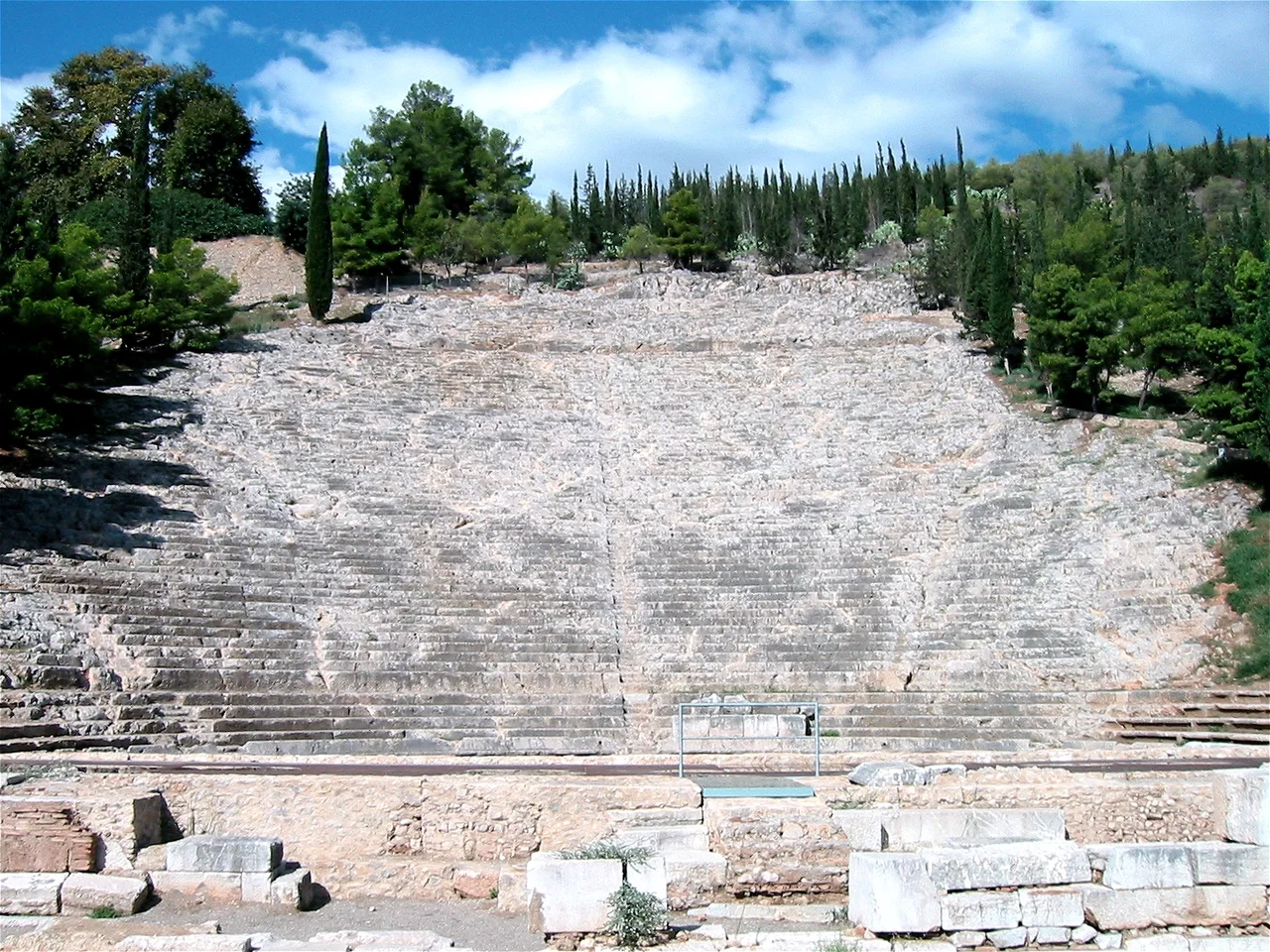

Ancient Theatre of Argos
There is a tunnel under the stage at Argos. It runs from the backstage area down beneath the orchestra floor, presumably so that actors could rise through a trapdoor and appear as if from nowhere — summoned from the underworld, or dropped from Olympus, depending on the play. Scholars debate whether the passage was actually wide enough for a costumed actor to navigate, and no firm conclusion has emerged. But the Charonian stairway, as it is called, captures something essential about this theatre: it was a place designed for spectacle, for illusion, for the management of time and space in front of an audience of twenty thousand people. Built into the eastern slope of Larissa Hill in the third century BC, it is among the largest ancient theatres in Greece. It is also, as excavations in 1988 confirmed, one of only two theatres in the Greek world proven to have had a fully circular stone orchestra. The other is Epidaurus.
Stone Cut from the Hillside
The theatre does not follow the textbook plan of a Greek theatre. British archaeologist Richard Allan Tomlinson, who studied it closely, noted that the steps of the cavea do not conform to any regular geometry — the blocks vary in size and angle in ways that suggest organic growth over time rather than a single unified design. Ninety steps climb a steep incline from the orchestra, forming a narrow rectilinear seating bowl divided into three horizontal tiers by two wide landings. Four staircases cut the cavea vertically into sections corresponding to the four tribes of Argos, so that citizen seating was organized by civic unit. A high wall was erected around the theatron, partly to prevent unauthorized entry and partly, it appears, to help channel sound. The acoustic result, by most accounts, remains good today. At its largest, the theatre seated approximately 20,000 spectators — numbers that rival or exceed the famous theatre at Epidaurus, which is typically celebrated as the finest in the ancient world.
Rome Rebuilds, Hadrian Takes Note
Around 120 CE, during the reign of the Emperor Hadrian, the theatre was substantially renovated. The Romans were enthusiastic adapters of Greek theatrical infrastructure, and at Argos they added a proskenion — a raised stage platform — over part of the orchestra, with a hyposkenion (a below-stage space) beneath it. A smaller theatre nearby was converted to an odeon for music and recitation. Hadrian himself documented the construction activity. Floor levels shifted, new buildings went up on the eastern side of the site, and what had been an entrance of five steps was expanded to six during some phase of reconstruction. A pool was at some point incorporated into or near the theatre to allow for aquatic spectacles — evidence of Rome's habit of transforming Greek dramatic spaces into more varied entertainment venues. Despite all this modification, the seating cavea itself shows few signs of Roman-era intervention, suggesting that the Hellenistic stone tiers were considered adequate, or simply too solid to alter cheaply.
Assembly Hall and Arena
The theatre was not only for drama. Political assemblies — the Ecclesia, at which male citizens could speak and vote — were held here, using the natural acoustics and sightlines that made the space ideal for public speech. The Nemean Games, moved from the city of Nemea to Argos around the third century BC, eventually made the theatre their primary venue for athletic competitions, music contests, and gladiatorial exhibitions. A pool was developed, possibly in the orchestra area, to permit aquatic events. The theatre's position — visible from anywhere in the ancient city, with the Nafplio bay shimmering to the south — gave it a civic centrality that combined culture, politics, and spectacle in one site. When Ioannis Kapodistrias convened the Fourth National Assembly of the new Greek state here in 1829, he was choosing a venue whose role as a gathering place for collective decision-making stretched back two thousand years.
Buried, Found, Understood
The theatre was buried for roughly 1,400 years. In 1892, Greek archaeologist I. Kophiniotis partially excavated the larger theatre; from 1902 onward, Wilhelm Vollgraff excavated extensively on behalf of the French School of Archaeology (École Française d'Athènes), and the French School has continued research at the site ever since. The excavations eventually unearthed two theatres close together in the ancient city, roughly 100 meters apart. The smaller, earlier structure — dated to the third or fourth century BC — had been converted into an odeon when the larger Hellenistic theatre was built just to its north. Finds from the excavations included pottery, terracotta figures, Greek and Roman sculpture (including rare works attributed to the sculptor Attalus), mosaics, and fragments of armor. The 1988 excavations that confirmed the full circular orchestra were a significant discovery — finally resolving the question of whether Argos shared this unusual feature with Epidaurus, its neighbor and perpetual rival in architectural reputation.
From the Air
The Ancient Theatre of Argos sits at 37.6316°N, 22.7195°E, cut into the eastern slope of Larissa Hill on the western edge of the city. From the air at 4,000–6,000 feet, the semicircular scar of the cavea is visible against the hillside, with the flat Argolic plain stretching south and east. The Nafplio bay glints in the distance to the south-southeast. The nearest major airport is Athens International (LGAV), approximately 100 km to the northeast. Morning light from the east illuminates the seating bowl most dramatically.
Nearby Stories
- Villa of Herodes Atticus 3 km away
- Sicyon 3.5 km away
- Battle of Megalopolis 4.5 km away
- Hermione: The City at the Edge of the World 7.5 km away
- Agia Lavra 7.7 km away
- Megara 13 km away
- Agistri 13 km away
- Teuthis 15 km away