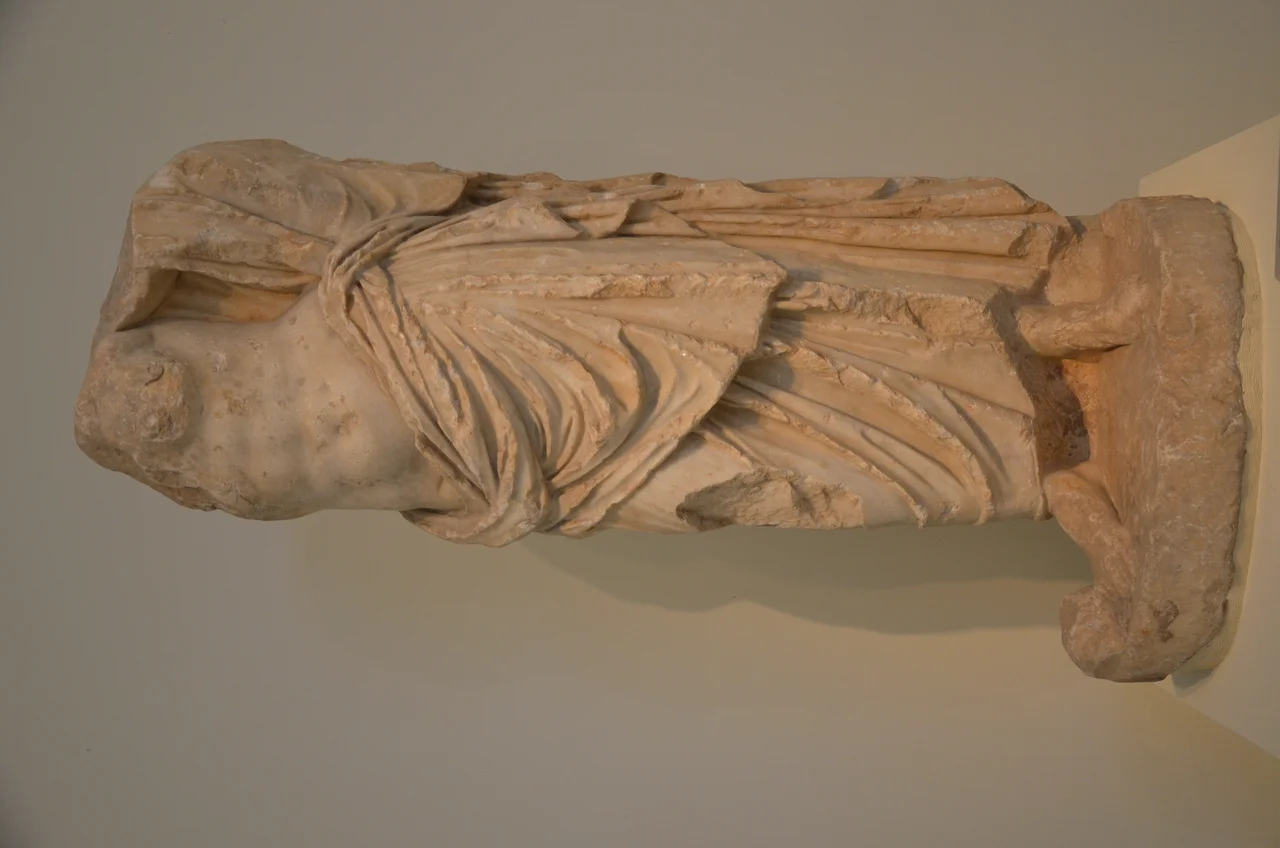
,_probably_from_the_decoration_of_the_villa_of_Herodes_Atticus,_middle_of_2nd_century_AD,_National_Archaeological_Museum_of_Athens_(14118953833).jpg)
Villa of Herodes Atticus
Grief does strange things to the very rich. When Herodes Atticus lost his wife Régilla and his adopted sons in the second century AD, he did not simply mourn — he transformed his Arcadian estate into a monument of almost bewildering scale and sorrow. Statues of his beloved dead filled the courtyards. A shrine to Antinous, Hadrian's deified favourite, became a funerary dining hall lined with cenotaphs. Mosaics of mythological figures spread across the floors. In his anguish, one of the Roman world's wealthiest men built something that looks, in the archaeological record, less like a holiday villa than like a private city dedicated to the memory of the people he had loved.
The Man Behind the Marble
Herodes Atticus was not a typical Roman patron. Born Greek, educated in Athens, and phenomenally rich, he became one of the great literary and rhetorical figures of the 2nd century AD — a sophist, a senator, a consul suffect under Antoninus Pius, and a man who funded spectacular public buildings across the Greek world. His family's connection to this patch of Arcadian coastline, near the ancient town of Eva on the Argolic Gulf, went back at least to his grandfather Tiberius Claudius Hipparchus, who acquired the land. His father, Tiberius Claudius Atticus Herodes, probably built the first structures in the 1st century AD. But it was Herodes himself who, sometime around 165 AD, expanded the estate into something extraordinary — a sprawling villa rustica of some 20,000 square metres, part working farm, part lavish retreat, and ultimately part mausoleum for his sorrow.
A Villa Like a City
Walking the ruins today, it is the scale that stops you. The building footprint alone covers approximately 6,500 square metres, spread across three terraced levels rising from north to south. At the heart of the complex, a rectangular atrium contained a channel three metres wide enclosing an island sixty metres long — an arrangement echoing the famous Maritime Theatre at Hadrian's Villa in Tivoli. A peristyle of nearly fifty columns ran around three sides, their surfaces richly decorated with mosaics. A cryptoporticus — a covered walkway — stretched for a hundred metres along the south wing, linking an octagonal tower, bath suites, a shrine to the Egyptian god Serapis, and the funerary hall dedicated to Antinous. An aqueduct whose stalactite-encrusted remains are still partly visible once fed the complex with water from a spring 1.5 kilometres to the northwest. A library, a gymnasium, and stadium-like gardens completed a compound that functioned as a world unto itself.
Mosaics of Gods, Reliefs of the Dead
Most of the mosaics that have survived date from the 5th century, their mythological subjects spreading across the floors in vivid colour: the Muses Euterpe and Calliope, the doomed love of Dido and Aeneas, the river-gods Ladas, Alpheus, and Acheloos, the Labours of Heracles, Achilles slaying the Amazon queen Penthesilea. From the soil around the villa, archaeologists have retrieved a remarkable wealth of sculpture — statues and busts carved from Doliana marble, Roman copies of classical masterpieces, portraits of the Antonine imperial family and of Herodes's adopted sons Achilles, Polydeukes, and Memnon. A Pentelic marble head of Memnon now sits in the Altes Museum in Berlin. A stele listing soldiers fallen at the Battle of Marathon was found here too, a reminder that Herodes inhabited a world saturated with the prestige of Athenian memory. The finds are distributed today among the Archaeological Museum of Astros, the Museum of Tripoli, and the National Archaeological Museum of Athens.
Earthquake, Monks, and Slow Rediscovery
The estate survived into the 4th century, and probably into the 5th, before being partly destroyed — perhaps by earthquake, perhaps by Visigoth raids. By the early 5th century, what had been bath suites were repurposed as workshops; the north wing was converted into a large basilica. A major earthquake in 856 finished much of what remained standing. A 12th-century monastery, the Monastery of the Transfiguration, rose 250 metres south of the villa and incorporated Roman masonry into its walls; it still houses ancient artefacts almost certainly from the villa's original holdings. The site slept for centuries after that. A British traveller named William Martin Leake stumbled upon it in 1809 and mistook the wall remains for a Hellenistic fortification. The German archaeologist Ernst Curtius corrected that reading decades later but missed the villa's true identity. Only in 1906 did the Greek archaeologist Konstantinos Rhomaios connect the ruins to Herodes Atticus. Systematic excavation came later still: campaigns in 1978, the 1980s, and the 1990s have progressively revealed the compound's full extent, with conservation work continuing into the present.
What Remains
The Villa of Herodes Atticus is now an open-air archaeological site, one of the most significant examples of Roman villa architecture anywhere in Greece. It is not a polished museum experience — the ruins are raw, the scale hard to read without some imagination — but that rawness is also part of the draw. You stand in the remnants of a peristyle where mosaics once glittered underfoot and statues of the dead watched from their niches, and you feel the peculiar ambition of a man who used tremendous wealth not to build triumphal monuments to himself, but to create a place where grief could be given permanent, beautiful form. The Monastery of the Transfiguration nearby is worth visiting too, both for the artefacts it shelters and for the long view it offers down toward the Argolic Gulf, the same water that Herodes Atticus looked out over nearly two thousand years ago.
From the Air
The Villa of Herodes Atticus lies at 37.416°N, 22.685°E on the eastern edge of the Peloponnese, near the small town of Astros on the Arcadian coast. From the air, the site is visible as a low archaeological footprint set against the terraced hillside above the Argolic Gulf. The coast here offers excellent visual orientation — the gulf stretches south toward the open sea, and the green hills of Arcadia rise immediately to the west. The nearest airport with scheduled services is Kalamata International (LGKL), roughly 100 km to the southwest, but most visitors fly into Athens International Eleftherios Venizelos (LGAV), approximately 150 km to the northeast. A low-altitude approach from the north gives the clearest view of the terraced estate layout. Visibility is typically good in summer; sea mist can reduce clarity in autumn and spring mornings.
Nearby Stories
- Anthochori, Arcadia 2 km away
- Ancient Theatre of Argos 4.2 km away
- Hermione: The City at the Edge of the World 5.3 km away
- Kalamata Castle 5.6 km away
- Diocese of Amyclae 9.4 km away
- Agistri 15 km away
- Barony of Akova 21 km away
- SS Heraklion 86 km away