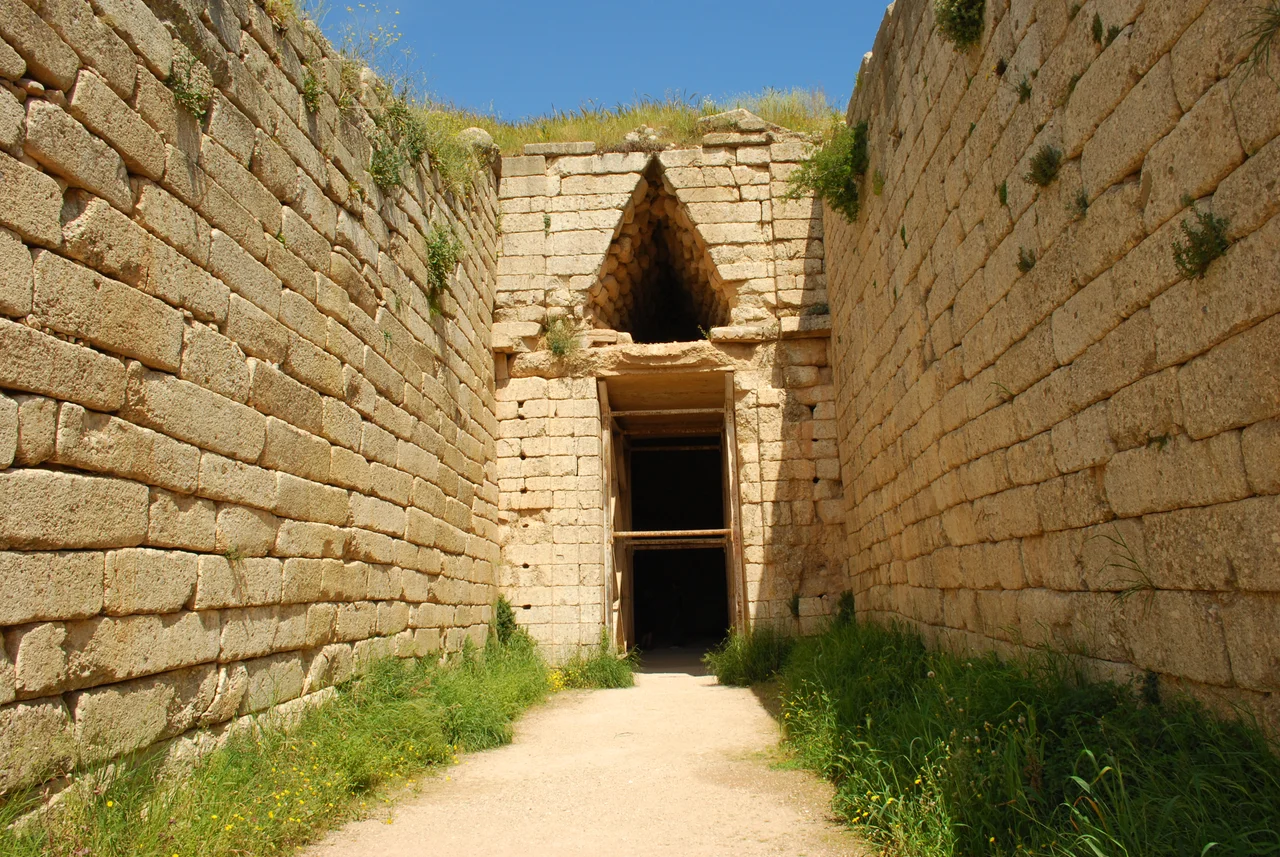

Tomb of Clytemnestra
The name is a romantic inheritance, not an archaeological one. 'Clytemnestra' — the queen who, in Greek mythology, helped murder her husband Agamemnon on his return from the Trojan War — was attached to this tholos tomb at Mycenae by later scholars following the logic of association: a great tomb near the tomb already called 'Agamemnon's Treasury' might plausibly belong to his queen. The ancient geographer Pausanias mentioned that Clytemnestra and Aegisthus were buried outside Mycenae's walls, because murdering a king disqualified you from burial inside them. Heinrich Schliemann followed Pausanias's text to search the area and excavated here. But no body was found. The chamber, like all nine of Mycenae's royal tholos tombs, had been thoroughly looted in antiquity. What survived was the architecture, and that is more than enough.
Last of the Nine
The Tomb of Clytemnestra was built around 1250 BC, making it the last of the nine royal tholos tombs constructed in the vicinity of the citadel of Mycenae during the 15th and 13th centuries BC. The tholos tomb form — a circular burial chamber with a high corbelled dome reached by a long, stone-lined passage called a dromos — emerged in Mycenaean Greece around 1500 to 1450 BC as the preferred burial monument of the ruling class. Over the following two centuries, the form evolved: tombs grew larger, façades grew more elaborate, and the structural sophistication of the masonry increased. The Tomb of Clytemnestra represents the endpoint of that trajectory. Together with the Treasury of Atreus, it is the most monumental of all nine tombs. Scholars have noted that its slightly more advanced technical features — rows of curved stones continuing around the structure at the level of the lintel — may indicate it was built marginally later than the Treasury of Atreus, though both are conventionally dated to the same general period of Mycenaean construction.
The Façade That Inspired Centuries
What distinguishes the Tomb of Clytemnestra above all is its entrance façade. The dromos — the long approach passage — is lined with walls of ashlar conglomerate, the same material used for the doorway. But the exterior face of the stomion (the doorway proper) is decorated with half-columns made of gypsum, carved with ornate capitals and vertical fluting. A small drain is cut through the lintel block, lined with rubble walls and roofed with small slabs to direct rainwater away from the structure. The surface of the tomb was originally covered with a coat of white plaster, giving the whole monument a finished, imposing appearance that matched its function. Those decorative half-columns were no mere ornament: the architectural features of this specific tomb — particularly the semi-column design — were adopted by later classical architects in both the Greek and Latin world during the first millennium BC. A funerary monument on the outskirts of a Bronze Age citadel became, in this way, a template for classical architecture that outlasted the civilization that created it.
What Schliemann Found — and Didn't
Heinrich Schliemann arrived at Mycenae in the 1870s following Pausanias's description of the site, and he excavated the Tomb of Clytemnestra as part of his broader campaign to find the heroes of the Trojan War in the archaeological record. The inner burial chamber was empty — looted, as were the other eight royal tombs, probably in the Iron Age. But the dromos yielded something. Excavations in the 1960s, conducted after Schliemann's time, led to the discovery of the tomb's surrounding walls. Within the dromos, a woman's grave was found, along with accompanying artifacts: two mirrors, ornaments, and beads. The woman was not buried in the main chamber, and her burial is believed to be a secondary interment of a later period. Who used the main tholos for their burial, and what was placed with them before the looters came, remains unknown. Schliemann believed mythology; the stones refuse to confirm it.
A Question Still Open
Modern scholars have raised an intriguing alternative to the 'Clytemnestra' identification: some have suggested that the tomb might have been Agamemnon's rather than his queen's, or that it may never have been occupied at all, given that Mycenae faced destruction during the period of its construction. These possibilities remain speculative. What the archaeology does establish is that the tomb was constructed with exceptional skill and care at the peak of Mycenaean architectural ambition, that its chamber stood approximately 13 meters high at its corbelled apex, and that it was designed to be seen — its position and façade calculated for maximum visual impact on those approaching the citadel. The woman found in the dromos, buried with her mirrors and ornaments, left more physical evidence of her presence than the monument's supposed namesake ever did. In the gap between the myth and the evidence, the Tomb of Clytemnestra invites visitors to sit with uncertainty — which is, in fact, the more honest posture toward the Bronze Age.
From the Air
The Tomb of Clytemnestra is located at 37.7307°N, 22.7550°E, at the western edge of the Mycenae citadel in the Argolid, northeastern Peloponnese, Greece. It sits near the Lion Gate, close to the Tomb of Aegisthus. The site of Mycenae occupies a ridge between two small hills on the eastern edge of the Argive plain, approximately 10 km inland from the Gulf of Argos. The nearest major airport is Athens International (LGAV), approximately 130 km to the northeast. In clear conditions, the Argive plain and distant Gulf of Argos are visible from altitude. Approach from the north via the Corinth corridor; the citadel ridge is identifiable on the plain's northern edge.
Nearby Stories
- Villa of Herodes Atticus 3 km away
- Sicyon 3.5 km away
- Battle of Megalopolis 4.5 km away
- Hermione: The City at the Edge of the World 7.5 km away
- Agia Lavra 7.7 km away
- Megara 13 km away
- Agistri 13 km away
- Teuthis 15 km away