
Medeon (Phocis)
In 346 BCE, Philip II of Macedon destroyed Medeon. He destroyed it along with every other town in Phocis, punishment for the Phocians' role in the Third Sacred War and their seizure of the treasuries at Delphi to fund their armies. The towns were not rebuilt. Medeon — a coastal settlement on the Gulf of Antikyra, named according to ancient writers for Medeon, son of Electra and Pylades — simply ceased to exist as a living place. The hill it stood on kept its walls. The cemetery below it kept its dead. And two thousand years later, under a soil layer disturbed by bauxite mining operations and the construction of an aluminum factory, archaeologists found what the town had left behind.
A Hill Above the Gulf
The ruins of Medeon sit on a steep hill called Agioi Theodoroi — named for a small church at its summit — on the east side of the Gulf of Antikyra. The view from the hill takes in the water across to Antikyra itself, also an ancient Phocian town, and the ridgeline of Mount Amalia rising behind. Olive trees cover the slopes below. The road that now runs along the gulf carries trucks to the aluminum factory that dominates the valley floor.
Strabo, writing in the first century BCE, placed Medeon on the Crissaean Gulf (the eastern arm of the Gulf of Corinth), at a distance of 160 stadia from Boeotia. Pausanias, who traveled through the region in the second century CE, noted that it was near Antikyra. The geography matches the Agioi Theodoroi hill precisely. The location is confirmed: this is where Medeon stood.
What the Ground Remembers
The first archaeologist to dig at Agioi Theodoroi was Georgios Sotiriadis, who excavated the hill in 1907. Half a century later, in 1962–63, the French School of Archaeology — which had also excavated Delphi — returned for a rescue campaign prompted by the new aluminum factory's bauxite mining operations in the valley below. The 1960s work focused not on the acropolis but on a cemetery near it, which proved to span an extraordinary range of time: artifacts from the Middle Helladic period (2100–1600 BCE) through the second century BCE were recovered.
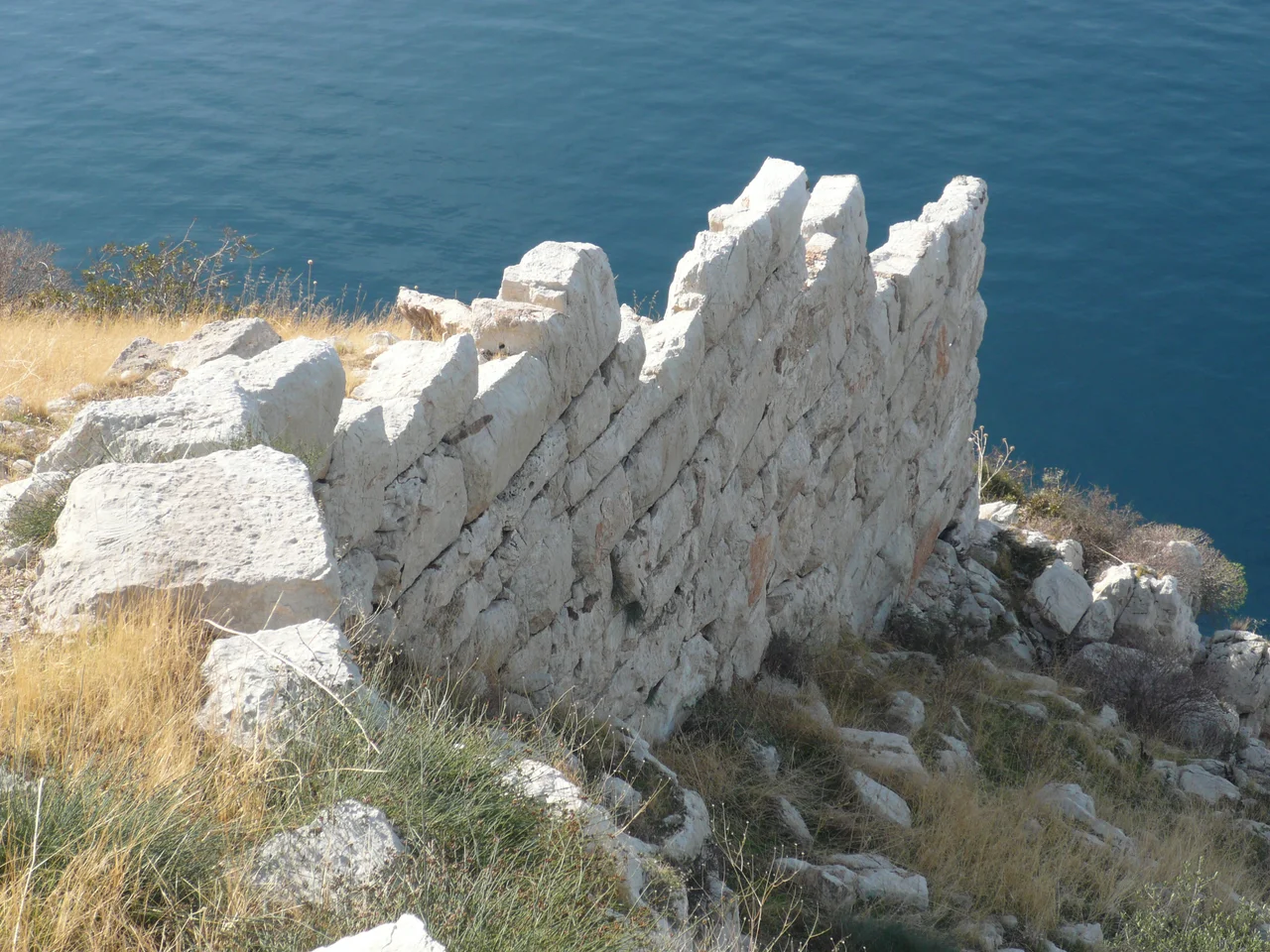
Among the cemetery's discoveries was a beehive tomb — a tholos — with a small side chamber, a burial form that suggests connections to the Mycenaean world. The fortification walls of the acropolis, built in the fourth century BCE, were also examined. They stand in good condition on the south flank of the hill: courses of stone fitted without mortar, designed to defend a community that would be gone before the century was out.
The Treaty That Survived the Town
Philip destroyed the Phocian towns in 346 BCE, but Medeon's story does not entirely end there. In the second century BCE, an inscription was cut on a stele recording a sympoliteia — a political and religious union — between Medeon and the neighboring town of Stiris. Both cities had the approval of the Phocian League for the arrangement. The stele was placed inside the temple of Athena Cranea at Elateia; a sealed copy was kept by a citizen of Lilaea named Trason; witnesses came from Tithorea, Elateia, and Lilaea.
The terms are precise and carefully balanced. The Medeonites and Stirisians would be equal in assemblies and share common magistrates, but Stiris was the senior partner. Medeon could appoint its own hierotamias — a sacred treasurer — who would make sacrifices according to Medeon's own law and sit in judgment alongside Stiris's archons. Former magistrates of Medeon were not required to serve in Stiris unless they chose to. The sanctuaries, territory, and ports would be held in common.
This is how small Greek cities negotiated survival after catastrophic defeat: not by disappearing entirely, but by formalizing their dependencies and carving them into stone.
A Town That Was Not Restored
What makes Medeon unusual is its completeness as a historical endpoint. Most ancient sites were abandoned, rebuilt, abandoned again, built over, reclaimed. Medeon was destroyed in 346 BCE and never again restored — the ancient sources say so explicitly, and the archaeology confirms it. There is no Roman layer above the Greek one, no Byzantine church on the acropolis, no medieval village in the valley. The aluminum factory is the next chapter after the fourth century BCE.
The hill of Agioi Theodoroi stands today much as it stood when Philip's forces were done with it: steep, defended by walls that no longer needed defending, with a view of the gulf and the opposite shore that the last inhabitants saw before they left or were driven away. What Medeon might have become — had the Sacred War ended differently, had Philip spared it — belongs to the category of history's un-run experiments. What it was is recoverable only in pieces: a hillside cemetery, a set of walls, an inscription about sharing sanctuaries with a neighbor, and the precise record of Strabo and Pausanias noting, almost as an afterthought, that it had once been there.
From the Air
Ancient Medeon is located at 38.366°N, 22.685°E on the east shore of the Gulf of Antikyra, a southern arm of the Corinthian Gulf, in the modern municipality of Distomo-Arachova-Antikyra in Boeotia (administrative Voiotia). The site is on the hill of Agioi Theodoroi, visible from the water and from the road running along the gulf shore. From altitude the gulf is immediately recognizable as a narrow inlet running northwest-southeast, with the aluminum factory complex visible on the valley floor below the archaeological hill. Recommended viewing altitude is 4,000–6,000 ft on a clear day, approaching from the south over the gulf. The nearest major airport is Athens International (LGAV), approximately 140 km to the east-southeast. The ruins are within the administrative area of the village of Steiri, a part of Distomo.
Nearby Stories
- Battle of Vasilika 7.9 km away
- Siege of Negroponte (1470) 8.5 km away
- Battle of Kalavryta 13 km away
- Church of the Nativity of the Theotokos, Limni 14 km away
- Pellene 16 km away
- Panagia Varnakova Monastery 18 km away
- Megara 21 km away
- Karpenisi 41 km away