
Pleuron (Aetolia)
Homer listed it among the Aetolian cities whose ships sailed for Troy. That line in the Catalogue of Ships in the Iliad is the oldest surviving reference to Pleuron, and it established the town's mythology before its history was properly recorded. Pleuron appears in the Iliad's war, in the legends of Oeneus and the Calydonian Boar, in Sophocles, in the tragedies of Phrynichus. It was a city ancient Greeks understood as ancient — a place whose heroic associations predated even the written word.
Old Pleuron and the People Before
The first Pleuron stood at the foot of Mount Curium, in the fertile triangle between the Achelous and Evenos rivers. Before it became Aetolian, it was the home of the Curetes — the same Curetes whose wars with Oeneus, king of nearby Calydon, are embedded in the myths of the Calydonian Boar hunt. Ephorus, the ancient historian, wrote that the Aeolians expelled the Curetes from the region, which Thucydides corroborates indirectly by noting that the district was called Aeolis in earlier times. By the period of the Trojan War, Pleuron was fully Aetolian: its warriors sailed under the command of Thoas, grandson of Oeneus himself, joining the Greek fleet bound for Troy. The circuit walls of Old Pleuron, built in Cyclopean masonry — large rough stones fitted with smaller stones in the gaps — survive in the landscape, 1.5 kilometers to the southeast of the later city. They are the physical signature of a Bronze Age settlement that was already famous when Homer described it.
Destroyed and Rebuilt
Old Pleuron was abandoned, Strabo tells us, because of the ravages of Demetrius Aetolicus, king of Macedon, who reigned from 239 to 229 BCE. The town was not simply sacked; its population left and did not return to the same site. The new city — New Pleuron — was built a short distance away, at the foot of Mount Aracynthus, on a terrace more than 200 meters above sea level. The move was almost certainly the work of Pantaleon of Pleuron, who served as strategos of the Aetolian League in five separate terms between 242 and 213 BCE. He built a city worth protecting: walls with 31 towers and 7 gates, a theater, an agora with a 62-meter stoa, a gymnasium, a large communal cistern with five rectangular basins. The new city was linked to the sea by a defense wall that enclosed the ancient harbor of Elaius.
A City You Can Still Walk
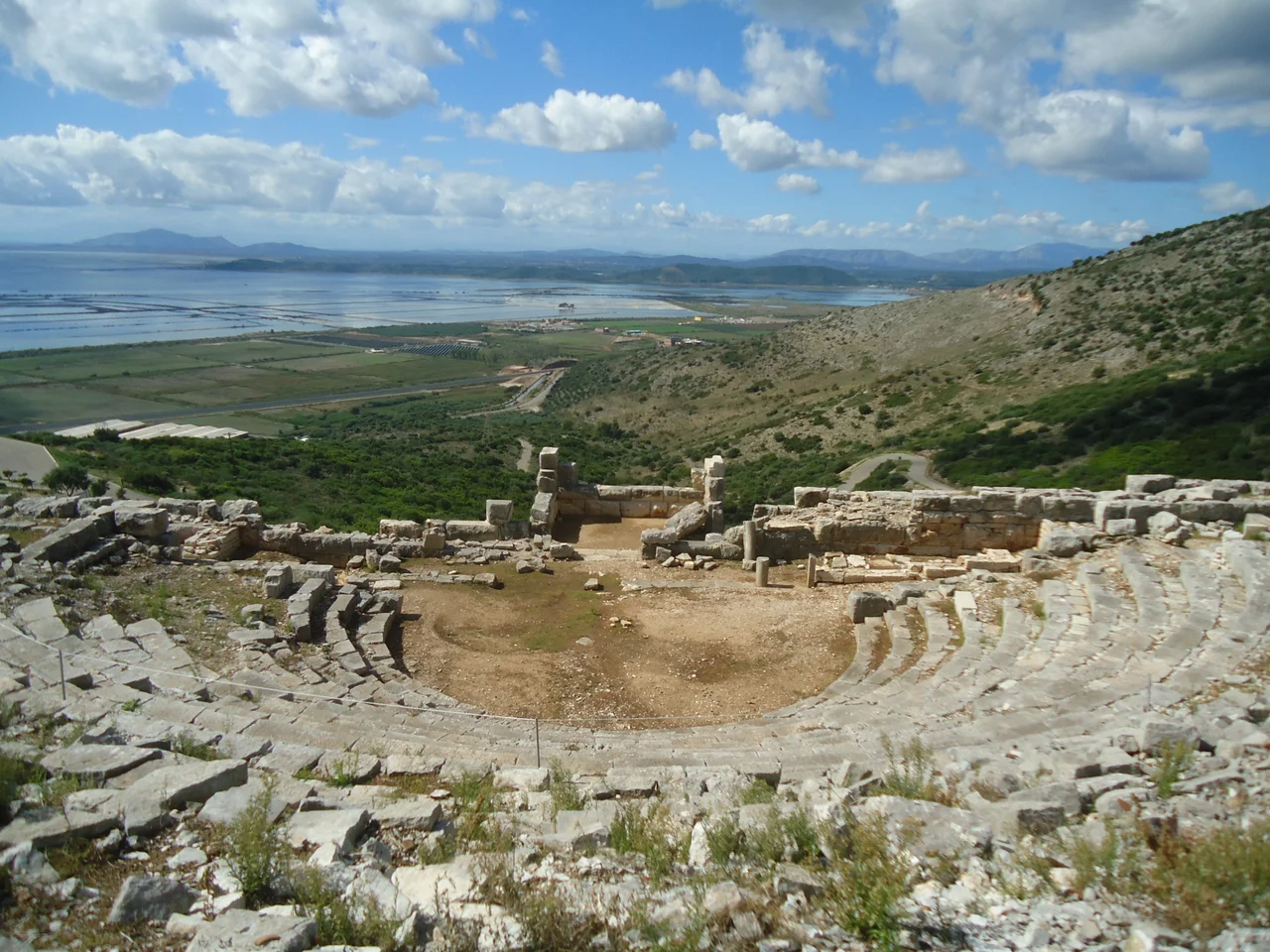
New Pleuron is one of the better-preserved Hellenistic cities in western Greece, partly because it was never reoccupied on a large scale after it declined under Roman rule. The masonry is trapezoidal and pseudo-isodomic — well-cut stone faces with rubble fill — and stands in many places to significant height. The theater occupies the southwest part of the city, its proscenium built against the city wall, with the central building of the skena forming a tower. The cavea had five sections and six staircases; the northern portion is well preserved. From the theater seats, the view extends south toward the Missolonghi lagoon, a sheet of pale water visible in clear weather. A Byzantine chapel was later built on the remains of the Temple of Athena, its stones reused for a new kind of devotion. The site is near the modern city of Missolonghi, a few kilometers to the north.
The Myths Embedded in the Walls
Pleuron's mythology runs deep into Greek legend. Oeneus, the king entangled with the Calydonian Boar, is both Pleuron's mythic founder through family connections and a figure the ancient writers placed alternately at Pleuron and at Calydon next door — the two cities blurring in legend as they did in geography. The playwright Phrynichus wrote a tragedy about Meleager, son of Oeneus, and titled it the Pleuronian Women, suggesting the city was firmly in the mythic consciousness of classical Athens. Sophocles placed Oeneus himself as king of Pleuron. And the ancient Greek poet Alexander Aetolus, a figure of the Hellenistic period who worked at the Library of Alexandria, was born here. The city produced at least one literary figure, embedded in one of antiquity's great institutions, carrying the name of his home region into his identity.
From Aetolian League to Roman Republic
Pleuron's political history in the Hellenistic period followed the Aetolian League, which was the dominant power in western Greece from the 3rd century BCE onward. After the League's defeat in the Roman-Seleucid War, the citizens of Pleuron petitioned the Roman Senate directly for permission to join the Achaean League — an unusual step that reflects both the diminishing leverage of Aetolia and the town's desire to maintain some form of political autonomy. After the destruction of Corinth in 146 BCE, Pleuron became part of the Roman Republic. References to the town in the Imperial age are sparse. It fades, as most Hellenistic cities eventually did, into the background of a landscape reorganized by Roman priorities. What remains are the walls, the theater, the cisterns, and the view from the terrace southward toward the lagoon.
From the Air
Ancient Pleuron (New Pleuron) is located at approximately 38.415°N, 21.414°E, on a terrace above 200 meters in elevation several kilometers north of Missolonghi, in the Aetolia-Acarnania region of western Greece. From the air, the elevated ridge on which the ruins sit is distinct from the flat lagoon landscape to the south. The Missolonghi Lagoon is visible to the south-southwest. The nearest major airport is LGRX (Araxos), approximately 50 kilometers to the east-southeast along the Gulf of Patras. Old Pleuron's ruins lie roughly 1.5 kilometers southeast of the newer site. At 3,000–5,000 feet, the theater and wall terracing are potentially identifiable in clear conditions.
Nearby Stories
- Taphians 2.4 km away
- Nafpaktos 3.2 km away
- Ithaca (island) 6.6 km away
- Achaea (Ancient Region) 8.5 km away
- Battle of Manolada 13 km away
- Castle of Saint George, Cephalonia 17 km away
- Acarnania 18 km away
- Greece 41 km away