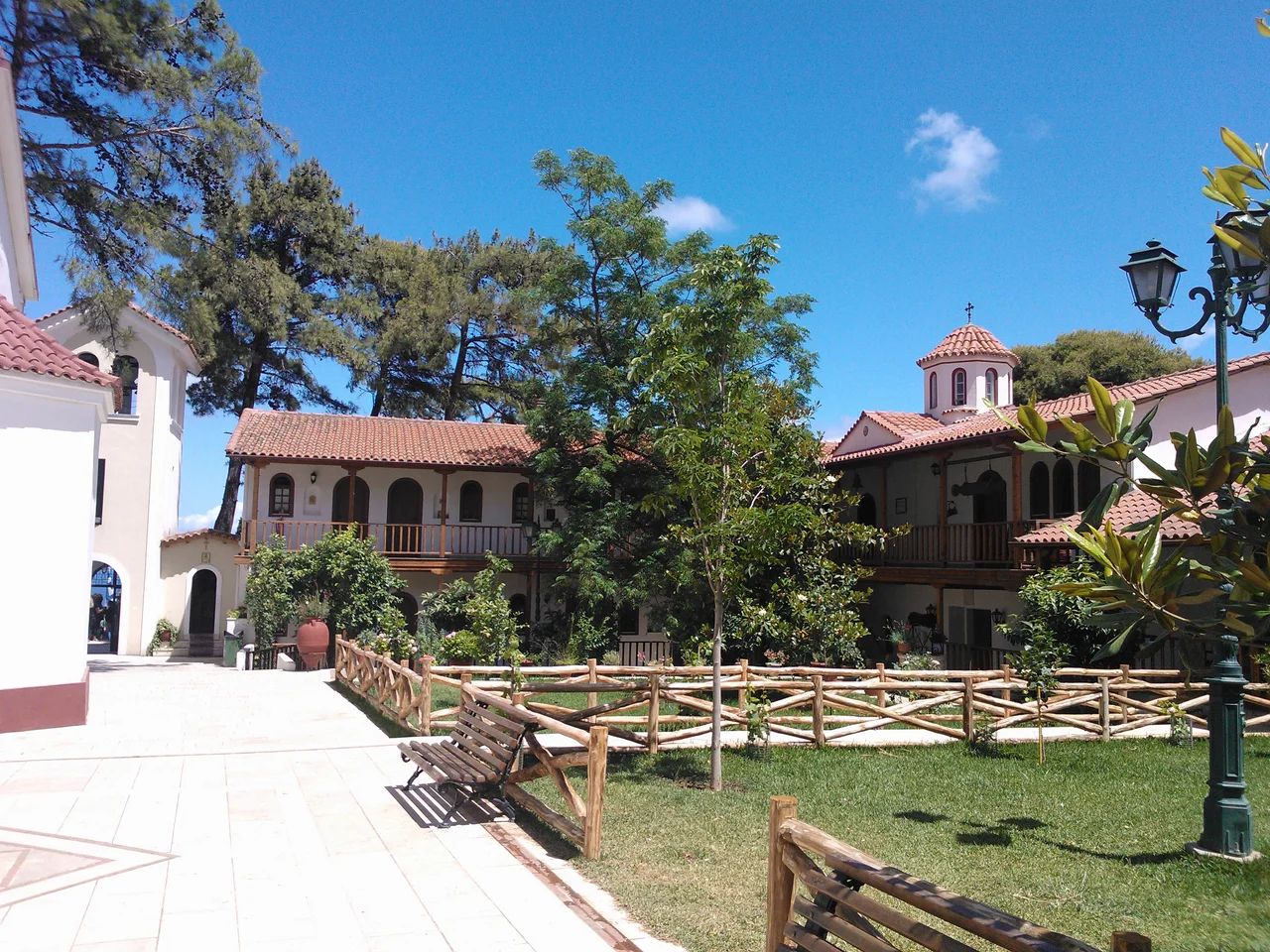

Phaneromeni Monastery, Lefkada
Three kilometres west of Lefkada town, where the land rises toward the pine-covered hills, the Phaneromeni Monastery has been the spiritual anchor of this Ionian island for as long as anyone can remember. Its full Greek name — Ιερά Μονή Υπεραγίας Θεοτόκου Πεφανερωμένης Λευκάδος — translates roughly as the Holy Monastery of the Most Holy Mother of God Who Has Made Herself Manifest. That last phrase matters. The monastery is built on the idea of divine revelation, of the sacred becoming visible in a particular place.
Where Artemis Once Stood
Tradition holds that the ground beneath the monastery was sacred long before Christianity came to Lefkada. A marble sanctuary of the goddess Artemis is said to have occupied the site in ancient times — a fitting predecessor for a monastery dedicated to another figure of sacred feminine protection. Near the village of Fryni, with views opening toward the Ionian Sea and the town below, the location commands both landscape and horizon. Whatever the historical truth of the Artemis sanctuary, the tradition reflects something real about the site's longstanding pull on the people who lived around it. Sacred places have a way of remaining sacred across the transitions of faith.
An Apostolic Beginning
The monastery's founding tradition reaches back to 63 AD, when — according to local belief — the Apostle Paul, travelling between Nicopolis and Preveza on the mainland, sent three companions across to the island: Akyla, Sosionas, and Herodion. The three men gathered the people of Lefkada at the site near Fryni and preached the teachings of Jesus. Afterward, they built a church in honour of the Virgin Mary — the first church on Lefkada, the tradition says. Paul himself is said to have ordained Sosionas as the first bishop of Lefkada. Whether or not this account is literally historical, it places the monastery at the very origin of Christianity on the island, a claim that gives it an authority no later foundation could match. The monastery's own records date it to the 17th century, but its spiritual genealogy reaches back much further, to that apostolic moment on a hillside overlooking the sea.
The Life of the Monastery
Today the Phaneromeni Monastery is a male community with an abbot and four monks — a small community by any measure, but the oldest and largest on Lefkada. The central church, the katholikon, is dedicated to the Dormition of the Theotokos. Once a year, on Whit Monday — the Monday of the Holy Spirit, a moveable feast — pilgrims travel from across Lefkada and from the surrounding islands and mainland to gather here. It is the monastery's principal celebration, and it draws people who come not only for devotion but for the connection to place and community that such festivals sustain. For Lefkadians everywhere, wherever they have scattered, the Phaneromeni Monastery remains a touchstone — the religious point of reference for the island.
Books and Relics
The monastery's library holds more than 2,000 titles, and among them are manuscripts that span several centuries: a Gospel manuscript from the 15th century, Gospels from the 17th and 18th centuries, an 18th-century liturgical calendar, and a manuscript book of psychophiles dated 1691. These are not curiosities but working documents of an ongoing religious tradition, kept in a library that has continued to accumulate and preserve. Beside the library, a small Byzantine chapel with a dome is dedicated to Saint Siluanos of Athonite, an early 20th-century monk of Mount Athos who was canonised in 1988 — a more recent layer in a place built from layers. The chapel holds holy relics. The monastery can accommodate up to fifty pilgrims overnight, and a reception area — the archontariki — is maintained for those who make the journey.
A Place That Reveals Itself
The name Phaneromeni — "she who has made herself manifest" — suggests that the sacred presence here did not arrive by human plan but by divine disclosure. It is a fitting name for a place that accumulates meaning rather than announcing it. The hilltop above Lefkada town is not dramatic by Greek standards. The monastery buildings are solid rather than grand. But the pilgrims who come on Whit Monday, the manuscripts kept in the library, the dome of the small Byzantine chapel — these things speak of a continuity of devotion that outlasts any individual act of building or founding. The Phaneromeni Monastery is, in the most literal sense, the oldest living institution on the island.
From the Air
The Phaneromeni Monastery sits at 39.356°N, 20.995°E, on the hillside west of Lefkada town, near the village of Fryni. From the air, look for the monastery buildings set into the slope above the flat coastal strip of the town. Nearest airport is LGPZ, Aktion National Airport (Preveza/Lefkada), approximately 15 km to the northeast across the Lefkada Canal and the lagoon. Approaching from the east at around 2,000 feet provides a clear view of the monastery against the pine-covered hills, with the town and the Ionian Sea to the west.
Nearby Stories
- Nativity of the Theotokos Monastery 0.9 km away
- Paxos 22 km away
- Agrafa 24 km away
- Meteora: The Monasteries Built on Impossible Pillars 25 km away
- Evrytania 27 km away
- Butrint 38 km away
- Vikos Gorge 45 km away
- SM UC-38 86 km away