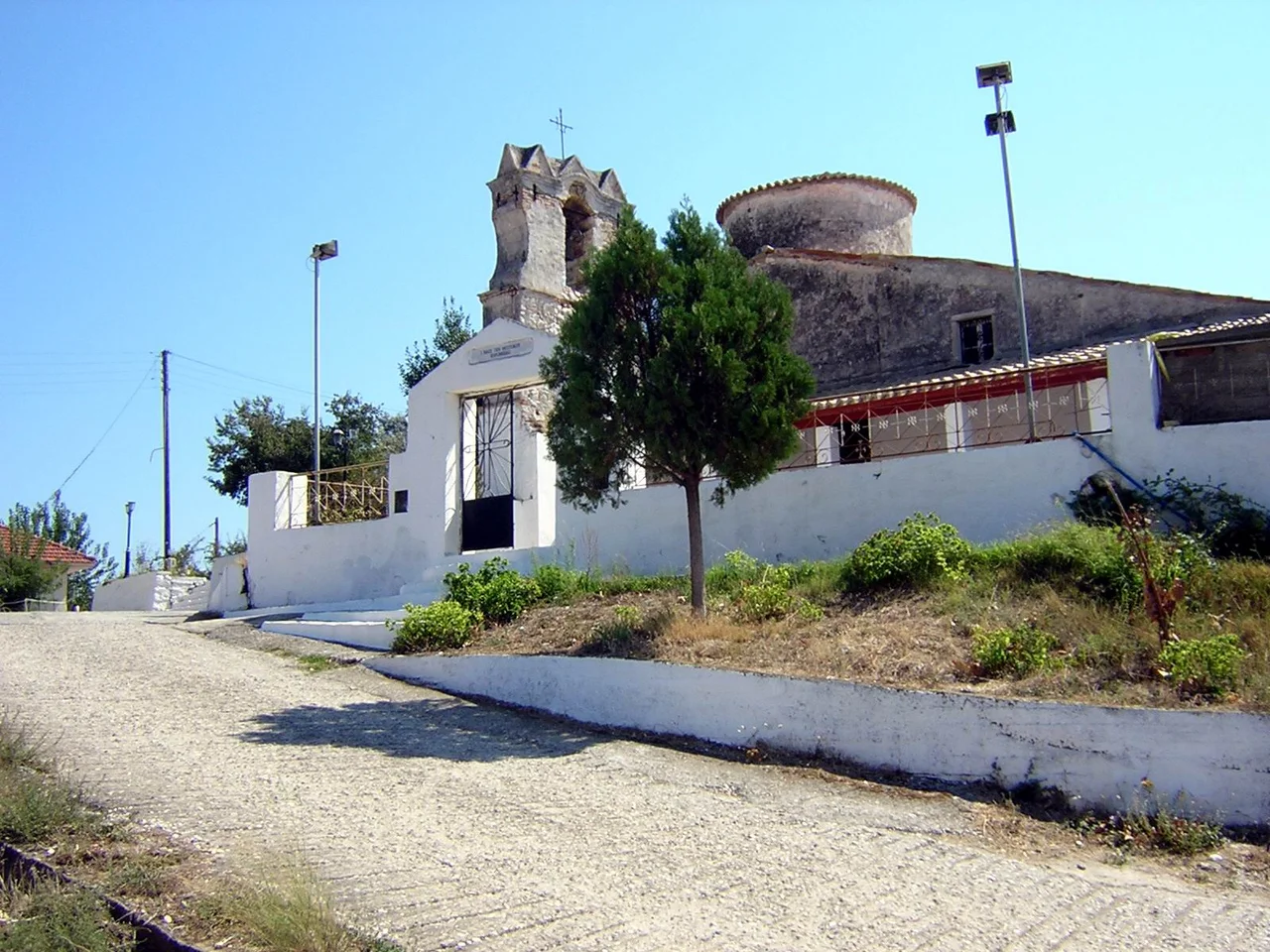

Nativity of the Theotokos Monastery
The Patriarch of Constantinople wrote a stern letter in 1530. Its subject was not theology, not church doctrine, not the great questions of the faith — it was eels. Specifically, the patriarch warned the bishop of Vonitsa to stop harassing the monks of Koronisia over their eel farms in the Ambracian Gulf. Seventy years later, Sultan Mehmed III himself sent a decree to the regional governor demanding that military authorities leave the monastery's property alone. That a small Byzantine church on a small Aegean island required the intervention of both the highest Christian authority in the Orthodox world and the ruler of the Ottoman Empire says something about the tenacity of the community that gathered here — and about how fiercely people have always contested the rich waters of this gulf.
A Church Built at the Edge of the Byzantine World
The Nativity of the Theotokos Monastery was built at the end of the tenth century, in the middle Byzantine period, on the island of Koronisia in the Ambracian Gulf. It is a small building — just 15 meters in its main dimension — but its proportions are more ambitious than that figure suggests. The main church belongs to a rare architectural type: the semi-inscribed cruciform with a dome. Three interconnected sections form the whole: the main church, a narthex covered with a continuous semi-cylindrical dome, and an outer narthex with a wooden roof. The floor is made of stone slabs; at the center, a carved marble panel preserves the decorative theme of the five loaves, a subtle reminder that bread and feeding — physical and spiritual — have always been woven together here. The frescoes in the main church and narthex are fragmentary, worn by time and moisture, but they whisper of what was once a livelier decoration.
The Iconostasis and Its Centuries
The most arresting object inside the church is the nineteenth-century wood-carved iconostasis, a screen of dense floral and animal carving that runs the full width of the nave. Every surface is filled: leaves, blossoms, creatures real and imagined, all rendered with the patience of craftsmen who understood that God is in the details. The central image of Christ dates from 1854; the flanking icons from 1884 to 1885. These are not ancient objects, but they carry an authority that comes from being made for a specific place and kept there, generation after generation. Along the north side of the church, a wooden-roofed portico provides shelter. The bell tower — a perforated wall type, 2.90 meters wide and 7.75 meters tall — was added at the end of the nineteenth century, according to its foundation inscription. Beside the church, a ruined building once housed the olive press of the monastery. Nearby stood the koulia, where the monks lived. The community was modest in scale. Its endurance was not.
Monks, Merchants, and the Ambracian Gulf
The first written record of the monastery comes from 1193, in a marginal note in the Gospel of the Monastery of Mega Spilaio, which mentions an abbot named Methodios. By then the community had already been here for two centuries. In 1436, the Italian antiquarian Cyriacus of Ancona visited the area, attended a liturgy at the church of Panagia, and was hosted by the monastery — a reminder that even remote religious communities maintained links with the wider Mediterranean world of scholarship and travel. The monastery's real economic base, though, was not scholarly hospitality. It was fish. The monks held property along the coasts of Aetolia-Acarnania and operated fish farms in the gulf, most notably eel farms whose productivity was evidently worth fighting over. Eels from the Ambracian Gulf have been prized since antiquity; the monks understood a viable business when they saw one. The disputes with the inhabitants of Vonitsa grew serious enough that the highest authorities in both the Christian and Ottoman worlds felt compelled to intervene on the monastery's behalf.
Survival Under Ottoman Rule
The Ottoman period tested the monastery's resilience in ways that went beyond property disputes. In 1670 the community was in decline, and a hieromonk named Eugene arrived to rebuild it — literally. He constructed the monastery cells and gathered the monks who had scattered. A century later, in 1860, the Ottoman government built a small protective fortress, the koulia of Koronisia, to guard the monastery's fish farms. The state was protecting its tax revenue as much as anything else, but the effect was the same: the monastery survived. It functioned as a monastery until 1918, when it became a dependency of the Monastery of Prophet Elijah at Iliovounia and was converted into a parish church. A ministerial decree in 1969 declared the temple a protected monument, and it remains one today — a listed site on the island of Koronisia, where the same gulf waters that once made the monks prosperous still glitter through the reeds.
Koronisia Today
Koronisia is a small island connected to the mainland, and the monastery sits at its heart. The setting is unhurried — this is a place where the Ambracian Gulf is ever-present, where the smell of salt and reeds mingles with the faintly smoky interior of an old church, and where the centuries feel compressed. The ruined olive press beside the church is an honest reminder that monasteries were not only houses of prayer but also working economic institutions, embedded in the landscape and dependent on it. The wood-carved iconostasis still stands. The dome still holds. The island that once required letters from sultans and patriarchs to protect its eel farms continues quietly, as islands in sheltered gulfs tend to do.
From the Air
The island of Koronisia sits within the Ambracian Gulf at approximately 39.016°N, 20.916°E. From the air, the enclosed gulf is distinctive — a nearly landlocked body of water connected to the Ionian Sea only through the narrow channel at Preveza. The monastery island is visible at low altitudes as a small settlement amid the reed-fringed shoreline. Aktion National Airport (LGPZ) is located on the Actium peninsula approximately 12 km to the southwest, across the gulf mouth. Approach from the west over the open Ionian at 1,500–3,000 feet for the best view of the gulf's geography. The narrow Preveza channel, now crossed by Greece's only undersea road tunnel, is clearly visible from altitude.
Nearby Stories
- Lake Trichonida 15 km away
- Battle of Karpenisi 17 km away
- Phaneromeni Monastery, Lefkada 19 km away
- Paxos 19 km away
- 2015 Lefkada Earthquake 28 km away
- Lake Plastiras 29 km away
- Italian Destroyer Angelo Bassini 30 km away
- SM UC-38 47 km away