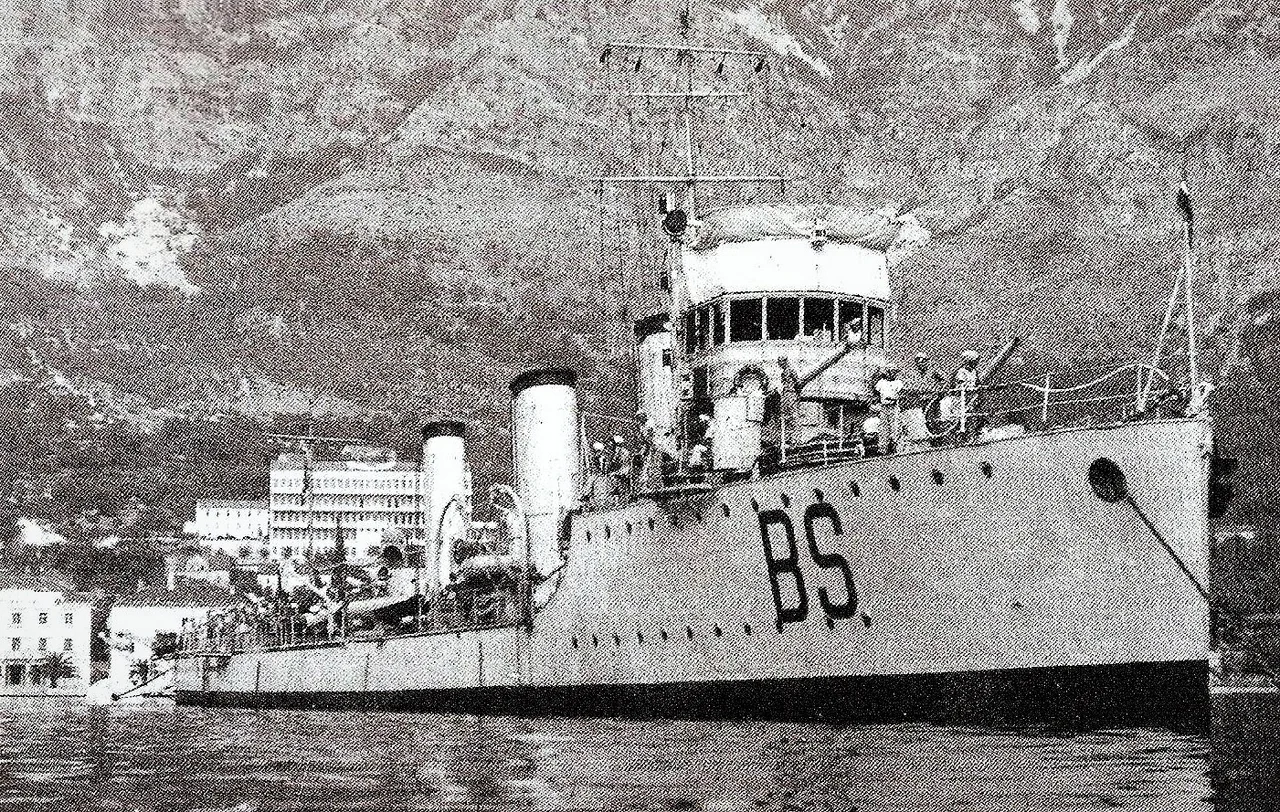

Italian Destroyer Angelo Bassini
She was built for one war and fought in two. The Angelo Bassini was laid down at a shipyard in Sestri Ponente, near Genoa, in October 1916, launched in March 1918, and commissioned just in time to join the final weeks of the First World War. By the time she was stricken from the naval register in 1946, the world had changed so completely that the kind of war she had been built for — destroyer escorts in the Adriatic, convoy work between Italian ports and Albanian harbours — belonged to an era that would not return.
Born in the Yards, Into the Last Months of a War
The Cantieri navali Odero shipyard in Sestri Ponente had been building warships for the Italian Regia Marina — the Royal Navy — through the war years, and the Angelo Bassini was one of them, a destroyer of the La Masa class. She was launched on 28 March 1918 and commissioned on 1 May 1918. The First World War ended six months later. She had participated in the Adriatic campaign but not in any major action before the armistice of November 1918. In 1922, the city of La Spezia awarded battle ensigns to the Bassini and her fellow ships in formal recognition of their service. In 1929, she was reclassified as a torpedo boat — a smaller, lighter designation that reflected both her age and the evolving structure of the Italian fleet. She was assigned to the 5th Destroyer Squadron, based at Taranto.
The Ionian Routes: Escort Work in a Second War
When Italy joined the Second World War on 10 June 1940, entering on the side of Germany, the Angelo Bassini was based at Brindisi as part of the 7th Torpedo Boat Squadron. Her assignment was convoy escort: the routine, grinding, dangerous work of shepherding merchant ships and troop transports across the southern Adriatic and Ionian Sea between Italy, Albania, and Greece. In October 1940, the Regia Marina established a specialised Albanian convoy command — the Maritrafalba — and the Bassini was assigned to it. She escorted postal vessels between Brindisi and Durrës, Albania, and cargo steamers along the coast. On 21 October 1942, she escorted a steamer and the tanker Devoli from Preveza, Greece, northward to Vlorë and then to Brindisi. These were waters she knew well by then: the northwestern Ionian, the channel between Corfu and the Greek mainland, the Albanian coast, the passages where weather and submarines and aircraft all posed their own varieties of danger.
The Company She Kept
In November 1939, command of the Bassini passed to Giovanni Barbini. He left about a year later to take command of another torpedo boat, the Nicola Fabrizi — and in that role, Barbini would receive the Gold Medal of Military Valor for his actions in the Action in the Strait of Otranto in November 1940. The Angelo Bassini was one vessel among many in a fleet that endured years of convoy duty: repetitive, exhausting, conducted in waters contested by British submarines, aircraft, and surface ships. On 6 November 1942, she left Taranto together with her sister ship the Antonio Mosto to escort the tanker Giorgio toward Patras, from which the tanker continued under other escort to Souda Bay in Crete. The two torpedo boats that had served together in these waters for years would part here; their subsequent fates would diverge.
The End in Harbour
The Angelo Bassini's final entry in the historical record is abrupt. Allied bombers attacked a Mediterranean harbour — the specific location not recorded in surviving accounts — and struck numerous ships moored inside it. The Bassini was among them. A bomb hit her, she capsized, and she sank. Her wreck was refloated in 1946 and subsequently scrapped. She was stricken from the naval register on 18 October 1946. She had served through the final months of one world war and the full length of another. The men who crewed her across those years — the officers, the engine-room ratings, the lookouts who scanned the Ionian for submarine periscopes and aircraft — are not individually named in the surviving records. They served, and the ship served with them, until the bombs found her in harbour and the Regia Marina recorded her loss in its registers.
From the Air
The Angelo Bassini's primary operational area was the Ionian Sea and southern Adriatic, particularly the convoy routes linking Brindisi (Italy) with Durrës (Albania) and the Greek coast around Preveza. The coordinates associated with this vessel — 39.07°N, 20.08°E — place her in the waters west of the Greek mainland, northwest of Lefkada, in the channel between Corfu and the coast. The nearest major airport for this area is LGKR (Corfu International Airport), on the eastern shore of Corfu island. LGPZ (Aktion National Airport near Preveza) on the mainland is also close and served the coastal ports the Bassini regularly called at. Flying at 5,000–8,000 feet along the coast north of Preveza, the convoy routes through which the Bassini operated are visible as the open water between the Ionian Islands and the Greek mainland — water that in wartime was never truly safe.
Nearby Stories
- Rogoi 10 km away
- Skorpios 17 km away
- Dodona 20 km away
- Italian torpedo boat Sagittario (1936) 31 km away
- Achilleion (Corfu) 34 km away
- Llogara National Park 94 km away
- Apollonia (Illyria) 180 km away
- The Arrival of the Black Death: When Ships Brought the Apocalypse 367 km away