
Skorpios
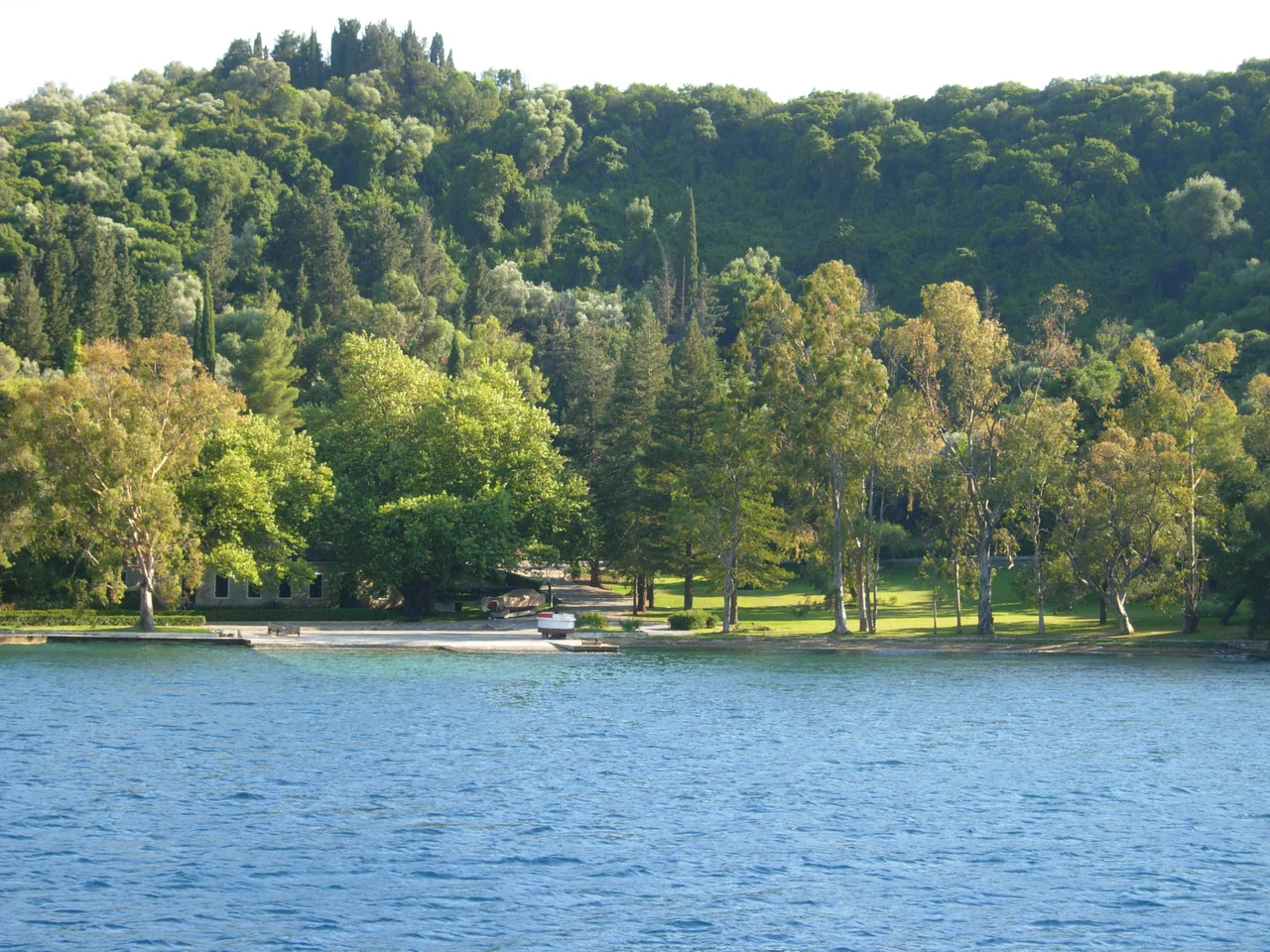
The island was nearly barren when Aristotle Onassis bought it in 1963. He imported more than 200 varieties of trees to cover its 83 hectares with dense forest. He brought sand from Salamis Island to create East Beach. He docked his legendary yacht, the Christina O, in a purpose-built harbor on the north side. By the time the world's press arrived by boat on October 20, 1968, to watch Onassis marry Jacqueline Kennedy in a small chapel on the island, Skorpios had become something that money and determination can occasionally achieve: a place that feels inevitable.
An Island Made, Not Found
Skorpios sits just east of Lefkada in the Ionian Sea, irregularly shaped, running roughly north to south. At 83.2 hectares — about 205 acres — it is small enough to walk across in an hour, large enough to sustain the illusion of a private world. When Onassis acquired it, the island was largely bare rock and scrub. The transformation he imposed was systematic and expensive: hundreds of species of trees planted across the hillsides, a harbor built to accommodate one of the world's great private yachts, three residences constructed at various points around the shore. The sand beach that appears natural was engineered. Nothing about Skorpios happened by accident. It was designed as a stage, and for a decade it served as one of the most closely watched private stages on earth.
October 20, 1968
The wedding of Aristotle Onassis and Jacqueline Kennedy shocked much of the world. She was the widow of an assassinated American president, five years out of her Washington life, still in her thirties. He was a 62-year-old Greek shipping billionaire, previously divorced, known for his wealth and his appetite for spectacle. The ceremony took place in the small Chapel of Panayitsa — the Little Virgin — on Skorpios, conducted in Greek Orthodox rites. Photographers tried to reach the island by boat and were turned away. The guests were few. After the service, the wedding party moved to the Christina O anchored in the northern harbor. The world's reaction, particularly in the United States, ranged from bewilderment to outrage. Onassis, by most accounts, was satisfied.
The Family That Stayed
Onassis died in 1975. He is buried on Skorpios, beneath the cypresses near the chapel. His son Alexander, who died in 1973 following a plane crash, is buried beside him. His daughter Christina, who inherited the island upon her father's death and died in 1988, is buried there too. Three graves on a small forested island in the Ionian Sea. Christina's daughter Athina Onassis became the sole surviving heir, and Skorpios passed to her. In 2013, Athina sold a long-term lease on the island and its smaller neighbor Sparti to Ekaterina Rybolovleva, daughter of Russian oligarch Dmitry Rybolovlev, for $153 million. Development of a luxury resort began in 2018, though Skorpios is a Natura 2000 protected area and no more than 5% of its land may be developed.
What Onassis Left Behind
The trees are the most enduring thing. Over 200 species now cover hillsides that were bare scrub sixty years ago. The harbor is still there. The three residences stand. The island holds its shape as a private world, even as its ownership has shifted and its future is being redesigned. Onassis wrote in his will that Skorpios should remain in the family as long as the family could afford its upkeep — and that if they could not, it should be donated to the state. That contingency, whatever its legal complications, captures something true about the island: it was always more than real estate. It was a project, a statement, an act of creation by a man who believed that places, like people, could be remade from scratch.
From the Air
Skorpios lies at 38.692°N, 20.743°E, in the Ionian Sea just east of Lefkada and south of the Ambracian Gulf. From the air it appears as a dense green oval surrounded by deep blue water, distinct from the larger Meganisi island to the southeast. Nearest airport: LGPZ (Aktion National Airport, Preveza), approximately 30 km to the north-northeast. Approach from the northwest along the Lefkada channel for the clearest view of the island's forested profile and small harbor. Recommended altitude 3,000–5,000 ft for a close look at the island's shoreline and tree cover. Visibility in the Ionian is generally excellent in summer months.
Nearby Stories
- Kommeno 10 km away
- Battle of Karpenisi 12 km away
- Calydon 16 km away
- Prousou Monastery 18 km away
- Battle of the Echinades (1427) 19 km away
- Italian Destroyer Angelo Bassini 27 km away
- SM UC-38 27 km away
- Italian Destroyer Antonio Mosto 43 km away