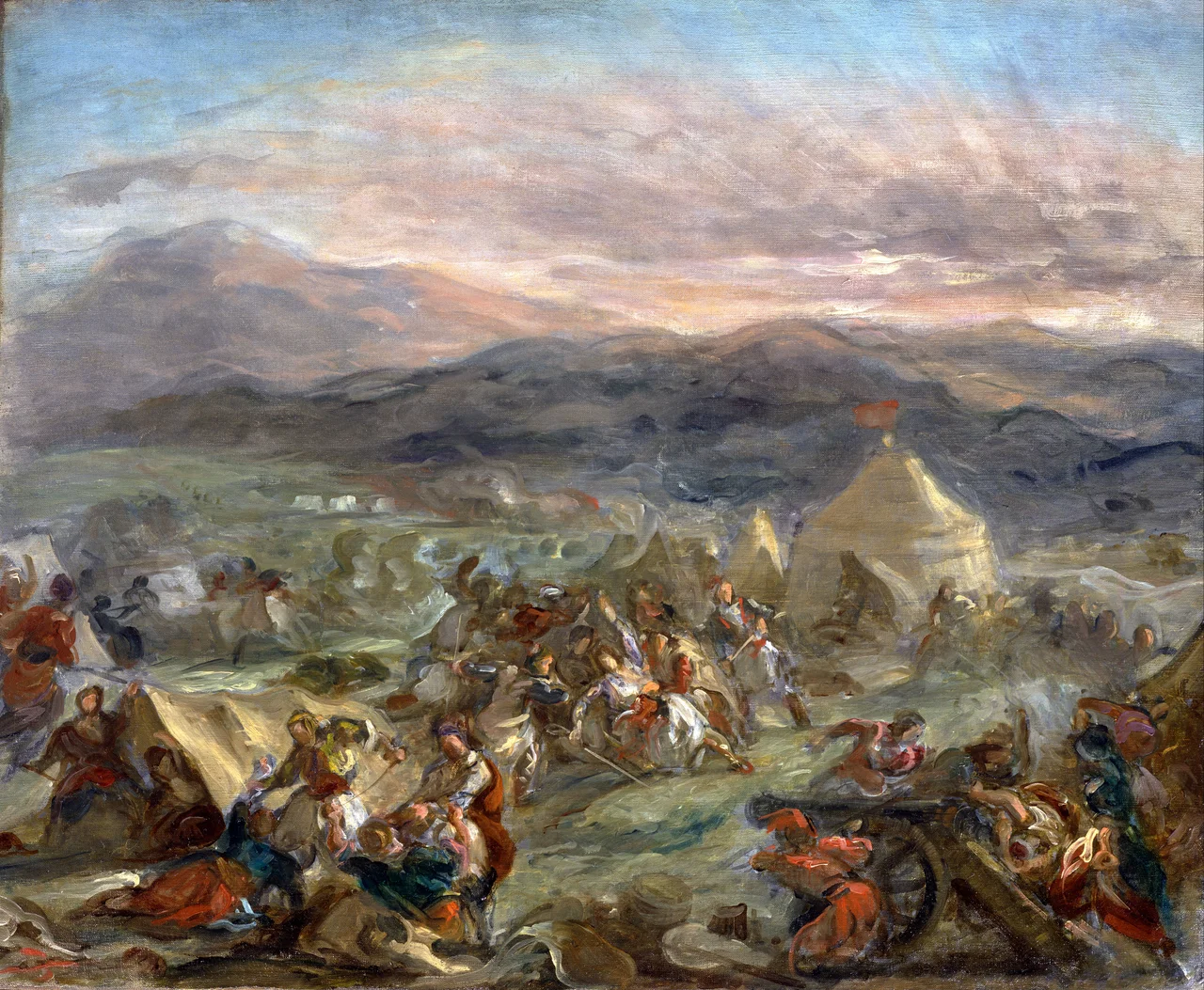

Battle of Karpenisi
By the summer of 1823, the Greek War of Independence was two years old and in a precarious position. The Greeks had held off Ottoman attempts to crush the revolt, but the empire was reorganizing. Sultan Mahmud II devised a plan for 1823 that would send a large army through the western side of central Greece rather than the more expected eastern route, striking toward the Peloponnese through Patras. Command of this expedition went to Mustafa Bushati, the Albanian pasha of Shkodër, who assembled a force at Ohrid — sources put its size at somewhere between 8,000 and 13,000 Albanian mercenaries — and marched south through July. The Ottoman-Albanian column moved through the Pindus Mountains, arrived at Trikala, and encamped at Karpenisi. It was there, in the highlands of Evrytania, that the Souliote captain Markos Botsaris decided to meet them.
Who Botsaris Was
Markos Botsaris came from the Souliot clans, a group of Albanian-speaking Orthodox Christians from the mountains of Epirus who had built a fierce reputation as fighters in the decades before the revolution. The Souliotes had resisted Ali Pasha of Ioannina, the powerful Albanian warlord who dominated northwestern Greece in the early 19th century, before being forced out of their mountain stronghold and dispersed. Many ended up in the Ionian Islands, in the service of various powers, or eventually in the ranks of the Greek revolutionary forces when the uprising began in 1821. Botsaris was among the most capable of the Souliote commanders who threw their lot in with the revolution. By 1823 he was based in Missolonghi, the coastal town on the Gulf of Corinth that had become one of the revolution's most important western strongholds. When news of Mustafa Bushati's advance reached Missolonghi, Botsaris moved to respond.
The March to Karpenisi
Botsaris left Missolonghi with 350 men. As he moved northeast through the mountains toward Karpenisi, he gathered additional fighters — Greek revolutionaries who recognized both the threat and the opportunity that Mustafa's encamped army represented. By the time he reached the area, his force had grown to approximately 1,200 soldiers. The disparity in numbers between his force and the Ottoman-Albanian army was not something he could simply overcome in open battle; a conventional engagement would have been suicidal. What he could do was control the terms. Two days before the assault, Botsaris sent a small team of scouts — described in the sources as spies — into the Ottoman camp to map the positions of the enemy forces without being detected. They succeeded. The intelligence they brought back allowed Botsaris to plan a night raid that would strike quickly, cause maximum disruption, and withdraw before the larger army could bring its numbers to bear.
The Night of August 21
The assault came on the night of August 21, 1823. Greek forces moved into the Ottoman-Albanian camp under cover of darkness. The raid inflicted significant casualties on a force that substantially outnumbered the attackers. The operation demonstrated exactly the kind of tactical creativity that allowed the smaller Greek revolutionary forces to remain viable against an empire with vastly greater resources. Markos Botsaris was killed during the assault. The sources are consistent on this fact, though the details of exactly how and when he fell in the engagement are not fully documented. He was approximately 34 years old. His death was a serious loss — not because the raid failed, but because it succeeded, and he did not survive to see it through. The Greek forces withdrew after the attack. The objective had been disruption, not annihilation, and the night assault achieved that.
What Came After
The military consequences of the battle played out over the following months. The Ottoman-Albanian army, despite the disruption at Karpenisi, continued its campaign and moved against Missolonghi, laying siege to the town. That siege, the second of Missolonghi, ultimately failed. Mustafa Bushati retreated to Albania in December 1823, his campaign having achieved none of its strategic objectives. The Greek revolutionary cause survived. Missolonghi would face a third, catastrophic siege in 1825 to 1826, ending in the famous Exodus when its defenders attempted a mass breakout through the encircling Ottoman forces. But in the summer and autumn of 1823, the line held. The night raid at Karpenisi was part of why.
Memory and the Town Square
Markos Botsaris has not been forgotten in the place where he died. Karpenisi has a square named for him, and the town has maintained a civic connection to Missolonghi — the place he came from — across two centuries. In August 2022, the municipalities of Karpenisi and Missolonghi formally twinned in a ceremony at the Botsaris square, marking the anniversary of the battle and the bond that history made between these two places. The battle itself is recorded by name in every account of the Greek War of Independence as an example of audacious small-unit tactics in the service of a larger cause. Botsaris is remembered as one of the revolution's significant figures — not because his death was heroic in any simple sense, but because the decision he made, to lead his men into a much larger enemy camp in the dark, reflected the calculated bravery of someone who understood that the war would not be won by waiting.
From the Air
The Battle of Karpenisi took place near the modern town of Karpenisi, at approximately 39.056°N, 21.572°E, in the highland terrain of Evrytania, central Greece. The landscape is mountainous and forested, with ridgelines and valleys that explain the strategic value of this location during the Greek War of Independence — controlling the passes here meant controlling movement through central mainland Greece. The town of Karpenisi is visible from altitude as the most prominent settlement in the region. Recommended viewing altitude is 6,000–10,000 feet for orientation to the battle area relative to surrounding terrain. The nearest major airport is LGBL (Nea Anchialos National Airport, near Volos), approximately 90 km to the northeast. Athens Eleftherios Venizelos (LGAV) is roughly 200 km to the southeast. Mountain weather is variable; the Pindus ridgelines in the area reach over 2,000 meters.
Nearby Stories
- Battle of Peta 8.3 km away
- Acarnania 11 km away
- Prousou Monastery 11 km away
- Mount Oeta 12 km away
- The 1954 Sofades Earthquake 13 km away
- Dodona 33 km away
- Meteora: The Monasteries Built on Impossible Pillars 39 km away
- Tempi Train Crash 61 km away