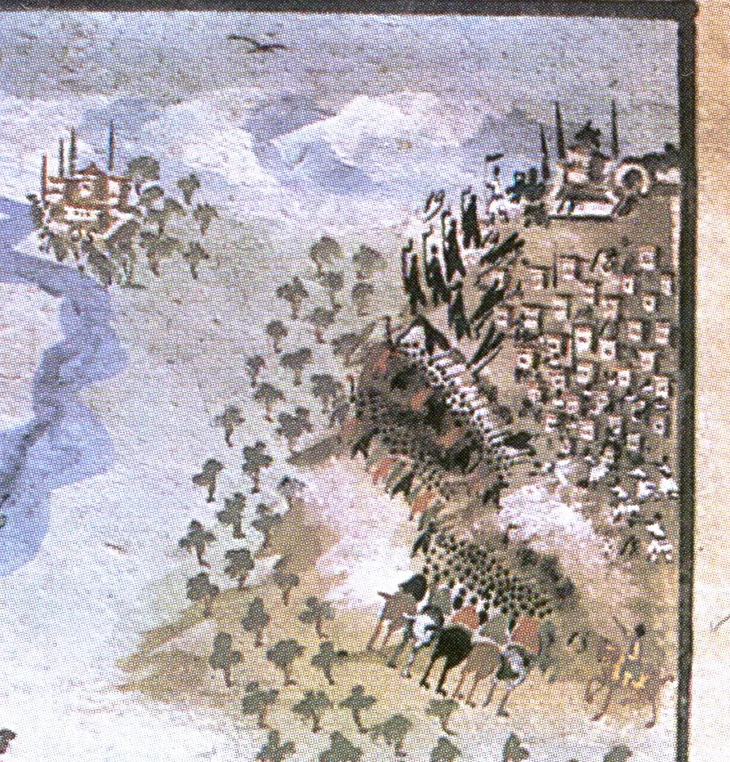

Battle of Peta
They had come from across Europe to fight for a cause they believed in. Germans, Poles, Swiss, French, and Italians — veterans of the Napoleonic wars alongside idealistic young men who had never seen battle — gathered in the hills of Epirus that summer to stand with Greek irregulars against one of the largest empires on earth. On 4 July 1822 (by the Julian calendar then in use, corresponding to 16 July in the Gregorian), near the village of Peta, that coalition was broken. The defeat was not only military. It was the end of a particular kind of hope.
The Volunteers Who Came
When the Greek War of Independence broke out in 1821, it electrified liberal opinion across Europe. The word 'Philhellene' — lover of Greece — had been in use for centuries, but now it acquired an urgent, personal meaning: people who left their homes and crossed seas to fight. Prince Alexander Mavrokordatos, who had landed at Missolonghi with Greek regular troops, was joined by a battalion of these foreign volunteers under Karl von Normann-Ehrenfels, a former officer of the Württemberg army who served as his chief of staff. The men were a combustible mix. Several Italian, German, and French veterans of the Napoleonic campaigns trained Greeks to fight in the European manner — disciplined volley fire, synchronized maneuver. But the volunteers themselves were 'Europeans of a generally difficult temperament,' wrote one French participant, Jean-François-Maxime Raybaud, 'different in their habits, education, language and weapons.' In a duel before the battle, a German shot a Frenchman dead. They were united by conviction, divided by almost everything else.
The Ground and the Numbers
Mavrokordatos's combined force numbered roughly 2,000 men — both regular soldiers and irregular fighters (the klephts and armatoloi, Greek mountain fighters who had long resisted Ottoman rule). Arrayed against them was an Ottoman-Albanian army under Omer Vrioni, an Albanian general who had assumed command in Epirus, numbering somewhere between 10,000 and 14,000. The position the Greeks chose was a pair of ridges near Peta. On the higher eastern ridge, Greek forces under captains Gogos Bakolas, Varnakiotis, and Vlachopoulos held the right and center, with the formidable Souliot commander Markos Botsaris on the left. On the lower western ridge stood the Philhellene battalion, alongside Greek regulars and volunteers from the British-protected Ionian Islands. Before dawn, the Ottoman force advanced in a crescent formation, 600 cavalry charging the western ridge. For two hours, wave after wave was repulsed. On the eastern ridge, Albanian irregulars pressed Bakolas's position and were initially thrown back. The line held — until it did not.
Betrayal
What broke the defense was not Ottoman strength alone. During the battle, Gogos Bakolas — a veteran klepht and captain of the armatoloi, men who had spent decades navigating the grey zone between Ottoman authority and Greek resistance — withdrew his force from the eastern ridge. Contemporary accounts suggest this was not impulsive: Bakolas had reportedly reached an agreement with the Ottoman commanders before the battle, and when the Albanians scaled the ridge, they made no effort to attack his retreating men. Whether one calls it paid defection or a calculated self-preservation that functioned as betrayal, its effect was catastrophic. With the right flank gone, the Philhellene battalion on the lower western ridge was suddenly exposed on three sides. The men who had crossed Europe to fight here — the veterans who had drilled Greeks in European tactics, the idealists who had come because they believed the cause was worth dying for — were cut apart. Botsaris fought hard and managed to withdraw to Missolonghi with Mavrokordatos, but the Philhellene unit was largely destroyed. The men who fell on that hillside near Peta had names, families, and letters home they would never finish writing.
What the Defeat Changed
The loss at Peta reverberated well beyond Epirus. It damaged Mavrokordatos's prestige severely — he had championed a regular, Western-style Greek army, and that model had just collapsed at its first major test. Political gravity within the Greek revolutionary movement shifted toward the irregular captains of the Peloponnese, especially Theodoros Kolokotronis, whose guerrilla approach was proving more adaptive to the terrain and the enemy. In Europe, the news of Peta added a darker note to Philhellenic enthusiasm. The cause survived — Lord Byron would arrive at Missolonghi less than two years later — but the battle reminded everyone what idealism costs when it meets a larger, more experienced force on an open hillside. The village of Peta today is a quiet place in the hills above the Arachthos valley, about ten kilometers northwest of Arta. The ground keeps no obvious monument to what happened there.
A Hillside in Epirus
The site of the battle lies in rough, sun-bleached countryside between the Arachthos River and the foothills of the Pindus mountains. The ridges are still there. Olive groves cover ground where men once held a line. The landscape makes the tactical logic legible even now: two ridges, a crescent of approaching cavalry, an army outgunned by perhaps six to one. What is harder to see is the human scale of it — the months of preparation, the arguments in three languages, the specific courage it takes to stand on a hillside knowing what is coming. The nearest airport is LGPZ, Aktion National Airport, roughly 45 kilometers to the southwest across the Gulf of Ambracia. Flying over Epirus, the ridges and valleys of this corner of northwestern Greece reveal themselves as terrain that has shaped every army that has moved through it.
From the Air
The battle site lies approximately 10 km northwest of Arta, near the village of Peta, at approximately 39.17°N, 21.03°E, in the hills above the Arachthos valley. Approach from the southwest over the Gulf of Ambracia, following the Arachthos northward. The nearest major airport is LGPZ (Aktion National Airport), about 45 km to the southwest. Best viewed at 3,000–5,000 feet; the two-ridge formation that defined the battle's geography is visible in clear conditions. The Pindus foothills rise to the northeast.
Nearby Stories
- Battle of Karpenisi 13 km away
- Castle of Santa Maura 17 km away
- Prousou Monastery 21 km away
- Paxos 22 km away
- Dodona 22 km away
- Meteora: The Monasteries Built on Impossible Pillars 42 km away
- Achilleion (Corfu) 47 km away
- SM UC-38 67 km away