
Paxos
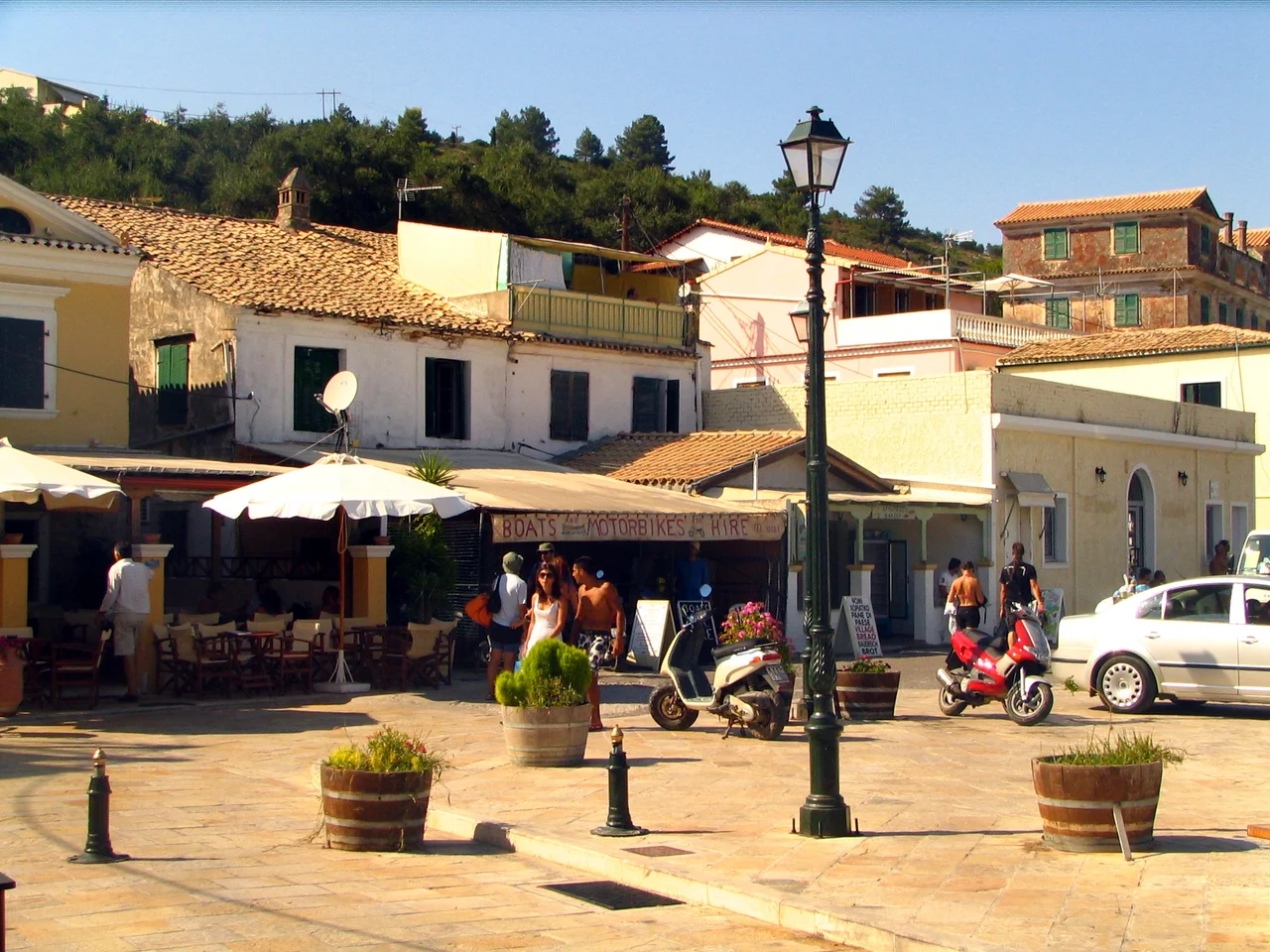
In Greek mythology, Poseidon struck Corfu with his trident so that he and Amphitrite could have somewhere quiet. The splinter that broke off became Paxos. That image — the god of the sea choosing this place for peace — captures the spirit of the island better than any travel brochure. Paxos is only 10 kilometres long and 3 wide, the smallest of the seven main Ionian Islands, but its landscape feels improbably lush: an unbroken canopy of ancient olive groves rolling from the harbour at Lakka in the north to the capital Gaios in the south, where small islets guard the entrance to the lagoon-like port.
The Groves and the Cliffs
Much of Paxos is dressed in olive trees, some of them centuries old, their silver-green foliage catching light that is distinct in the Ionian — brighter, somehow, than the Aegean. The eastern coast is gentle: three small harbour villages, Gaios, Lakka, and Loggos, each with brightly-painted houses crowded around a waterfront. Turn to the west and the island becomes suddenly dramatic. Steep chalk-white cliffs drop to the sea, heavily eroded at the base into a network of sea-caves — the so-called blue caves — where the water glows turquoise in certain lights. The highest point, Agios Isavros, reaches only 231 metres, so the views are wide rather than vertiginous. The island is approximately trapezoidal in shape, and some scholars connect that geometry to the Phoenician word pax, from which they believe the name derived.
Layers of Conquest
Few islands this small carry so much history. Phoenicians are said to have been the first settlers. In 229 BC, during the First Illyrian War, a battle was fought in these waters between Greek and Illyrian fleets, recorded by the historian Polybius. Rome came next, then pirates in the Byzantine era, then Crusaders, then the Venetians, who controlled Paxos from the late 14th century onward. During the Napoleonic Wars, the island was briefly in French hands before the Royal Navy frigate HMS Apollo arrived on 13 February 1814, accompanied by 160 troops from the 2nd Greek Light Infantry and the Royal Corsican Rangers. The British then established the United States of the Ionian Islands in 1815. In 1864, when King George I was crowned in Greece, Paxos and the rest of the Ionian Islands were formally ceded to the Greek state — the end of a long queue of masters.
Visitors and Inhabitants
Tourism replaced olive oil, soap, and fishing as the main industry from the mid-1960s onward, and Paxos became particularly well-known among British visitors. Among its semi-permanent British residents were actor Peter Bull, who wrote a memoir called It Isn't All Greek to Me, and actress Susannah York. The Agnelli family, of Fiat fame, built a palatial holiday home on the tiny islet of Kaltonisi, just off the southeastern tip, complete with a tower modelled on a medieval original. The Paxos International Music Festival, founded by John Gough and now organised by the Guildhall School of Music and Drama in London, has for years brought young classical musicians to perform in the former school at Loggos. Winter on the island is quieter — ferries still run year-round from the mainland port of Igoumenitsa, a 90-minute crossing, but hydrofoils from Corfu are weather-dependent and infrequent, and occasional storms can isolate the island entirely for short periods.
The Quiet That Poseidon Sought
Today Paxos has around 2,500 permanent residents. There are no airports: the island is reachable only by sea, which keeps it at a pace the myth prescribed. Gaios, the capital, is a small town of Venetian-influenced architecture, with a square by the waterfront and a museum of local history. The surrounding waters — clear, sheltered by the islets of Agios Nikolaos and Panagia that frame the harbour — are popular for sailing and swimming. Antipaxos, just 5 kilometres to the southeast, has sandy beaches and produces a small amount of wine. The hinterland of Paxos remains largely as it has been for a very long time: old stone paths through old trees, the occasional hamlet, birdsong, and the light shifting through the canopy. Whatever Poseidon was looking for, he chose carefully.
From the Air
Paxos lies at approximately 39.20°N, 20.17°E in the Ionian Sea, about 15 km south of Corfu's southern tip. From the air, the island's compact, roughly trapezoidal shape is clear, with the densely olive-covered interior and the white cliffs of the western coast visible in good weather. The small harbour of Gaios, protected by the islets of Agios Nikolaos and Panagia, is the most distinctive feature from altitude. The nearest major airport is Corfu International (LGKR), approximately 35 km to the north. Viewing altitude of 3,000–5,000 feet gives a good perspective on the island's relationship to Antipaxos and to the Epirus mainland to the east. Best visibility in summer; afternoon sea haze can reduce contrast in winter.
Nearby Stories
- Castle of Saint Andrew 7.1 km away
- Rogoi 17 km away
- Old Fortress, Corfu 26 km away
- Battle of Nicopolis (1798) 45 km away
- Llogara National Park 75 km away
- Meteora: The Monasteries Built on Impossible Pillars 78 km away
- Apollonia (Illyria) 161 km away
- The Arrival of the Black Death: When Ships Brought the Apocalypse 371 km away