
Cichyrus
Odysseus came here for poison. According to the Odyssey, before he sailed for Troy he stopped at Ephyra — the city that would later be called Cichyrus — to obtain a toxin for his arrows. Theseus and his companion Perithoos came here to attempt the abduction of Persephone herself, wife of Hades, king of the underworld. Neoptolemos, son of Achilles, landed here on his return from Troy. The place drew heroes the way certain cities draw trouble, because the city that occupied this hill above the confluence of the Acheron and the Kokytos was not just a capital. It was the gateway to the dead.
A City With Two Names
The city had been called Ephyra since the mythological era — named, according to some traditions, after an early founder. But the Greek geographer Strabo, writing in the late first century BC and early first century AD, noted that the name had changed. The city was now called Kichyros, or Cichyrus, reverting to an older name that had survived in neighboring settlements even while the main city went by Ephyra. Strabo placed the renaming about two hundred years before his own time, which corresponds roughly to the period after Philip II of Macedon absorbed the Elean colonies in the region in 343–342 BC and reorganized the political landscape of Thesprotia. The name Ephyra occurs in two passages of the Odyssey and is mentioned in the Iliad; scholars argued for centuries about which of several ancient Ephyras Homer meant. The city in Thesprotia, above the Acheron, had the strongest claim.
The Oracle of the Dead
The Necromanteion — the Oracle of the Dead — stood on the hill of Agios Ioannis near the village of Mesopotamo, about 150 meters north of where the Kokytos meets the Acheron. Ancient visitors came to the oracle not for prophecy in the usual sense, but for something more specific: the chance to consult the souls of the dead. Ancient literary sources describe elaborate preparation rituals — fasting, isolation, consumption of particular foods — before the supplicant descended into the inner chambers to receive communication from those who had already crossed to the other side. The geography supported the ritual. The Acheron ran cold and dark through marshland that, in antiquity, spread widely across the flat coastal plain. An Acherusian Lake once lay near the river's mouth, another body of water between the pilgrim and solid ground. To arrive at the oracle was to feel, physically, that you were approaching the edge of the world.
Bronze Age to Hellenistic Period
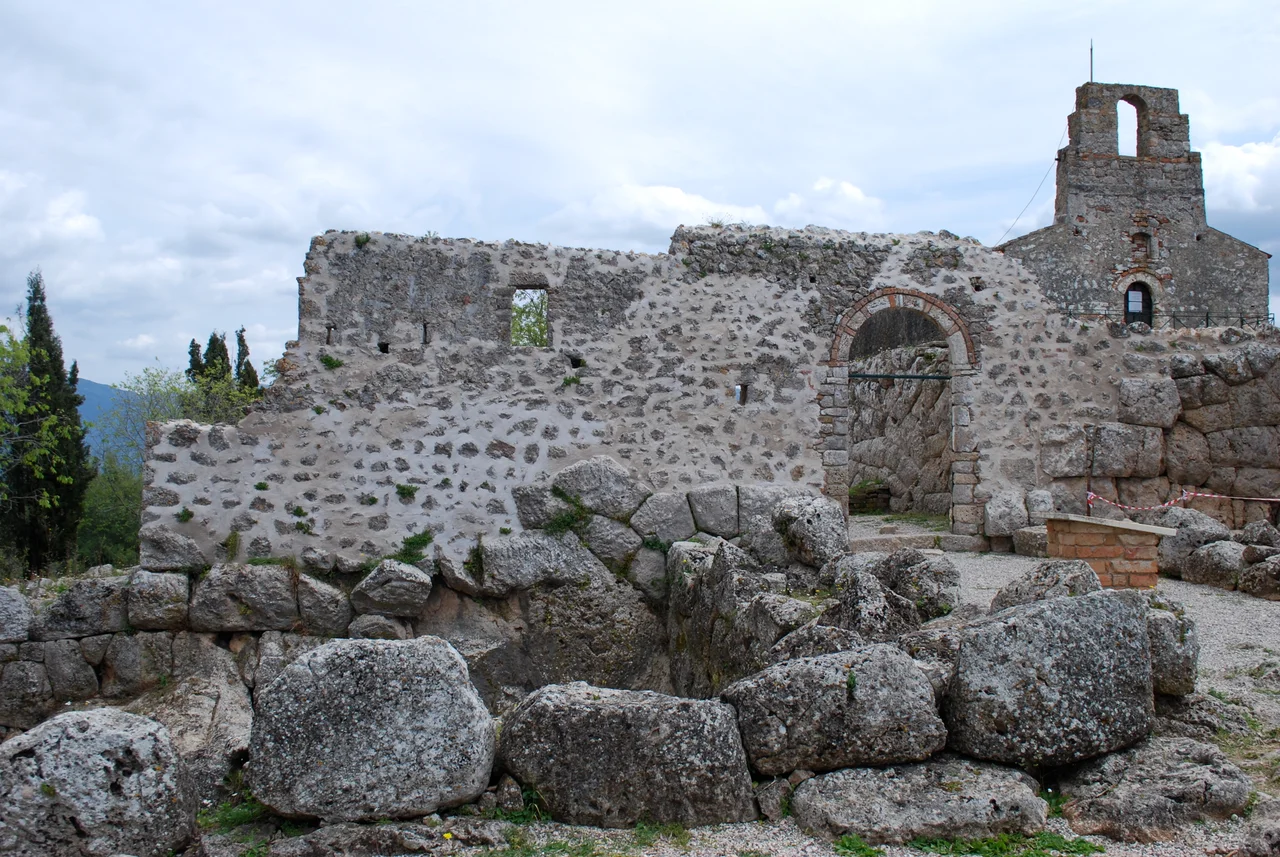
Excavations conducted between 1958 and 1987 by a team from the University of Ioannina, and expanded between 2006 and 2008, found that the site was first settled during the Bronze Age. The remains of the acropolis include the only Mycenaean fortification confirmed within the region of Epirus: two of the three ancient wall circuits were built in Cyclopean stone during the fourteenth or early thirteenth century BC. Sherds of local Bronze Age pottery and Mycenaean ceramics were found within the acropolis, along with evidence of worship of the chthonic goddess Persephone. Three large funerary burial mounds from the twelfth century BC lie on the western plateau. The third wall circuit is later — Hellenistic in date — showing that the site remained in use across more than a millennium. Pottery from the Hellenistic period confirms that the city remained inhabited for centuries after its political role had faded.
The Myths the City Collected
Some places accumulate mythology the way coastlines accumulate driftwood. Cichyrus-Ephyra acquired an extraordinary quantity. Heracles came and subjugated the city, fathering a son by the princess Astyoche — that son, Tlepolemus, became king of Rhodes. Thyestes arrived looking for his brother Atreus, found instead his own unrecognized daughter Pelopia, and their union produced Aegisthus, who would later murder Agamemnon and set in motion the catastrophe of the Oresteia. The city attracted gods, semi-gods, heroes, and the consequences of their choices. The Necromanteion anchored all of it: if Hades and Persephone had their shrine and oracle here, then any hero with business in the underworld had reason to stop. What remains is a low limestone hill above flat fields, a ruined wall circuit, and the quiet of a place that has been waiting a long time.
From the Air
The site of ancient Cichyrus-Ephyra lies at approximately 39.2353°N, 20.5344°E, near the village of Mesopotamo in the Preveza regional unit of northwestern Greece. The Necromanteion ruins are visible from low altitude as stone walls on a rounded hill above the flat coastal plain. The Acheron river and its confluence with the Kokytos are identifiable as water features in the agricultural landscape to the west and south. The nearest airport is LGPZ (Aktion National Airport, Preveza), approximately 45 kilometers to the south. Flying northwest from Preveza at 3,000–5,000 feet, the flat plain of the lower Acheron comes into view before the coastal hills; the hill of the Necromanteion is the most prominent elevated feature in the immediate landscape.
Nearby Stories
- Battle of Olpae 9.5 km away
- Achilleion (Corfu) 12 km away
- Battle of Nicopolis (1798) 14 km away
- Corfu 38 km away
- Vikos Gorge 45 km away
- Battle of Karpenisi 49 km away
- Meteora: The Monasteries Built on Impossible Pillars 50 km away
- Hellenic Trench 136 km away