
Phigalia
When plague swept through Phigalia during the Peloponnesian War, the city made a decision that would outlast everything else about it. The Phigalians hired Ictinus — the same architect who designed the Parthenon in Athens — to build a temple to Apollo on the summit of Mount Cotylium, in thanks for their deliverance. That temple, at Bassae, still stands. The city that built it has been largely swallowed by time, its walls tracing the ridgelines above the Neda gorge, its agora and gymnasium gone to scrub, its curious cults forgotten. But the temple survives on the mountain, two and a half hours' walk from the ruins of the city that raised it.
A City on a Precipice
Phigalia occupied a position that geography had already chosen: an elevated rocky site above the right bank of the Neda river, near the frontier of Messenia, enclosed by some of the highest mountains in the Peloponnese. Pausanias, who visited around 170 CE, described it as situated on a lofty and precipitous hill, with the greater part of the walls built directly upon the rocks. The river Lymax ran along the eastern side; a ravine bounded the west; the Neda itself curved below. This topography was not incidental. The walls — nearly two miles in circuit when complete — were set into the natural rock faces rather than built across open ground. At the summit of the acropolis stood a citadel 80 yards long with a round tower at its far end, 18 feet in interior diameter. On the acropolis slope sat the gymnasium and a temple of Dionysus Acratophorus. Below, on the ground where a modern village now stands, was the agora, adorned with a statue of the pancratiast Arrachion, a local athlete who won at the Olympic Games but died in the winning moment. The city and the athlete shared the same quality: strength extracted at the highest possible cost.
The Temple That Survived Everything
On Mount Cotylium — 30 stadia to the northeast of the city, according to Pausanias, though the walk today takes more than two hours — the Phigalians built their votive temple in the late fifth century BC. They named Apollo with the epithet Epicurius, the Helper, in gratitude for his role in ending the plague. Ictinus, fresh from the Parthenon, designed the building, and it shows: the Temple of Apollo at Bassae is a sophisticated architectural achievement, notable for its unusual features, including an interior Corinthian column — among the earliest known uses of the Corinthian order — and a side doorway in the south wall that faces a small outdoor seating area. Pausanias ranked it second only to the temple of Athena Alea at Tegea for beauty of stone and accuracy of masonry; he specifically noted that its roof was of stone, an unusual distinction. The nineteenth-century Scottish scholar William Mure, visiting the site, wrote that there was certainly no remnant of the architectural splendour of Greece more calculated to fascinate the imagination. The temple still stands near the summit of the mountain, in the midst of a wilderness of rocks studded with old knotty oaks, now sheltered under a protective tent erected by conservation authorities.
Strange Gods in the Mountains
Phigalia preserved cults that the wider Greek world had largely moved past. Near the city, in a grove of oaks on the mountain called Elaeum to the south of the Neda, sat a cavern sacred to Black Demeter — depicted with a horse's head, a form so old and strange that her image eventually required renewal by the sculptor Onatas. Another temple, accessible only once a year on a specific opening day, was dedicated to Eurynome — a fishtailed goddess whom Pausanias glossed as a surname of Artemis, though the iconography suggests something older and more specific. These were not pan-Hellenic deities brought in from fashionable theological centers; they were local powers, rooted in the rock and water of the Neda gorge, whose worship persisted long after the city itself had faded. Coins of Phigalia — autonomous issues of the kind that assert civic identity — are unknown. No records survive of the city's internal political life. What we have instead are the ruins, the temple on the mountain, and the strange persistence of animal-headed goddesses in limestone caverns.
History as a Series of Sieges
Phigalia's political history, sparse as the record is, runs on a single theme: the city was repeatedly taken, lost, recovered. In 659 BC the Lacedaemonians captured it. It was liberated with help from the Oresthasians — who, following an oracle, perished in the fighting and were honored afterward with a monument in the city's agora. In 375 BC, internal factional conflict allowed Spartan sympathizers to seize a nearby fortress and conduct raids against their own city. In 221 BC, during the struggle between the Achaean and Aetolian leagues, Dorimachus held the city until Philip V of Macedon approached and he withdrew. Under Roman rule, Strabo noted that Phigalia, like most Arcadian cities, had fallen into utter decay. The walls remained. Some of the temples stood long enough for Pausanias to describe them, though by his visit he found nothing above ground of the temples of Artemis or Dionysus, and the statuary and artwork he enumerated from an earlier age had vanished. What the mountains protected, the centuries still eventually claimed.
What Remains Above the Neda
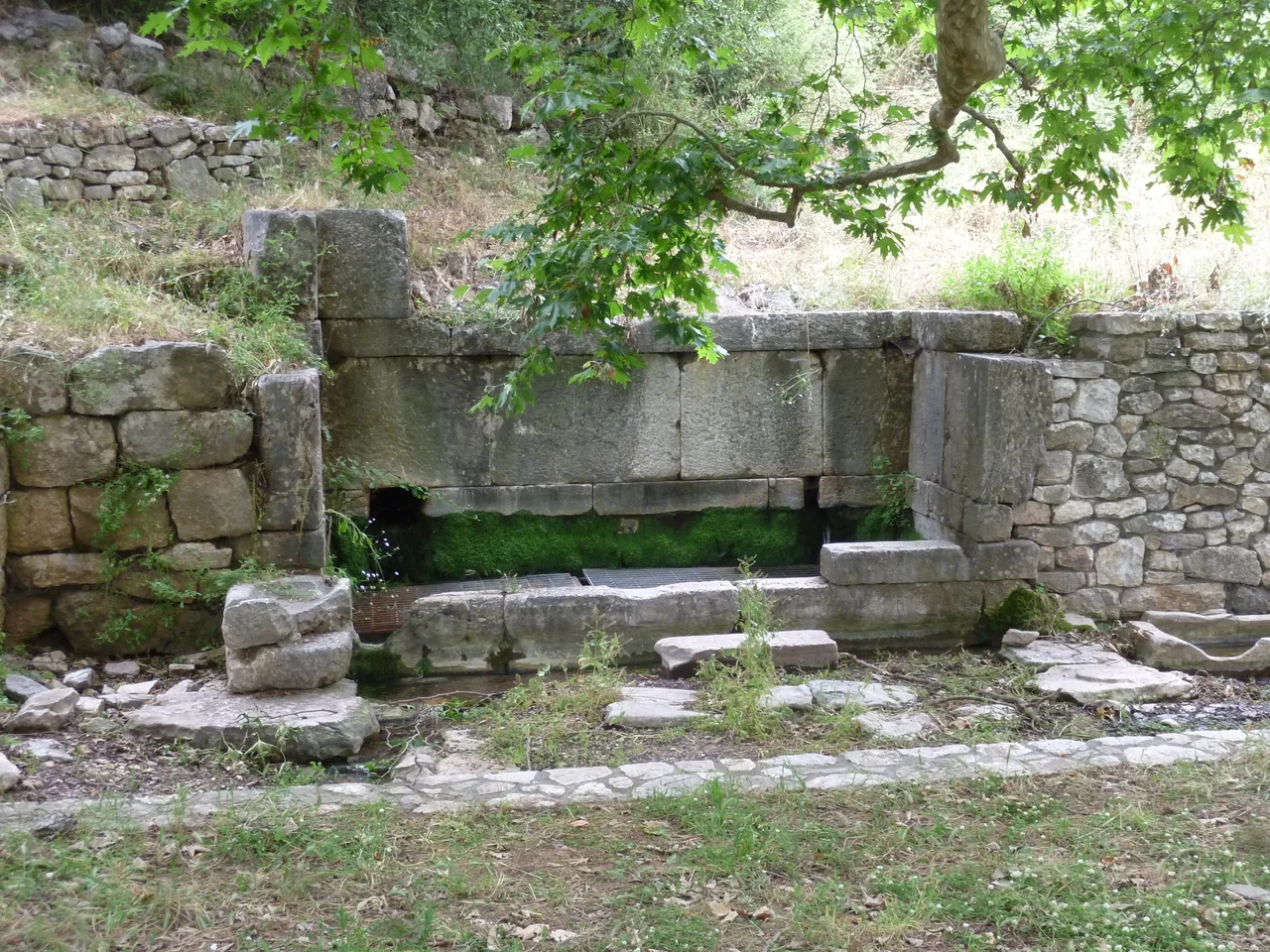
The walls of Phigalia are the most substantial surviving feature of the ancient city — polygonal masonry and isodomic ashlar fitted into the natural rock, climbing and descending the ridges above the river. The citadel at the acropolis summit survives in fragmentary form. The warm baths Pausanias mentioned, twelve stadia from the city, were traceable in the nineteenth century at the village of Tragoi, though the waters had ceased to flow long before. The modern village of Figaleia sits below the ancient site; it was known as Pavlitsa until the early twentieth century, when it took the name of the city above it. The Neda gorge below is one of the deepest and most dramatic in the Peloponnese, its waters dropping through limestone narrows toward the Ionian coast. And above all of it, on the mountain, the temple stands — roofed now in steel and fabric rather than stone, tented against the weather that preserved it imperfectly for two and a half millennia.
From the Air
Phigalia lies at approximately 37.396°N, 21.839°E, on a ridgeline above the Neda river gorge in the mountainous western Peloponnese. The Temple of Apollo at Bassae — the better-known landmark — is situated about 8 km to the northeast on Mount Cotylium (approximately 37.433°N, 21.900°E) and is visible from the air as a white protective tent structure near the summit. The Neda gorge runs north-south below the site and is visible as a deep incised valley. The nearest major airport is LGKL (Kalamata International), approximately 65 km to the south-southwest. Recommended viewing altitude is 6,000–10,000 feet to appreciate the dramatic topography of the gorge and surrounding mountain ridges. Clear days offer views to the Ionian coast.
Nearby Stories
- International Flight Training Center, Kalamata 5.3 km away
- Karyes 6.8 km away
- Barony of Akova 11 km away
- Agios Andreas, Katakolo 13 km away
- Diocese of Amyclae 14 km away
- Larisa (Argos) 19 km away
- 2023 Messenia Migrant Boat Disaster 26 km away
- Panagia Skafidia Monastery 40 km away