
Larisa (Argos)
Coin-minters, conquerors, and nuns have all occupied the high hill above Argos, and the ruins up top hold the evidence of every last one of them. Larisa — the ancient and medieval acropolis that the geographer Strabo said was named for a group of Pelasgians, the pre-Greek inhabitants of the region — juts from the western edge of Argos on a steep rocky cone visible for miles across the Argive plain. The Byzantines built a castle there in the 12th century. Crusaders seized it in 1212. Venetians purchased it in 1388. Ottomans conquered it in 1463. Then, in 1821, a Greek revolutionary climbed it and took it back. The site was fortified and continuously occupied for nineteen centuries. That record of endurance is not a boast — it is geography made visible in stone.
Born Before the City Below It
Larisa predates the city of Argos itself. In Mycenaean times, the main settlement and temples stood on the Aspis hill to the north, with its cemetery in the saddle between the two hills — the col of Deiras, which later became the location of the Deiras Gate. The eastern slopes of Larisa and the flat ground below were settled in the Late Bronze Age by the Dorians, and it was their settlement and temple that grew into Classical Argos. The hilltop served the city well: in roughly 418 BC, Athenian masons began constructing long walls connecting Argos to the port of Nauplion (modern Nafplio), analogous to the famous Long Walls outside Athens. When the threat of a Spartan invasion materialized, the Argives committed everyone available — unskilled men, women, enslaved people — to speed the construction. Even so, the walls were only half-finished when King Agis II of Sparta attacked and his forces tore them down. The hill survived. The walls did not.
A Castle Bought and Sold
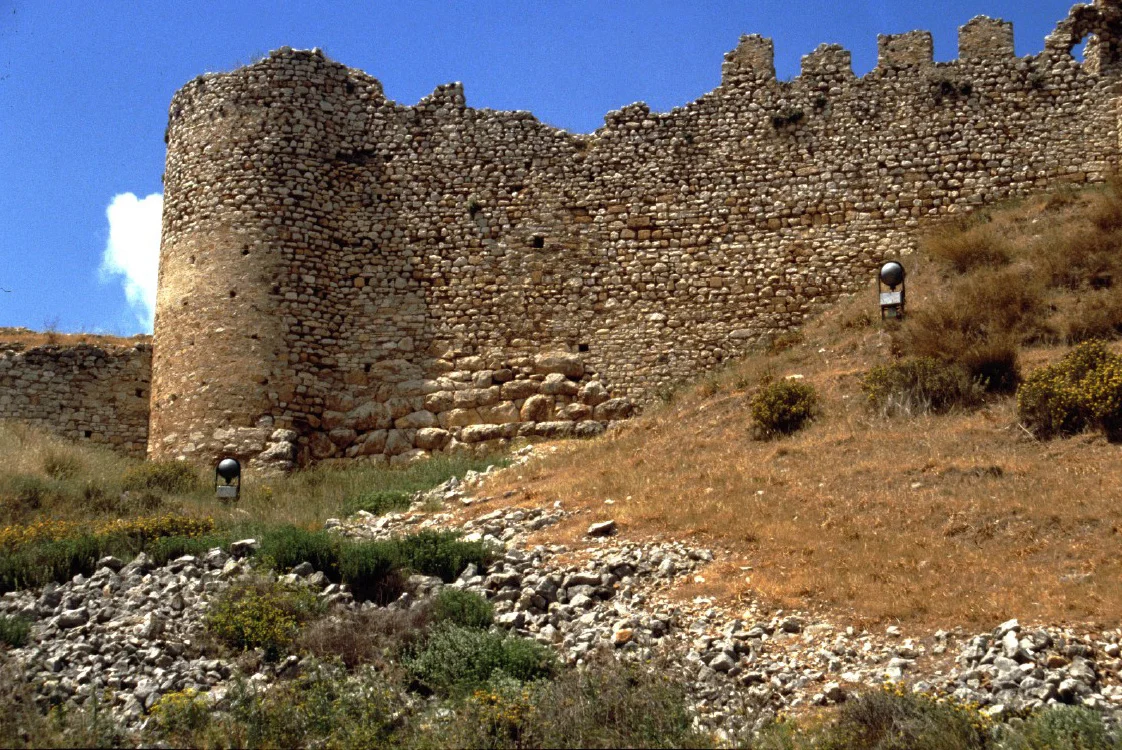
The Byzantine period gave Larisa its most durable architectural legacy: the castle that still stands in ruin at the summit. The Byzantines founded it in the 12th century, but control of it rarely stayed in one set of hands for long. In 1212, the Crusader Geoffrey of Villehardouin captured it. He then surrendered it to the Duke of Athens, Otto de la Roche, in exchange for military support, and it became one of the chief fortresses of the Lordship of Argos and Nauplia. In the 14th century, the brothers Walter and Francis Foucherolles, serving as bailiffs, held the castle against the depredations of the Catalan Company — mercenary fighters who had already overrun the Duchy of Athens and were threatening the Argolid. The castle held. Argos and Nauplia were sold by their last heiress, Maria of Enghien, to the Republic of Venice in 1388. But before Venice could take possession, the Byzantine Despot of the Morea, Theodore I Palaiologos, seized both towns with Ottoman military assistance. It took another six years of political maneuvering — including a summons by Sultan Bayezid I, complaints from rival vassals, and a deal brokered under duress — before the Venetians finally occupied Argos on 11 June 1394. A year later, Ottoman forces sacked the town.
Venetians, Ottomans, and a Brief Mint
After the sacking, Argos and Larisa remained under Venetian control until 1463, when the outbreak of the First Ottoman–Venetian War brought the Ottomans back — this time permanently, for nearly four centuries. Then came 1821. Demetrios Ypsilantis, one of the key figures of the Greek War of Independence, captured the castle at the summit in the uprising's opening years. The fortress played little military role after that, but one detail from the independence period stands out: for a brief time, the monastery partway down the hill was used as a national mint to strike coins for the provisional Greek government. That function was soon transferred to Aegina, and the monastery reverted to its religious purpose — a nunnery that had been founded on the slopes in the 18th century. A male monastery, now functioning as a church, followed in the 19th. The two religious communities, nestled between the castle ruins above and the city below, are among the quietest things on the hill.
What the Hill Looks Like Now
From the plain, Larisa reads as a long, dark ridge above Argos, its summit punctuated by the surviving walls and towers of the Byzantine-Venetian castle. The approach up the western edge of Argos passes through the town and then climbs steeply. Midway up the slope sits the Panagia Katakekrymeni-Portokalousa monastery. Near the castle entrance, across from its gate, the Monastery of Agia Marina — Saint Marina, or Saint Margaret — occupies a quieter terrace. At the summit, the castle ruins frame views over the Argive plain to the Saronic Gulf in one direction and toward the mountains of the Peloponnese in the other. The hill is not tall by alpine standards, but its position — western edge of the city, sudden steep rock — gives it a commanding quality that explains why every power that entered the Argolid considered it worth taking.
From the Air
Larisa (Argos acropolis) is located at 37.638°N, 22.715°E, on the western edge of Argos in the Argive plain of the northeastern Peloponnese, Greece. Approach from the east, following the plain south from Corinth. At 2,000–3,000 feet, the rocky hill of Larisa is identifiable as a steep promontory rising abruptly from the flat agricultural plain, with the modern city of Argos spreading to its east. The acropolis summit sits at approximately 289 meters (948 feet) above sea level. The nearest major airport is Athens International (LGAV, Eleftherios Venizelos), approximately 120 km to the northeast. Light aircraft can use Nafplio or approach via VFR through the Argolid corridor. Visibility is generally excellent across the plain in clear weather, with the mountains of Arcadia visible to the west.
Nearby Stories
- Villa of Herodes Atticus 3 km away
- Sicyon 3.5 km away
- Battle of Megalopolis 4.5 km away
- Hermione: The City at the Edge of the World 7.5 km away
- Agia Lavra 7.7 km away
- Megara 13 km away
- Agistri 13 km away
- Teuthis 15 km away