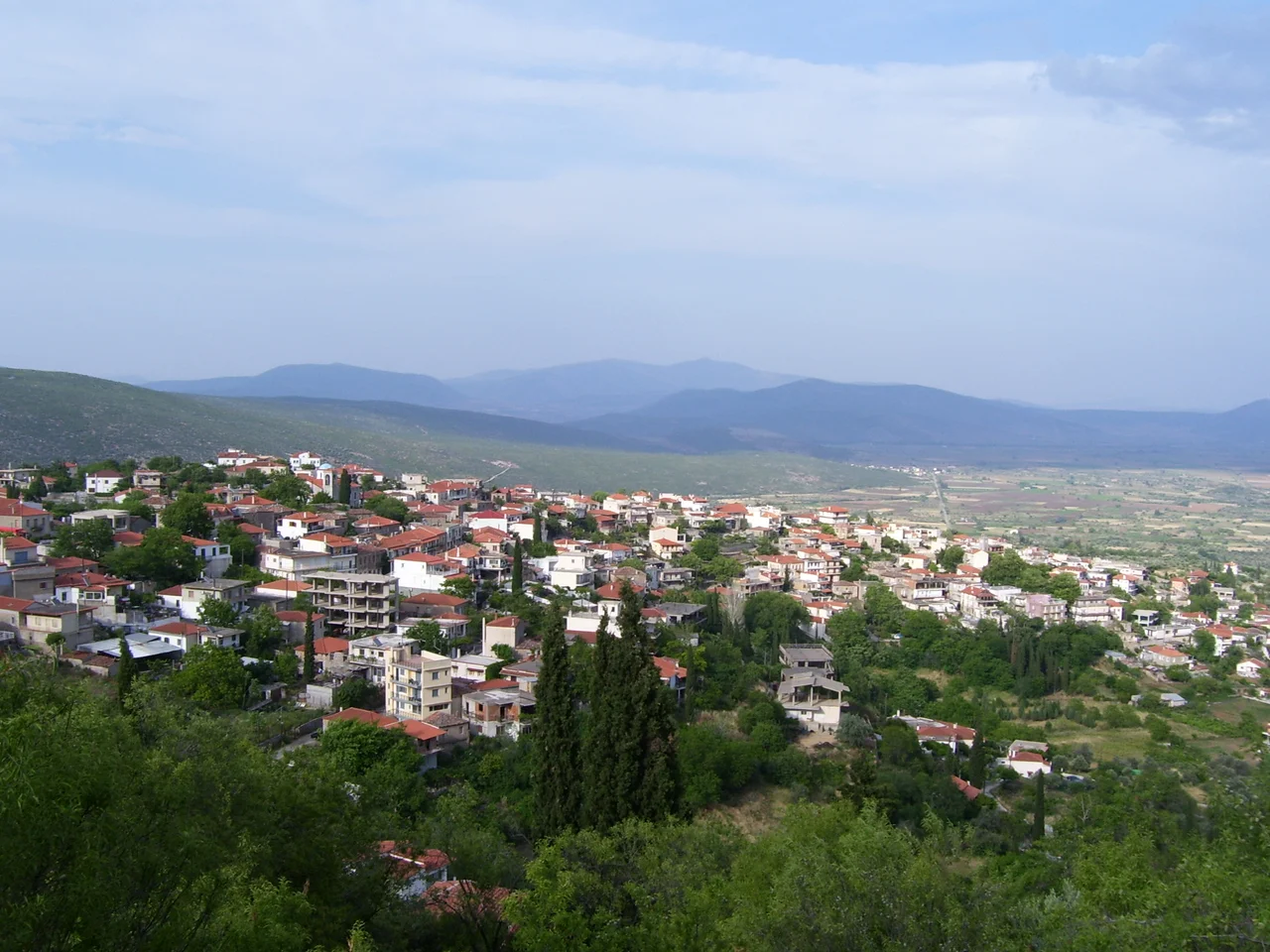

Davleia
The village sits where the valley narrows, below the crag where the ancient city once held off armies. Davleia is a small place — fewer than fifteen hundred people at the last count — but it carries a long history in its name. Δαύλεια is ancient Daulis worn smooth by time, the way a stone step wears under foot traffic. Below the acropolis walls that still trace the ridge above the rooftops, ordinary Greek life continues: a football club founded in 1936, a railway station eight kilometers to the north, a nunnery in the hills called the Holy Monastery of Jerusalem.
The Long Thread of the Name
Few modern Greek villages can point to such unbroken nominal continuity. The name Daulis appears in Homer's Iliad; it appears on Ottoman census records in 1466 (written as Tavla) when the settlement had 150 families, and again in 1506 with 220 families. Frankish documents from the last years of Latin rule in central Greece use the form Daulia. Through Byzantine administration, Ottoman occupation, and Greek independence, the name persisted in recognizable form. When travelers and antiquarians began visiting in the 19th century, they found the modern village directly below the ancient site, a continuity of settlement that is relatively rare and archaeologically useful: the medieval church of Agios Theodoros stands inside the ancient acropolis enclosure, a physical layering of sacred use across two millennia.
Revolution and Reprisal
Davleia was not a passive bystander in modern Greek history. The revolutionary fighter Panagiotis Antonopoulos was born here, and the village's inhabitants took an active part in the uprising of 1821. The area became a recurring battlefield between Greek revolutionaries and Ottoman troops. In 1856, gunmen from Davleia participated in the operation that ended the career of the outlaw Davelis — a robber whose name would later attach, with a certain dark romance, to a cave near Athens. The upheavals of the twentieth century left their mark as well. On 5 May 1943, a detachment of Italian Occupation forces set the settlement on fire. On January 29, 1918, during the political crisis of the National Schism, a clash between gendarmerie and anti-Venizelist forces left five Cretan gendarmes and an officer dead; six people, two soldiers and four civilians, were subsequently executed by military court order.
Where Myth Intersects the Road
Mythology gave Davleia two landmark associations, both preserved in local tradition. The acropolis above the village is the site of ancient Daulis, mythological home of Tereus — the king whose crimes drove Procne and Philomela to the transformations that became the nightingale and the swallow. Those stories belong to the ancient city; Davleia inherited the geography. The village's second mythological neighbor is more unexpected: near Davleia, tradition locates the crossroads where Oedipus, traveling to Delphi to learn his fate, killed an old man who refused to yield the road. He did not know the man was his father, Laius, king of Thebes. The road from Daulis to Delphi passed through here, and the detail that Oedipus took one fork and not the other — passed through this valley rather than another — is embedded in the myth's geography. The modern village thus stands in a landscape dense with Greek tragedy, carrying those stories lightly, as villages do.
A Functioning Place
Beyond mythology and history, Davleia is simply a place where people live, organized around its valley in the foothills of Parnassus. Since the Kallikratis administrative reform of 2011, it forms a municipal unit of Livadeia, a larger town to the east. The municipal unit covers nearly 95 square kilometers, including the eastern flanks of Mount Parnassos. National Road 3 passes near the village, connecting it to Livadia, Lamia, and central Greece. The railway station to the north serves Athens and Leianokladi. The fortifications of the ancient acropolis are preserved in good condition on the hillside above, and the nunnery north of town draws its own quiet visitors. Population figures tell the story of rural Greece in the late twentieth century: 2,264 in 1981, 1,240 by 2011. The village endures, as it has through far more dramatic losses.
From the Air
Davleia lies at approximately 38.515°N, 22.733°E in the narrow valley below the ancient Daulis acropolis ridge, on the eastern flanks of Mount Parnassos at around 300 meters elevation. From the air, the settlement is visible in the valley with the limestone ridge of the ancient acropolis rising clearly above it to the west-northwest. The Platania stream (ancient Cephissus tributary) threads through the valley. The nearest major airport is Athens International (LGAV), approximately 140 km to the southeast. National Road 3 is visible as the main artery connecting the valley north toward Lamia and south toward Livadeia.
Nearby Stories
- Martino, Phthiotis 2 km away
- Aigio 9.7 km away
- Helladic Chronology 9.9 km away
- Agia Anna, Euboea 17 km away
- Battle of Alamana 19 km away
- Panagia Varnakova Monastery 20 km away
- 1981 Gulf of Corinth Earthquakes 25 km away
- Karpenisi 31 km away