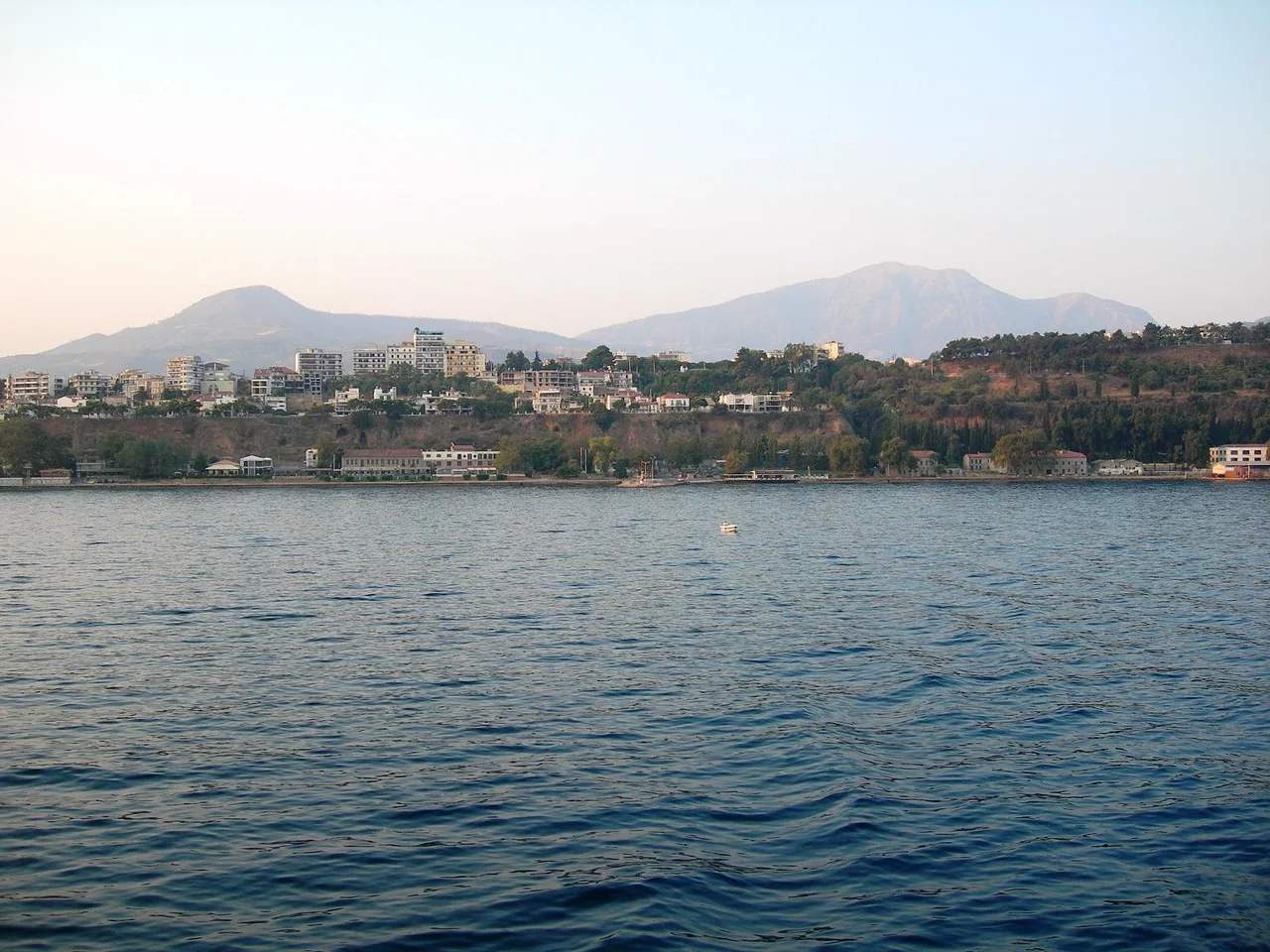

Aigio
Somewhere offshore from Aigio, beneath the blue water of the Gulf of Corinth, lies the ruins of Helike — a city swallowed by an earthquake and buried by a tsunami in 373 BC. Some scholars link it to Plato's myth of Atlantis. Archaeologists found it in 2000 and are still excavating. The story of Aigio, the port town that inherited Helike's territory after the disaster, spans three thousand years of Greeks living on this same stretch of coast — as colonizers, as athletes, as revolutionaries, as raisin exporters, as earthquake survivors. The Gulf has taken things from this place and given things back.
The Achaean Assembly Place
Aigion — the ancient predecessor of modern Aigio — was founded in Homeric times and became one of twelve cities in the first Achaean League, the confederacy of Peloponnesian city-states that formed around 800 BC. When the Achaeans reformed their league in the third century BC and expelled the Macedonian garrison, they chose Aigion as their assembly place. The famous temple of Zeus Homarios stood here, and it was to this temple that delegates came to govern what was, for a time, the most significant political federation in the Greek world. The city produced Olympic champions: Xenophon, Ladas (stadion race), Athenodorus, Straton — names recorded in the ancient lists of victors. The Romans ended all of that in 146 BC. They dismantled the city walls and Aegium faded from its former prominence.
Vostitsa — the Byzantine and Frankish Interlude
After centuries of Roman and then Byzantine rule, the city acquired a new name. By the ninth or tenth century it was being called Vostitsa — a name of debated origin, possibly Slavic, possibly meaning something like "fruit-bearing place." Crusaders captured it in the early thirteenth century and made it the seat of a barony within the Frankish Principality of Achaea. Ottoman forces took it in 1459, holding it with two brief Venetian interruptions until the Greek Revolution began. The city was one of the first to be liberated: Greek rebels captured it on 26 March 1821, just one day after the flag was raised at Agia Lavra monastery in the mountains above. The town formally reclaimed its ancient name, Aigio, after independence. In July 1822, fighters under Andreas Londos, Zaimis and Petimezas intercepted 4,000 Ottoman soldiers at nearby Akrata, driving them back to the sea.
Raisins, Bananas and the Port
For much of the nineteenth and twentieth centuries, Aigio's identity was agricultural and commercial. The area became one of the primary export hubs for Corinthian raisins — the small, intensely sweet dried grape called Zante currant in English, named for the island but grown extensively here. A 1903 geographic survey of Achaea estimated the region producing 7.5 to 10 million kilograms of raisins and 600,000 kilograms of olive oil annually. The port handled the trade, alongside Patras and Piraeus. Today the dynamic has shifted: Aigio's port now serves as a fruit import hub for Chiquita Brands International, primarily for bananas. A 256-meter pier completed in 2013 expanded the port's capacity. The raisins are still grown in the region, but the port's cargoes reflect how deeply global supply chains have rearranged what flows through old Achaean harbors.
The 1995 Earthquake
On 15 June 1995, a serious earthquake struck Aigio, destroying buildings and damaging roads through the downtown and southwestern sections of the city. People died. Small memorials went up across the city afterward — with candles that are kept burning day and night — and they remain today. The earthquake did not erase the city; it added another layer to a place already dense with memory. Fires have complicated the landscape in the mountainous countryside nearby, severely in the 2007 Greek forest fires and in subsequent years as climate change has extended the fire season. The city rebuilds, as it has always rebuilt, on the same ground above the same gulf.
What Remains
Walking through central Aigio today, you find layers compressed into a small space: neoclassical houses around Ypsila Alonia Square, its neogothic tower now housing a cafeteria; the Faneromeni cathedral, designed in 1914 by the Saxon-Greek architect Ernst Ziller; the Archaeological Museum of Aigion, also Ziller's work, built in 1890 in what was once the municipal market; and the shrine of Panagia Tripiti, built into a cliff thirty meters above the sea in a grove of cypresses and pines. The choreographer Hermes Pan — who worked with Fred Astaire on his great film musicals — was the American-born son of an emigrant from Aigio; he kept ties with family here. Since 2020, a new standard-gauge railway connects the city to Athens. The ancient assembly place of the Achaean League is a port town on a train line, still adding to itself.
From the Air
Aigio sits at approximately 38.25°N, 22.08°E on the southern shore of the Gulf of Corinth, at low elevation on a coastal terrace. The port is clearly visible from altitude, as is the urban grid extending inland toward the foothills of Panachaiko mountain. The Gulf of Corinth stretches east and west as a prominent geographic feature. Nearest major airport: LGRX (Araxos/Patras), approximately 40 km to the west at 38.15°N, 21.42°E. The EO31 road climbing south from Aigio toward Kalavryta, and the rack railway ascending through the Vouraikos gorge, are both visible in clear conditions as they trace lines into the highlands.
Nearby Stories
- Corycian Cave 2.8 km away
- Battle of Picotin 11 km away
- Battle of Lepanto 13 km away
- Astras 14 km away
- Aetolia 14 km away
- Phlius 19 km away
- Antikyra 20 km away
- Thermos (Aetolia) 27 km away