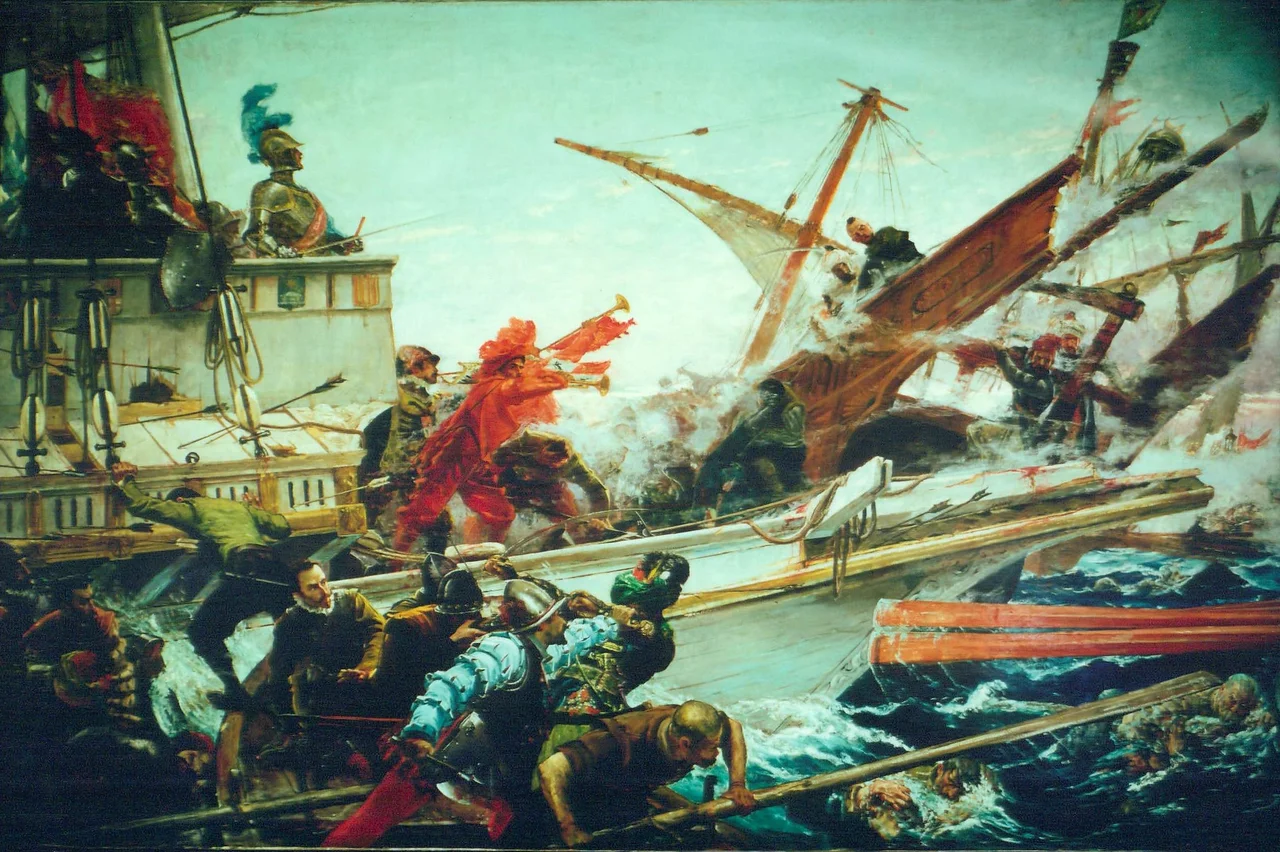

Battle of Lepanto
Before the fleets met on 7 October 1571, John of Austria — twenty-four years old, illegitimate son of the Holy Roman Emperor, appointed commander of the Holy League's combined navy — sailed through his fleet in a small swift vessel, calling out to his men. He had already ordered the galley slaves unchained from their oars so that they could fight. On the Ottoman flagship, the Sultana, Ali Pasha commanded a fleet that had not lost a major naval battle since the fifteenth century. Between them, in the Gulf of Patras off the Echinades islands near Naupactus, lay the water where perhaps 40,000 people would die before the day was over.
Two Empires at the Oar
Galleys were powered by people. This is the essential fact about the Battle of Lepanto that statistics alone cannot convey. The Holy League's fleet carried 40,000 sailors and oarsmen, in addition to some 30,000 fighting troops. Many of those oarsmen were free men — particularly in the Venetian squadrons, where citizen oarsmen could also bear arms. But across much of the fleet, the benches were occupied by men who had no choice: convicts, prisoners of war, and enslaved men, most of them Christians who had been captured in earlier Ottoman raids and conquests. The Ottoman fleet rowed on similar terms. The enslaved oarsmen on both sides — Christian on Ottoman galleys, Muslim on Christian ones — were not combatants by any recognised measure. They were tools, chained to the oar in the action of battle, exposed to cannon shot and fire, unable to flee. Before the battle began, John of Austria ordered the Christian galley slaves released from their chains; they would fight or swim as free men. The enslaved men on Ottoman galleys remained chained until the fighting ended.
The Scale of the Battle
More than 450 warships met in the Gulf of Patras — the largest naval engagement in Western history since classical antiquity. The Holy League deployed 206 galleys and six galleasses: large, heavily armed Venetian vessels that sat between the opposing lines and opened fire before the fleets made contact. Venice contributed 109 galleys; Spain and its territories 49; Genoa 27; the Papal States seven; the Knights of Malta and the Duchy of Savoy three each. The Ottoman fleet numbered approximately 210 galleys and around 60 smaller vessels. The Christians had a decisive advantage in artillery: roughly 1,815 guns against perhaps 750, and the Ottomans had insufficient ammunition for what they did have. Neither fleet, the sources note, had any particular strategic objective in the Gulf of Patras that day. Both chose to engage. The Ottoman commander Selim II had ordered his admiral Ali Pasha to fight. John of Austria fought because the expedition's credibility depended on it. History was made by a meeting that neither side could easily have avoided.
Four Hours in the Gulf
Fighting began in the morning and lasted most of the day, unfolding in the old way: galleys drove into each other, and men fought hand to hand on the decks and across the gangways. At the battle's centre, Ali Pasha's flagship drove into John of Austria's galley, the Real, so hard that it reached the fourth rowing bench. Spanish infantry and Ottoman janissaries fought across the locked hulls. The Real was nearly taken; Marcantonio Colonna came alongside in his papal flagship and mounted a counter-attack. The Turks were driven off. Ali Pasha's galley was boarded and swept — the entire crew killed, including Ali Pasha himself. The Holy League's banner was raised on the captured ship. On the Christian right, Gianandrea Doria's squadron drifted south, opening a dangerous gap; the Ottoman admiral Uluç Ali swung around through the opening and attacked the Knights of Malta's squadron. Only the arrival of the reserve squadron under Álvaro de Bazán prevented Uluç Ali from breaking the Christian centre. He retreated, the only Ottoman commander to escape with his force intact. By late afternoon, after roughly four hours of battle, it was over.
The Human Cost
The numbers are estimates, but the range of all sources is brutal. On the Ottoman side, approximately 30,000 people died and around 10,000 were taken prisoner; those prisoners entered enslavement. The Holy League lost approximately 7,500 dead. Somewhere between 10,000 and 15,000 Christian men who had been enslaved as galley rowers on Ottoman ships were freed — men who had been captured in years of raids and wars, chained to benches, their lives subordinated to the needs of a fleet. They walked or were carried ashore. Some had been there for years. The victory celebrations at Rome and Venice were public and elaborate; contemporary accounts describe parades at which Ottoman prisoners were displayed in chains — men who had, until very recently, been soldiers, sailors, and subjects of the most powerful empire in the Mediterranean world. The symmetry is uncomfortable but unavoidable. Enslavement was not a feature of one side of this battle. It was the engine of both fleets.
Among the thousands of wounded on the Christian side was a twenty-four-year-old Spanish soldier serving on the galley Marquesa. Miguel de Cervantes had been sick in the hold before the battle began; he insisted on being brought up to fight. He received two gunshot wounds to the chest and a third shattered his left hand, crippling it permanently. He would live for another forty-five years, lose his freedom briefly to Barbary pirates, and eventually write Don Quixote. He called his time at Lepanto the finest occasion he had ever seen or would ever see.
Victory That Changed Less Than It Seemed
Europe celebrated. Pope Pius V instituted a new feast day, Our Lady of Victory, later transformed into the feast of Our Lady of the Rosary. Philip II of Spain presented the triumph as proof of Catholic supremacy. For decades, preachers and poets had argued that Ottoman expansion was unstoppable; Lepanto proved otherwise, and the psychological impact was real. But the Ottoman Empire rebuilt its fleet with remarkable speed. Within six months, more than 150 galleys, 8 galleasses, and 250 ships in total had been constructed. The Grand Vizier Sokollu Mehmed Pasha told a Venetian envoy that Lepanto cost the Ottomans only their beards — they would grow back — while the loss of Cyprus, which the Ottomans had taken in the same year, had cut off the Christians' arm. He was not entirely wrong. The Holy League dissolved by 1573. Venice made a separate peace, formally ceding Cyprus and paying an indemnity of 300,000 ducats. The Ottoman Empire remained the dominant power in the eastern Mediterranean for generations. What Lepanto ended, more than Ottoman expansion, was the myth of Ottoman invincibility.
From the Air
The Battle of Lepanto was fought at approximately 38.2°N, 21.3°E, in the Gulf of Patras off the Echinades islands near ancient Naupactus (modern Nafpaktos). The gulf is a body of water roughly 60 km long between the northern Peloponnese and the mainland coast of western Greece. Nearest major airport is LGRX, Araxos Airport, approximately 50 km to the east on the southern shore of the Gulf of Patras. Approaching from the west at cruising altitude, the gulf opens clearly below: the narrow mouth between Antirrio and Rio (now crossed by the Rion-Antirion suspension bridge), the wide sheltered waters where the two fleets met, and the low-lying Echinades islands on the western horizon. The site offers no monuments visible from the air — the battle left its mark on history, not on the landscape.
Nearby Stories
- Andravida 7 km away
- Astras 9 km away
- Melissani Cave 11 km away
- Salmeniko Castle 13 km away
- Aetolia 18 km away
- Ionian Islands 19 km away
- The Septinsular Republic 21 km away
- Duchy of Neopatras 48 km away