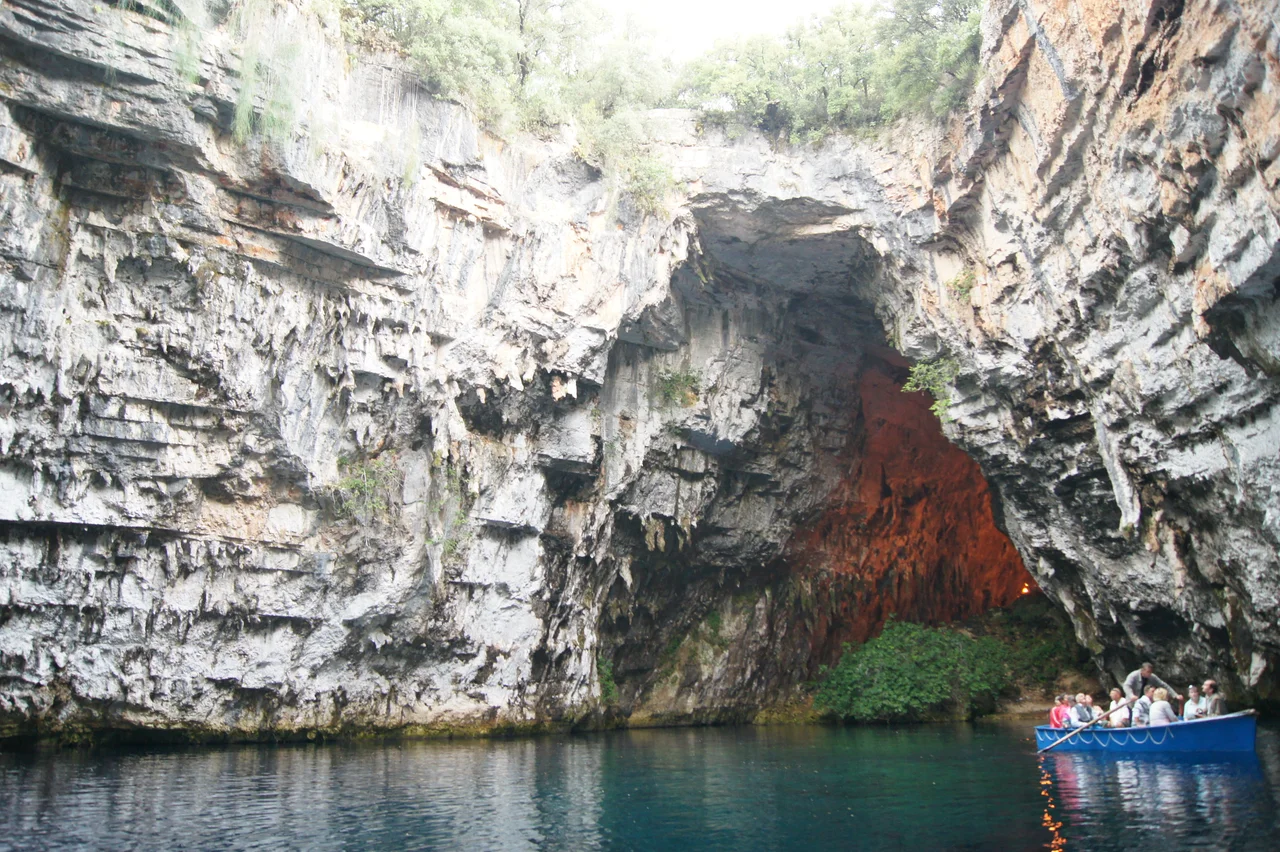

Melissani Cave
At noon on a clear day, a shaft of light falls through a hole in the earth onto the surface of an underground lake, turning the water a shade of blue that has no exact name. The hole was not always there. It appeared in 1953, when an earthquake caused the limestone ceiling of a cavern near the village of Karavomylos to collapse, exposing a pool of brackish water that had been hidden in darkness for thousands of years. The ancient Greeks already knew this place. They called it the Cave of the Nymphs — Melissani — and left votive offerings here to the god Pan. The modern world rediscovered it only in 1951, two years before the earthquake opened it fully to the sky.
The Cave the Earthquake Revealed
Melissani sits in the karst landscape of northeastern Cephalonia, near the small settlement of Karavomylos, about 2 kilometres from the town of Sami. The cave is a cenote — a collapsed sinkhole that has exposed the water table beneath — and the lake inside it is divided into two chambers. One chamber sits beneath the open sky, where the collapsed roof lets sunlight fall directly onto the water. The other is still enclosed, roofed with stone.
The water is brackish, a mixture of fresh groundwater and seawater that has percolated in from the Ionian Sea. Its color under direct sunlight shifts between an almost improbable turquoise and deep cobalt blue, depending on the angle of the light and the time of day. The effect on the boats that ferry visitors across the lake is the one most often remembered: the water is so transparent that the wooden hulls appear to float suspended in air, their shadows on the stone bottom below seeming sharper than the boats themselves.
An Island's Hidden Plumbing
What makes Melissani geologically remarkable goes beyond its appearance. The cave is part of an extraordinary hydrological phenomenon that puzzled scientists for decades. On the western side of Cephalonia, near Argostoli, seawater disappears into sinkholes called katavothres — the Greeks historically harnessed them to power water mills. For years, no one knew where the water went. Dye-tracing experiments eventually confirmed that it travels underground across almost the entire width of the island, emerging on the eastern coast at Melissani and along the shoreline near Sami.
The journey takes roughly two weeks. The water mixes underground with fresh water recharging from rainfall on the mountains above. By the time it surfaces in the cave, it has become the brackish, crystal-clear water that visitors see from the boats. Speleo-divers exploring the submerged karst passages beneath the cave have mapped extensive networks of conduits carrying this slow cross-island flow.
The Cave of the Nymphs
When archaeologists excavated the cave in the 1950s and 1960s — work led at one stage by the distinguished archaeologist Spyridon Marinatos — they found evidence of ancient worship. Clay figurines, small clay vessels, and a clay disc depicting dancing Nymphs were recovered from beneath the lake's surface. The artifacts are now in the Archaeological Museum of Argostoli. They confirm what Greek mythology had already asserted: Melissani was sacred, a place where the boundary between the human world and the world of gods and nymphs felt thin.
The name itself links to Melissanthi, a nymph said in local legend to have drowned herself in the lake after the god Pan rejected her love. Whether the legend gave the cave its name or the cave inspired the legend is the kind of question that resists answering. Both feel plausible, which is perhaps the point of such stories.
Light and Time
The best moment to visit Melissani, locals will tell you, is around midday in summer, when the sun is directly overhead and the light falls straight down through the opening in the roof. At that angle, the water glows from within rather than simply reflecting the sky above. The effect lasts perhaps an hour before the angle shifts and the intensity fades.
But the cave has a different quality in other lights too. In the early morning, before tourists arrive, or in the early evening when the boats have stopped, the enclosed chamber sits in deep shadow while the open chamber holds a residual light that makes the boundary between them — between the visible and the hidden — feel unusually precise. The ancient Greeks who left offerings here were not wrong to sense that the cave occupied more than one kind of space at once.
From the Air
Melissani Cave lies at approximately 38.257°N, 20.624°E, on the northeastern coast of Cephalonia near the town of Sami and the settlement of Karavomylos. From the air at 3,000–5,000 feet, the blue bay of Sami is clearly visible, with the cave tucked into the forested karst hillside inland. The Strait of Ithaca separates Cephalonia from the island of Ithaca to the east, visible in clear conditions. Nearest airport: Kefalonia International Airport (LGKF), approximately 35 km to the south near Argostoli.
Nearby Stories
- Glarentza 5 km away
- The Septinsular Republic 5.8 km away
- Battle of the Echinades (322 BC) 8.1 km away
- Hellenic Trench 19 km away
- Ionian Islands 22 km away
- Stratos 27 km away
- Achilleion (Corfu) 119 km away
- Corfu 153 km away