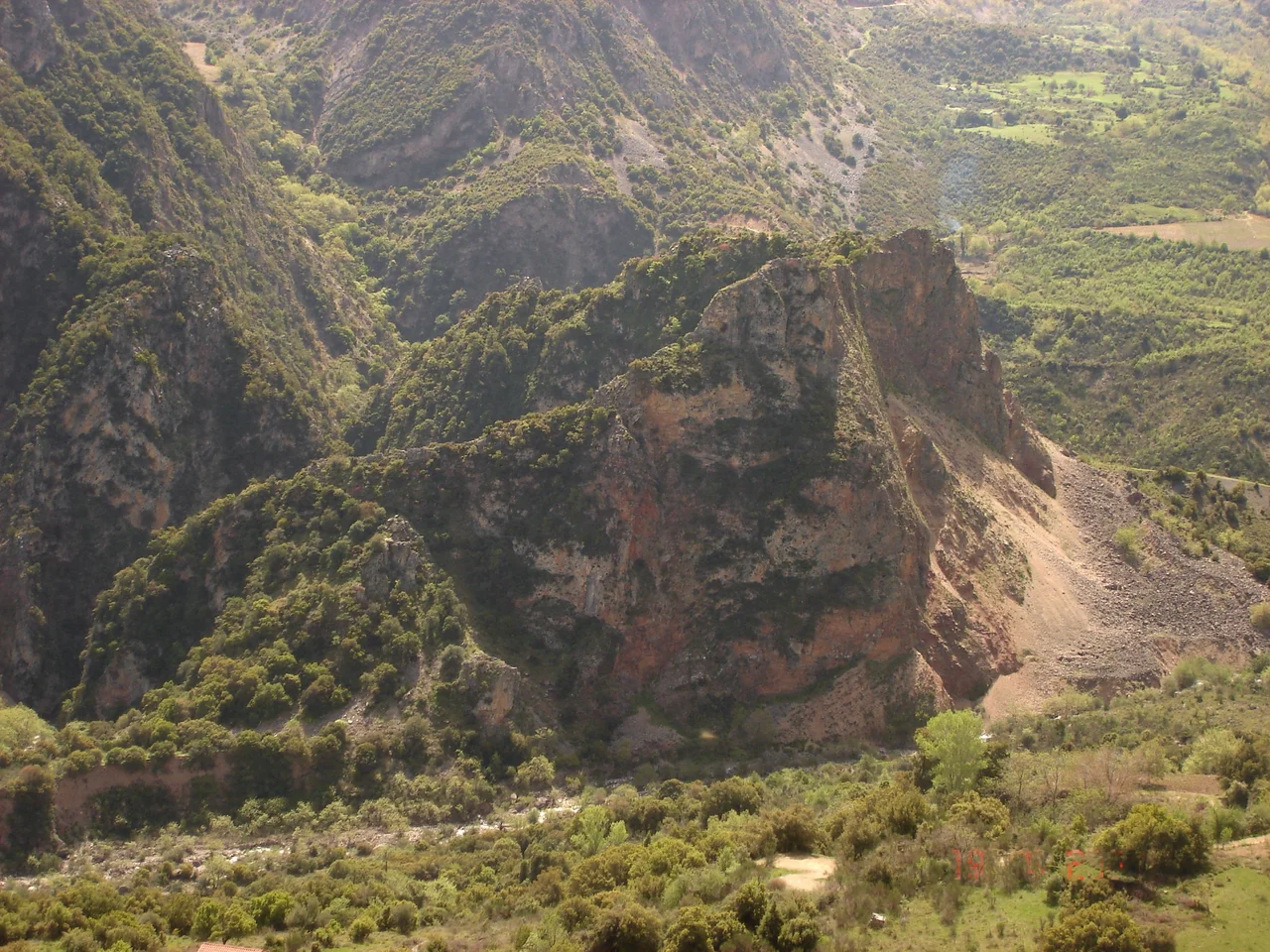

Salmeniko Castle
Eight years after Constantinople fell and the Byzantine Empire ceased to exist, one garrison was still fighting. Perched on a cliff above the river Foinikas in the mountains of Achaea, the castle of Salmeniko — also known as Oria — had become the last place in the Morea where the Byzantine flag had not yet come down. Every other fortress in the Peloponnese had surrendered to Sultan Mehmed II, often without resistance. Salmeniko had not. Its commander, Graitzas Palaiologos, was holding out against the most powerful military force in the Mediterranean world, and for a time, improbably, he was winning.
Built for an Impregnable Position
French barons of the Latin Principality of Achaea built Salmeniko between 1280 and 1310, choosing the site for the same reason Graitzas Palaiologos would later defend it: the geography was nearly perfect. The castle sat atop a hill with the river Foinikas running behind it, and the cliffs on that face were so sheer that no fortifications were needed there at all. Over the following century and a half, a large town grew up around the walls. By the time the Ottomans arrived in 1460, Salmeniko was not merely a fortress but a community — a place where thousands of people had built ordinary lives within walls that had, until then, kept them safe.
The Last Garrison of the Morea
In 1460, Sultan Mehmed II swept through the Peloponnese. The Byzantine Despotate of Morea, already weakened and fractured, crumbled castle by castle. Most surrendered quickly. Salmeniko did not. Under Graitzas Palaiologos, the fortress resisted the Ottoman siege for a year — the thick walls absorbing what the sultan's guns threw at them. But the garrison's survival depended on water. When the Janissaries finally found and cut the fort's supply line, the town outside the citadel could hold out no longer. According to local tradition, the townsfolk had been lowering sponges on ropes to collect water from the river far below, an ingenious improvisation that sustained them until the Janissaries discovered what was happening and started cutting the ropes one by one. The town surrendered. The historian Stefanos Thomopoulos recorded that 6,000 of its inhabitants were enslaved. Nine hundred children were taken under the Devşirme, the Ottoman practice of selecting boys from conquered Christian populations for training and service in the imperial household and military — a system that separated those children from their families permanently.
A Promise Broken, an Escape Made
Even after the town fell, Graitzas and a core of defenders held the inner citadel. He negotiated: free passage for his men in exchange for the fortress. Mehmed II agreed and departed for Aigio, leaving a certain Hamouzas in charge. Hamouzas ignored the agreement and arrested the first men who attempted to leave. When Mehmed learned of this, he replaced Hamouzas with Zaganos Pasha. Zaganos renewed the siege. Rather than wait to be starved out again, Graitzas led his remaining men in a breakout. They fought their way through the Ottoman lines and reached the Venetian-held fortress of Lepanto on the other side of the Gulf of Corinth. The fall of Salmeniko was the final chapter: the entire Peloponnese, excepting only the Venetian coastal holdings of Nafplion, Methoni, and Koroni, was now under Ottoman control. A Byzantine presence that had endured for more than a thousand years was finished.
What Survives on the Hillside
The castle and the town that grew around it are now ruins, visible on the hillside above Aigialeia in the Achaea region. A medieval bridge has survived intact — an engineering remnant from the period when Salmeniko was a living community rather than a historical footnote. Local tradition marks a rock formation nearby, called the Oria rock, as the place where a princess was killed by a traitor during the siege. Whether the story is historical or legend, it has kept alive some memory of the human cost of the siege at a site where the larger history — the final stand of Byzantine Greece — can otherwise feel abstracted into names and dates. Walking among the ruins, you are standing at the precise point where a world ended.
From the Air
Salmeniko Castle stands at approximately 38.268°N, 21.939°E, on a hillside at the foot of the Panachaiko mountain range in Aigialeia municipality, Achaea. Flying over this area at 4,000–6,000 feet, look for the rugged ridgeline of Panachaiko rising sharply south of the Gulf of Corinth coastline. The castle ruins are difficult to distinguish from the air due to vegetation, but the dramatic terrain — steep river valleys cutting through limestone hills — makes the site's strategic value immediately apparent. The Gulf of Corinth lies about 8 km to the north. The nearest major airport is LGRX (Araxos), approximately 45 km to the west near Patras. Patras itself lies about 25 km west-southwest.
Nearby Stories
- Corycian Cave 2.8 km away
- Battle of Picotin 11 km away
- Battle of Lepanto 13 km away
- Astras 14 km away
- Aetolia 14 km away
- Phlius 19 km away
- Antikyra 20 km away
- Thermos (Aetolia) 27 km away