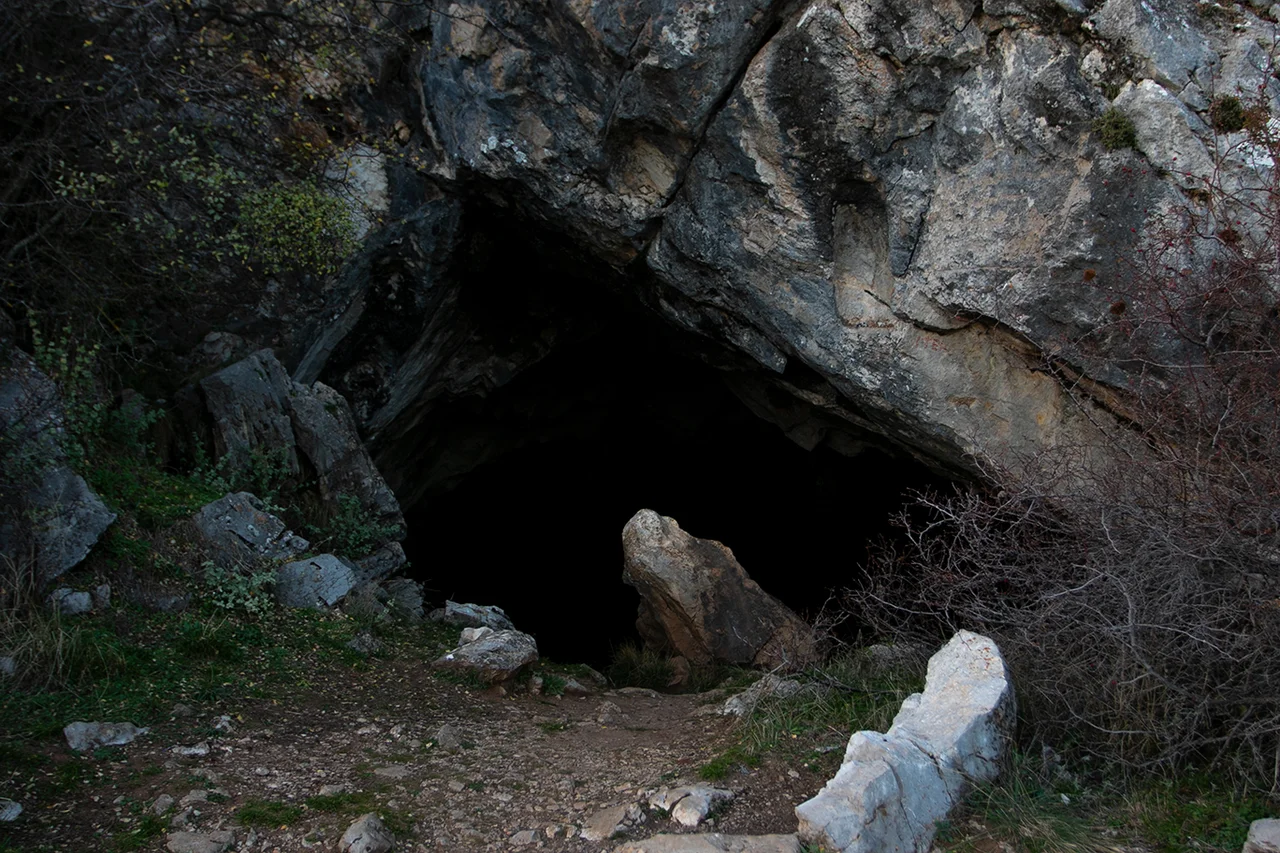

Corycian Cave
Two thousand feet above Delphi, where the track through the pines opens onto a vast limestone hollow, the mountain keeps a different kind of sanctuary. The Corycian Cave — known also as Sarantavli, the Forty Rooms — is not the polished oracle-site below. It belongs to older, wilder gods: Pan, the Nymphs, and Dionysus, who ancient tradition held would descend from here each winter to occupy Apollo's temple while its rightful lord was away. The cave has been sacred since the Neolithic period, and you sense, standing at its entrance, that it earned that status honestly.
Between Wilderness and World
Ancient Greeks understood landscape as moral geometry. Delphi below was civilization's navel — the omphalos, the center of the known world. The raw peaks of Parnassus above were pure wilderness, ungoverned and dangerous. The Corycian Cave sat between the two, neither tame nor fully wild. Scholar Jeremy McInerney described it as the pivot of a deeper movement 'from chaos to order,' a threshold where nymphs were said to be 'possessed and tamed by the gods.' Ancient texts place it in a large oval depression with high rocky walls, filled with shady woodland, saffron growing in the hollows, and an underground cavern opening at the bottom. Geologists believe the cavern formed after an older cave system collapsed — possibly in an earthquake. Whatever its origin, it became one of the most persistently sacred spaces in ancient Greece, used off and on across more than four thousand years rather than continuously.
The Worshipers and What They Left Behind
Archaeology reveals who actually came to the Corycian Cave. Not the great and wealthy, not the pilgrims who lined up at Delphi's oracle with civic questions. The offerings found here — clay figurines, bone votives, small humble things — point to shepherds and hunters, to women and children, to ordinary people who worked the slopes of Parnassus and climbed to a place that felt genuinely sacred. Nine inscriptions have survived, several mentioning Pan and the Corycian Nymphs by name. One eroded inscription is thought to record the Thyiades — the women of Delphi who performed the Dionysiac rites on the mountain. An inner cavern was believed to be the lair of Typhon, the monstrous adversary of Zeus; a shrine to Poseidon stood near its entrance, meant to keep the creature contained. When worshipers of Pan dressed as the god and hunted fish to sacrifice, they were re-enacting the myth of Pan's role in Typhon's defeat. The rituals were intricate, locally rooted, and centuries old.
Apollo Goes, Dionysus Comes
The cave's connection to Dionysus is more ambiguous than its link to Pan, and more fascinating for it. Aeschylus, in the Eumenides, hints at the association. Ancient tradition held that Dionysus had his residence in this cave just as Apollo had his at Delphi — and that in winter, when Apollo departed, the Thyiades were sent up to escort Dionysus down from the mountain into the sanctuary below. The god of wine and transformation literally took the oracle-god's place. Pan appears in countless scenes alongside Dionysus in ancient art, suggesting a deep connection between the two. The cave's ritual function thus bridged two divine worlds: the pastoral and the ecstatic, the everyday and the transgressive. Somewhere in that overlap, people climbed the mountain and left offerings in the dark.
A Refuge Across the Ages
Sanctity and safety often coincide in a good cave, and the Corycian filled both roles repeatedly. During the Greek-Persian Wars, Herodotus records (8.36) that the people of Delphi hid their most sacred objects here when the Persian army approached in the 5th century BCE. Sixteen hundred years later, villagers again took shelter in its caverns from Ottoman soldiers during the Greek War of Independence. In 1943, the German Occupation drove people back to the same stones. The mountain kept its promise each time. Today the cave is a destination for hikers following ancient paths from Delphi up through Parnassus National Park. They pass the entrance on the way to the broader views of the Livadi Valley far below — and some, perhaps, notice the hollow in the rock where shepherds once left clay offerings to a god with goat's feet.
From the Air
The Corycian Cave sits at approximately 38.515°N, 22.521°E, on the southern slopes of Mount Parnassus at an elevation of roughly 1,370 meters (4,500 feet) above sea level. From the air, Parnassus dominates the skyline above the Gulf of Corinth plain; the ski resort below the summit and the archaeological site of Delphi to the south provide key visual fixes. The nearest commercial airport is Athens International (LGAV), approximately 165 km to the southeast. Araxos Airport (LGRX) on the northern Peloponnese lies roughly 160 km to the southwest across the Gulf. Visibility at altitude often extends to the Corinthian Gulf and beyond, making the pale limestone crown of Parnassus a distinctive landmark at cruise altitude.
Nearby Stories
- Martino, Phthiotis 2 km away
- Aigio 9.7 km away
- Helladic Chronology 9.9 km away
- Agia Anna, Euboea 17 km away
- Battle of Alamana 19 km away
- Panagia Varnakova Monastery 20 km away
- 1981 Gulf of Corinth Earthquakes 25 km away
- Karpenisi 31 km away