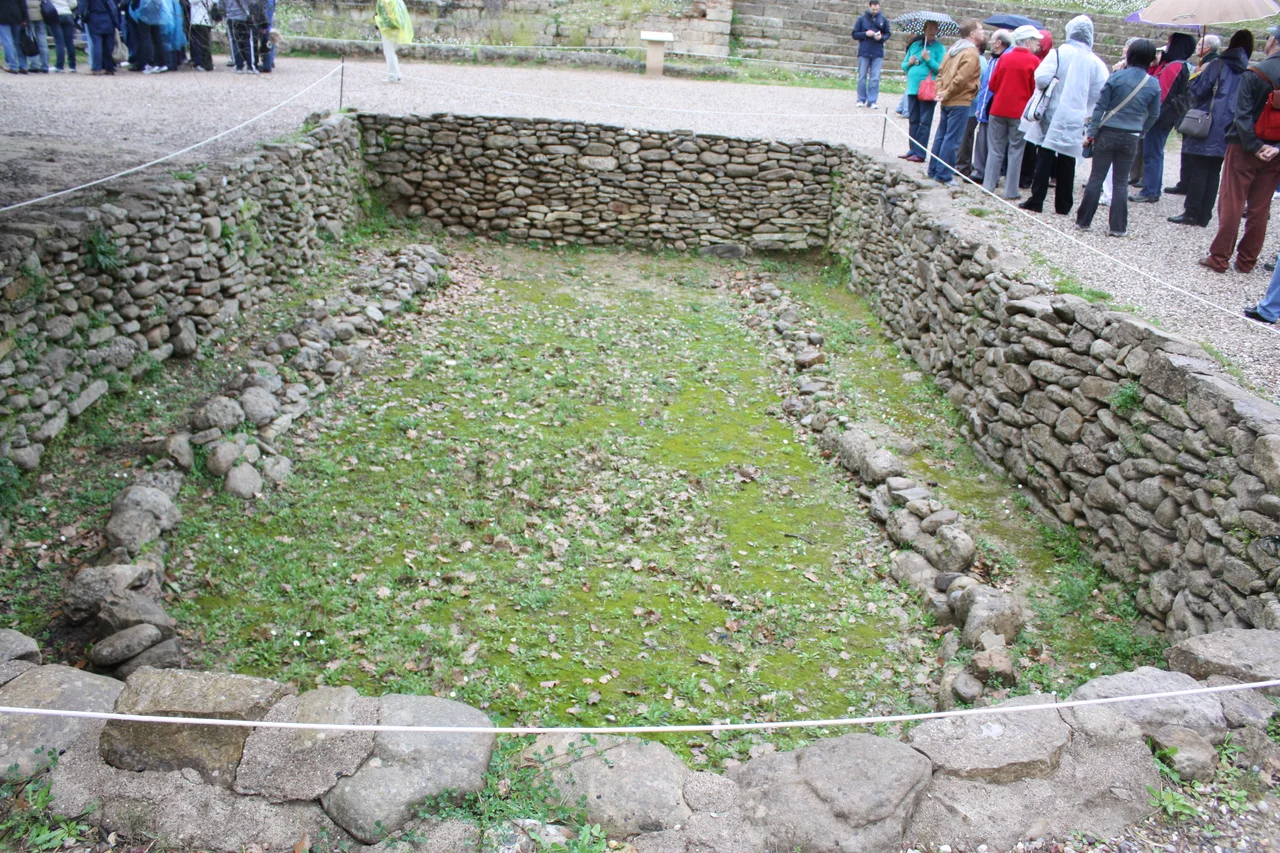

Helladic Chronology
Imagine trying to date two thousand years of human history without a single written word to anchor it. No king lists, no inscriptions, no dated documents, only the rubbish people left behind. That was the problem facing archaeologists studying Bronze Age Greece, and their solution was elegant in its simplicity: pottery. Styles change. A potter in 3000 BC made vessels that looked nothing like those of 1500 BC, and those differences, layered in the earth, become a clock. The Helladic chronology is that clock, the framework that orders the prehistory of the Greek mainland from roughly 3200 to 1050 BC, built almost entirely from the most ordinary thing a household ever threw away.
Reading Time in Clay
The system was modeled on the work of Sir Arthur Evans, the British archaeologist who excavated Knossos on Crete and sorted Minoan finds into Early, Middle, and Late periods. The Helladic scheme applies the same logic to mainland Greece, while a parallel Cycladic chronology covers the Aegean islands. Together they are grouped loosely as "Aegean." The genius of the approach is that it does not depend on fixed dates at all. Evans's labels mark sequence rather than calendar years, so when new evidence shifts a date, the scheme simply absorbs the change without collapsing. Pottery makes an ideal timekeeper because it was everywhere in daily life and nearly indestructible. A pot may shatter, but the sherds survive in the soil for millennia, and stratified layers reveal which objects were buried together, and therefore which are contemporary.
The Early Helladic World
The Early Helladic period, spanning roughly 3200 to 2000 BC, overlaps in time with Egypt's Old Kingdom, the age of the great pyramids. Its key sites cluster along the Aegean shores of Boeotia and the Argolid, places like Lerna, Thebes, and Tiryns, along with island settlements on Aegina and Euboea. This was a society learning new technologies: the fast-spinning potter's wheel arrived from western Anatolia, and a large longhouse called a megaron appeared as a center of community life. At Lerna, the Early Helladic II period ended with the burning of an imposing structure archaeologists call the House of the Tiles. Earlier scholars read such destructions as evidence of invasion. Today, with continuity visible at many sites and climate shifts around 2200 BC implicated in the upheaval, the picture looks more like gradual transformation than sudden conquest.
Decline, Then a Golden Age
The Middle Helladic period, about 2000 to 1550 BC, was long described as one of cultural retreat. Settlements drew inward and climbed to defensible hilltops. Its signature artifact is Minyan ware, the gray burnished pottery that Heinrich Schliemann, the excavator of Troy, named after the legendary Minyans. Once thought to mark the arrival of a new people, it is now understood as a local evolution, traced through unbroken layers at Lerna. Then came the Late Helladic, from roughly 1550 to 1050 BC, the era better known as the Mycenaean Age, when Mycenae rose to dominate the mainland. This was the world of fortified citadels, of warriors buried with gold, of the Linear B clay tablets that record an early form of Greek. Mycenaean pottery traveled across the eastern Mediterranean, even turning up in the cargo of the Uluburun shipwreck off the Turkish coast.
An Anchor in Boeotia
These coordinates fall in Boeotia, the central Greek region whose Bronze Age sites helped build the chronology itself. Thebes, one of the most important Early Helladic centers, lies just to the north, its later glory in the classical age layered atop far older foundations. Around 1050 BC the entire Aegean world fell into a long decline that some historians still call a Dark Age, as war and upheaval swept away the palaces and silenced the Linear B scribes. When Greece emerged centuries later, the memory of the Mycenaeans survived only as myth, the heroes of Homer's epics. The Helladic chronology is how we recover the rest, not through legend but through the patient reading of broken clay, period by period, sherd by sherd.
From the Air
These coordinates sit at 38.317 N, 23.317 E in Boeotia, central Greece, near ancient Thebes and roughly 50 km northwest of Athens. There is no single monument here; the Helladic chronology is a framework drawn from sites scattered across the mainland. For an aerial sense of the Bronze Age landscape, fly the Boeotian plain and the hill country toward Mount Cithaeron at 3,000-5,000 ft AGL. Nearest major airport: Athens International (LGAV), about 60 km southeast. Clearest visibility in spring and autumn.
Nearby Stories
- Spata 1.1 km away
- Helios Airways Flight 522 5.7 km away
- Anthedon (Boeotia) 6.1 km away
- Euboea 8.2 km away
- Salamis Island 9.9 km away
- Davleia 11 km away
- Corinthia 11 km away
- Mount Helicon 14 km away