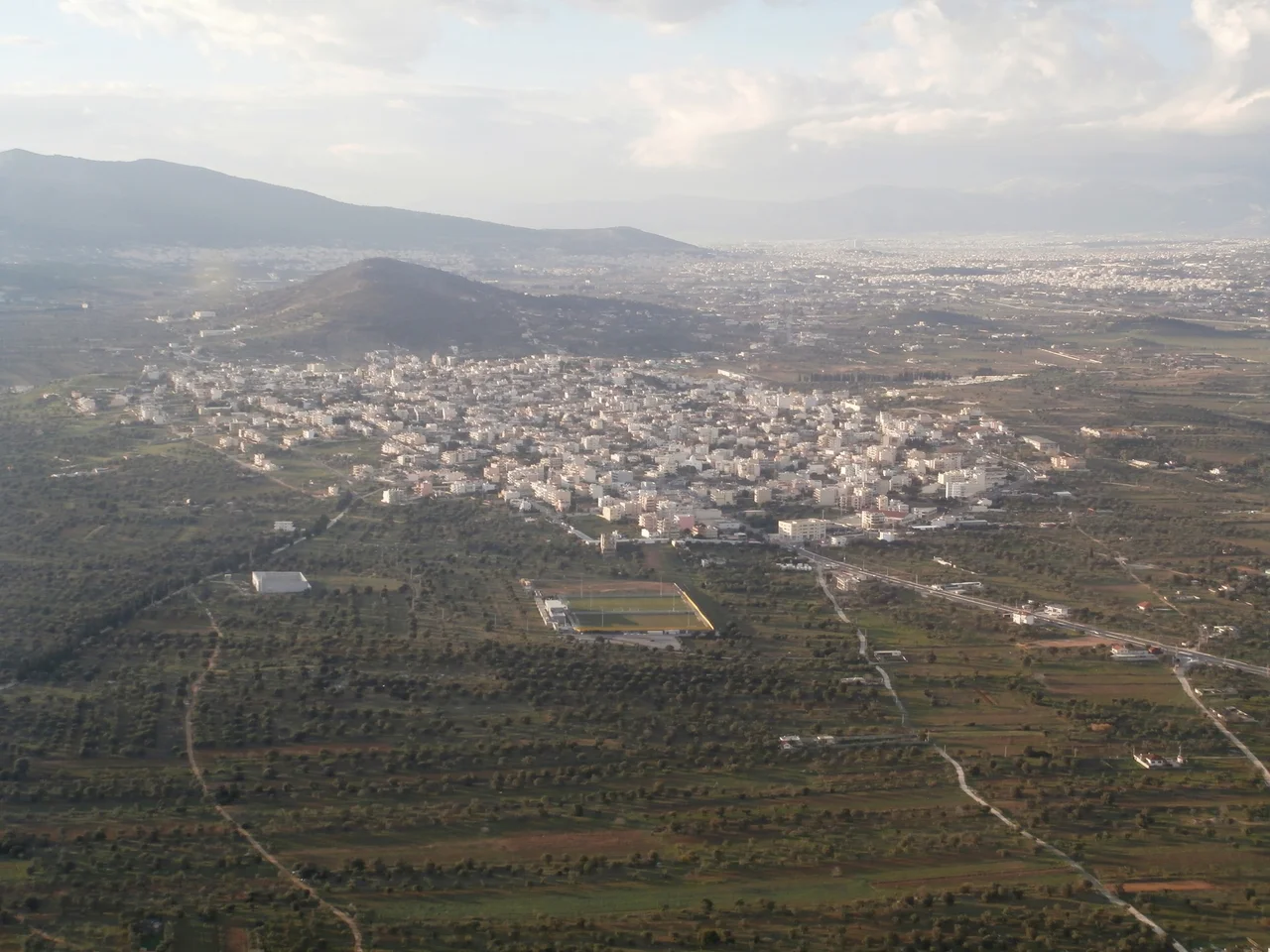

Spata
The name Spata comes from an Albanian word for sword — shpatë — and it belonged first to a medieval despot, John Spata, whose clan repopulated this Attic plain in the fifteenth century after migrating from Epirus. Six centuries later, the town's most conspicuous neighbour is not a feudal stronghold but the glass-and-concrete terminal of Athens International Airport, whose runways occupy the eastern portion of Spata's municipal land. The sword and the jet: history here has never been polite about juxtapositions.
The Mesogeia Plain
Spata sits in the middle of the Mesogeia, the inland plain of east Attica, twenty kilometres east of central Athens and cushioned between Mount Hymettus to the west and the Aegean coast to the east. The landscape is agricultural in texture even now — vineyards, olive groves, fig trees — though the planting rhythms have shifted. Retsina, the resin-flavoured white wine that once defined the whole region's cash economy, is less dominant than it was. In its place, artisan wineries have emerged, many of them working with the local Savatiano grape, a variety well adapted to the dry summers of Attica. The bulk of the area's grape harvest is still processed through a local co-operative, but the labels are becoming more individual, more confident. Wine tourism has quietly begun to layer itself over the older agricultural identity of the plain.
Deep Time: The Mycenaean Past
Long before the Spata clan arrived, this land was ancient Athenian deme territory. Two demes fell within the area: Erkhia, remembered as the birthplace of the historian and general Xenophon, and Kýthēros. A Mycenaean cemetery was excavated at the southern edge of town in the 1870s by the archaeologist Panagiotis Stamatakis; its finds are now held in the National Archaeological Museum in Athens. More ancient still, a Neolithic fortified settlement occupied Zágani hill nearby. When construction crews broke ground for Athens International Airport in the mid-1990s, they kept uncovering settlement traces — fragments of a layered past that now have a permanent home in displays inside the main airport terminal building, one of the stranger archaeological exhibitions in Europe: ancient Attica viewed between check-in desks.
An Albanian Clan and a Byzantine Feast
The medieval repopulation of Spata by Tosk Albanian Arvanites has shaped the town's character for six hundred years. The Arvanites were Greek-speaking Orthodox Christians who arrived from Epirus and settled across much of Attica and the Peloponnese, and in Spata they have been the dominant community since at least the 1400s. The town's patron saints are Peter and Paul, celebrated on 29 July at a Byzantine chapel on the eastern edge of town. The celebration includes a tradition that reaches back into the Middle Ages: the community prepares a large communal batch of stifado — the slow-cooked beef and onion stew — overnight in cauldrons, then distributes it to all the faithful gathered outside the chapel after Mass. It is the kind of ritual that resists modernisation precisely because it has fed real hunger for so many centuries.
The Airport and the New Spata
In 1995, the Greek government committed the southern portion of Spata's territory to the new international airport. Construction took six years. Athens International Airport "Eleftherios Venizelos" opened in March 2001, and Spata has not been the same since. Olympic Air — one of Greece's two major carriers — has its head office on the airport grounds. The Attica Zoological Park, Greece's largest zoo, opened just north of the airport in May 2000. AEK Athens FC established its training complex in Spata, bringing professional football alongside the vines and olive trees. The town still has five kindergartens, three primary schools, and a junior football club called Aittitos — meaning 'Invincible' — but the scale of what surrounds it has changed entirely. Spata is still a place people are from; it is also now a place the whole world passes through.
From the Air
Spata lies at approximately 37.962°N, 23.915°E on the Mesogeia plain directly west of Athens International Airport (LGAV). On approach from the west, the town appears as a compact residential cluster set against a patchwork of vineyards and agricultural land; the airport terminal and runway complex occupy the ground immediately east of town. At 3,000 ft on a visual approach to LGAV runway 03L, Spata sits just off the left wing. The Attica Zoological Park is visible to the north of the town. Mount Hymettus provides a natural western reference point; its slopes are visible from the airport apron on clear days.
Nearby Stories
- German Submarine U-565 7.7 km away
- Gyaros 9.5 km away
- Rhamnous 9.6 km away
- Zoodochos Pigi Church, Dervenosalesi 11 km away
- Kalaureia 13 km away
- Battle of Andros (1790) 14 km away
- Agios Georgios (island) 21 km away
- Aegean Sea 72 km away