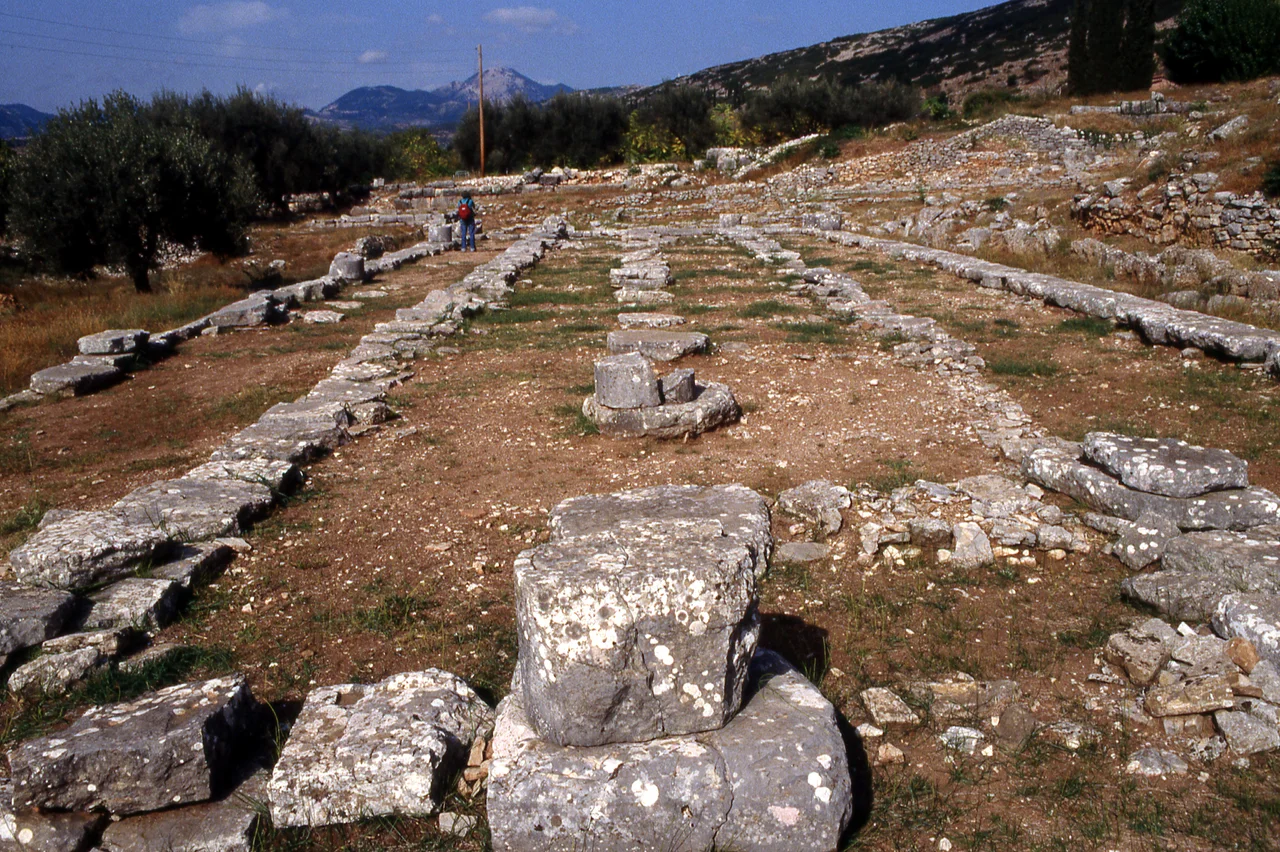

Thermos (Aetolia)
No city walls, no agora, no theatre — Thermos was never a city in the way Athens or Corinth were cities. It was a gathering place: the sanctuary of Apollo Thermios in the Aetolian hills, the spot where the tribes of Aetolia came together every year to meet, worship, display their bronze offerings, and conduct the business of their league. For several centuries it served as the religious and political capital of one of the most powerful confederacies in ancient Greece, yet it functioned more like a sacred fairground than an urban centre. What it lacked in streets and monuments it made up for in age: people had been congregating on this ground since at least 1500 BC.
A Temple Before Stone Was the Rule
The Temple of Apollo Thermios was built around 630 to 610 BC, making it one of the earliest developed Doric temples known to exist. When it was new, the walls were mud brick, the columns were wood, and the entablature — the horizontal band above the columns — was wood decorated with painted terracotta. Even the roof was terracotta tile, which was a recent innovation for the Greeks; the extra weight compared to thatch and wooden shingles may have been one of the forces pushing builders toward stone construction.
The temple measured approximately 12 by 38 metres, carried fifteen columns on each long side and five at each end, and had a row of ten columns running down the interior. In the Hellenistic period, the wooden columns were replaced with stone, but the terracotta entablature appears to have been left in place. Because the site gradually lost its regional importance rather than being rebuilt and expanded like most ancient sanctuaries, the temple was never fully modernised. That neglect turned out to be preservation: it survived with more of its early fabric intact than many far more celebrated buildings.
The Oldest Painted Panels in Greece
The most extraordinary survivals from Thermos are its terracotta metopes — the painted panels that filled the spaces between the structural elements of the temple frieze. They are among the oldest known examples of this art form anywhere in Greece. Nearly three feet square, they were painted with scenes from mythology: a large gorgon head, Perseus running with the severed head, three seated women, a hunter with his kill. One of the best preserved shows the mythological figures Procne and Philomela preparing Itys for the table — a scene of revenge from deep in Greek myth, painted in vivid colour on fired clay.
The similarity in style between these panels and Corinthian painted pottery of the 630s BC provides the main basis for dating the temple. The clay itself is local, and the painters may well have been local too. Scholars have debated whether the Doric frieze in stone later copied these earlier wooden-and-terracotta structures or developed independently. The Thermos metopes — and the stone metopes of Temple C at Selinus in Sicily, dating to around 550 BC — are commonly held to be the oldest examples of the form. Most of the surviving pieces are now in the National Archaeological Museum in Athens; others remain in a local museum at the modern village of Thermo.
Three Thousand Years of Use
Long before Apollo was worshipped here, Thermos was already a significant place. Excavations have found remains of a long apsidal building — a structure with one rounded end — along with elliptical and square houses and pottery from the Middle Helladic tradition, all datable to around 1500 BC. The site continued through the Mycenaean period; after the collapse of the Mycenaean palace system around 1200 BC, a fine krater decorated with warriors in the same style as Heinrich Schliemann's famous Warrior Vase from Mycenae was brought to Thermos. The continuity of occupation across the Bronze Age collapse is remarkable.
A large rectangular building called Megaron B underlies the Archaic temple. For a long time scholars thought it demonstrated the development of the Greek temple from Mycenaean palace architecture. Recent excavations led by Professor I. Papapostolou for the Archaeological Society of Athens have established a more complicated picture: the building post-dates the Mycenaean period, probably constructed between 1000 and 900 BC; a layer of burnt offerings from the Geometric period, around 800 to 700 BC, lies between its remains and the foundations of the later temple. The site was evidently important across all these periods without any architectural continuity from one to the next.
Rise and Ruin of the League's Heart
In the Hellenistic period Thermos was embellished with an astonishing number of bronze dedicatory statues — gifts from the Aetolians and their allies celebrating military victories and political successes. Substantial fortification walls with gates and towers were built around the sanctuary. Three long stoas rose inside the precinct, and a spring just south of the temple was enclosed in a fine stone-lined fountain or pool. The sanctuary was at the height of its regional power and physical grandeur.
Then politics brought it down. The Aetolian League's alliances turned against it: first, King Philip V of Macedon sacked Thermos during the Social War of 220 to 217 BC, carrying off or destroying much of the bronze wealth. Then the Romans sacked it in 189 BC. After these blows the site never fully recovered. By the 1st century BC, burials were being made into the foundations of the former public buildings — the surest sign that a place has been abandoned as a living sanctuary and left to memory. Today the ruins lie near the modern village of Thermo, the ancient name preserved almost unchanged across more than two thousand years.
From the Air
Ancient Thermos sits at 38.5599°N, 21.6687°E in the Aetolian interior, roughly 25 km east of Lake Trichonida and 15 km northeast of the modern town of Thermo. The site lies in rolling upland terrain between the lake basin to the west and the Panaitoliko mountains to the north. From the air at 3,000–4,000 feet, the area appears as a mix of agricultural fields, scattered woodland, and small villages. The ruins themselves are not conspicuous from altitude. Nearest major airport: LGRX (Araxos Airport), approximately 65 km to the south. The Rio–Antirrio Bridge and the Gulf of Patras are visible on clear days from higher altitudes looking south.
Nearby Stories
- Ypati 8.3 km away
- 1861 Eliki Earthquake 9.2 km away
- Patras 12 km away
- Evrytania 15 km away
- Duchy of Neopatras 16 km away
- Acarnania 19 km away
- Kommeno 23 km away
- Melissani Cave 42 km away