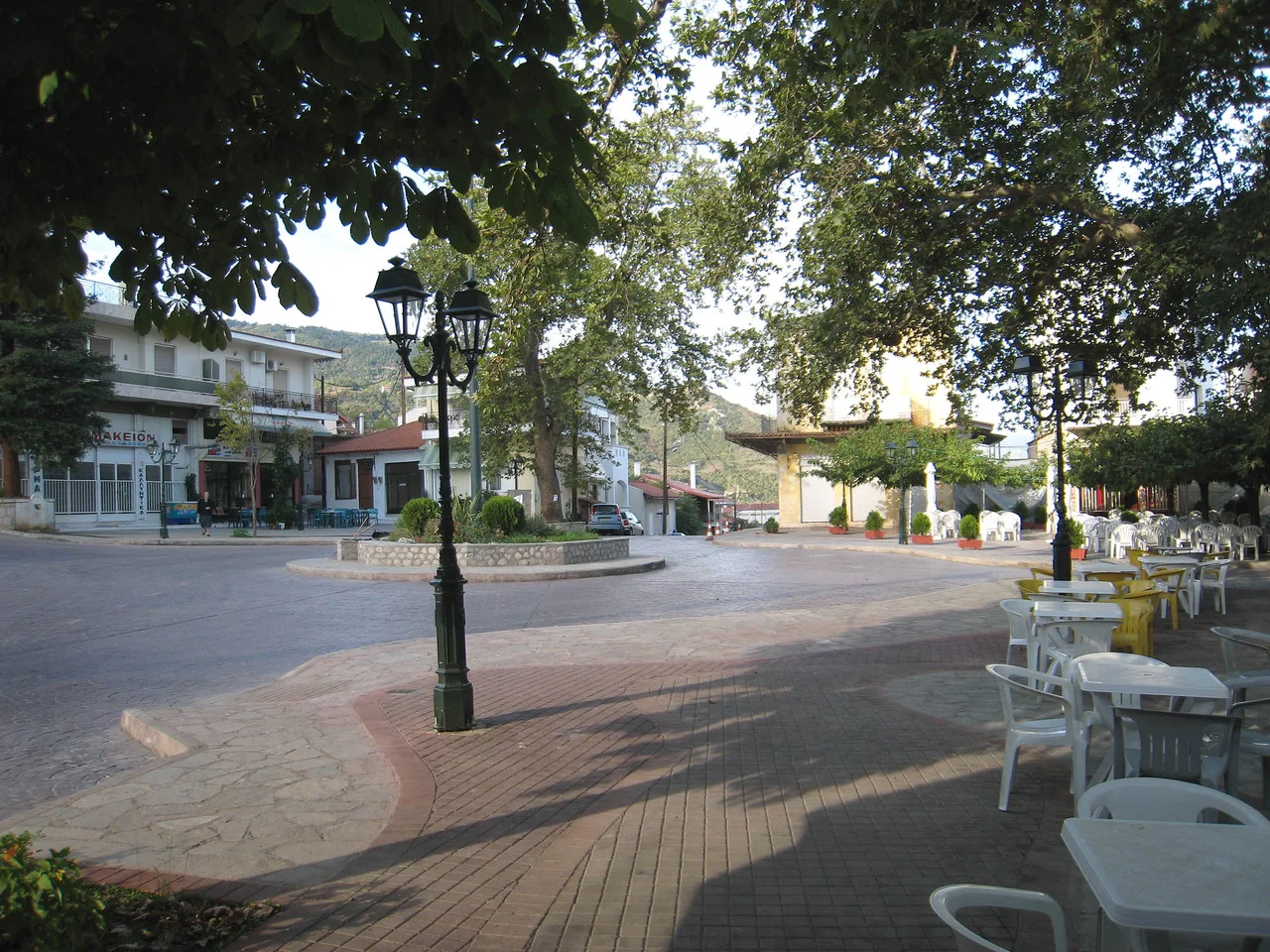

Ypati
Apuleius set his novel The Golden Ass in a town called Hypata, and his choice was not random. This was a place, he wrote, infested with bandits and alive with sorcery — witches who could transform men into animals. Whether or not you believe the supernatural element, the location was real: the ancient city of Hypata, today called Ypati, climbing the lower slopes of Mount Oeta in central Greece, just west of the Spercheios River valley. The hot springs nearby — recorded by Herodotus himself and still drawing visitors today as Loutra Ypatis — gave the place an otherworldly atmosphere even before the storytellers arrived.
From City-State to the Edges of Empire
Ypati earned its place in the historical record as a polis — a genuine city-state — that passed through the hands of most of the powers that contested central Greece. Around 344 BC it fell under Macedonian rule. It flickered briefly free during the Lamian War, when the Greek cities rose against Macedonia after Alexander's death, then settled into the Aetolian League. After Rome made peace with Aetolia, Hypata held an unusual distinction: it was the only Aetolian possession remaining north of Mount Oeta. When Augustus reorganized Greece after the Battle of Actium in 31 BC, the city was incorporated into the Thessalian League and granted the right to call itself 'Hypata Augusta' — a title it used throughout the Roman Imperial period. A prominent local family, mostly bearing the names Cyllus and Eubiotus, dominated the regional magistracy for generations, supplying the League's leading general — the strategos — until that office was abolished in the mid-second century AD.
The Witches of Hypata
Apuleius knew his geography. In The Golden Ass, written in the 2nd century AD, his protagonist Lucius travels to Hypata specifically because it is reputed to be the world's capital of magic. Women there, the stories insisted, could peel off their skins at night and fly. They could turn unwary travelers into animals. Apuleius wrapped this folklore into one of the great comic novels of antiquity, and in doing so preserved a snapshot of how Hypata was regarded by the wider Roman world: as a liminal place, mountain-edged, spring-fed, a little uncanny. A poem written by a contemporary named Ammianus mocked the local magistrate Cyllus as a 'spear-moron,' perhaps because his military expeditions against bandits — the very bandits Apuleius mentioned — had gone badly. The reputations layered on top of one another: witches, bandits, a bumbling official, ancient thermal springs. It is not hard to see why the place lodged in the literary imagination.
Castle, Church, and Centuries of Siege
The town went quiet after Slavic invasions in the 7th century, then reappeared in Byzantine records in the 9th century under new names — Neai Patrai, 'New Patras,' or Patrai Helladikai, 'Patras in Hellas.' It remained primarily an ecclesiastical center through the middle Byzantine period, its bishop subordinate first to Larissa and then elevated to a metropolitan see around 900. The medieval castle that still dominates the town was probably built in its current form in the 13th century, though a large round tower is attributed to the Catalan period. That castle's military career stretched from the medieval quarrels over who controlled central Greece all the way to the Greek Civil War of the 1940s, when it saw its last active use. It was restored between 2011 and 2015 with EU funds and opened to the public in December 2015. Alongside the castle stands the Byzantine-era Church of Hagia Sophia, built on the footprint of an even earlier Christian church; archaeologists have found remnants of a 5th-century baptistery at its southern side, and the masonry is rich with spolia — stones recycled from earlier buildings, each one a small artifact of continuity.
Living on the Mountain's Hem
With a settlement population of 440 people in 2021, Ypati is a small place now — but it carries an improbable density of things to see and think about. The Byzantine Museum of Phthiotis, housed in a barracks building from 1836, displays mosaics, coins, and everyday objects from across the prefecture's ancient past. A traditional water mill still turns at a waterfall near the village entrance. The Agathonos Monastery, 3 km to the west and dating to the 15th century, houses the Oiti Natural History Museum, devoted to the ecology of Mount Oeta and its national park. At the central square stands a monument to those the Germans executed here on 17 June 1944 — a reminder that the mountain's slopes have been stages for violence in every era. Mount Oeta itself, rising behind the village, is the peak where the hero Heracles, according to myth, built his own funeral pyre. Ypati lives in the shadow of that mountain and all the stories it has accumulated, a small village that has somehow held the weight of centuries.
From the Air
Ypati sits at approximately 38.87°N, 22.24°E, on the lower slopes of Mount Oeta, about 20 km west of Lamia along the Spercheios valley. From the air, the village and its castle are visible against the mountainside, with the flat river valley stretching east toward Lamia. Nearest major airport is Nea Anchialos (LGBL), roughly 70 km northeast near Volos; Athens Eleftherios Venizelos (LGAV) is about 220 km south. At 5,000–6,000 feet on an approach from the east, the Spercheios valley provides clear orientation, with Mount Oeta's ridgeline rising sharply to the south of the village.
Nearby Stories
- Karpenisi 2.6 km away
- Duchy of Neopatras 2.7 km away
- Kalapodi 5.1 km away
- Farsala 11 km away
- Lake Plastiras 12 km away
- Thermos (Aetolia) 17 km away
- Demetrias 17 km away
- Free and Real 21 km away