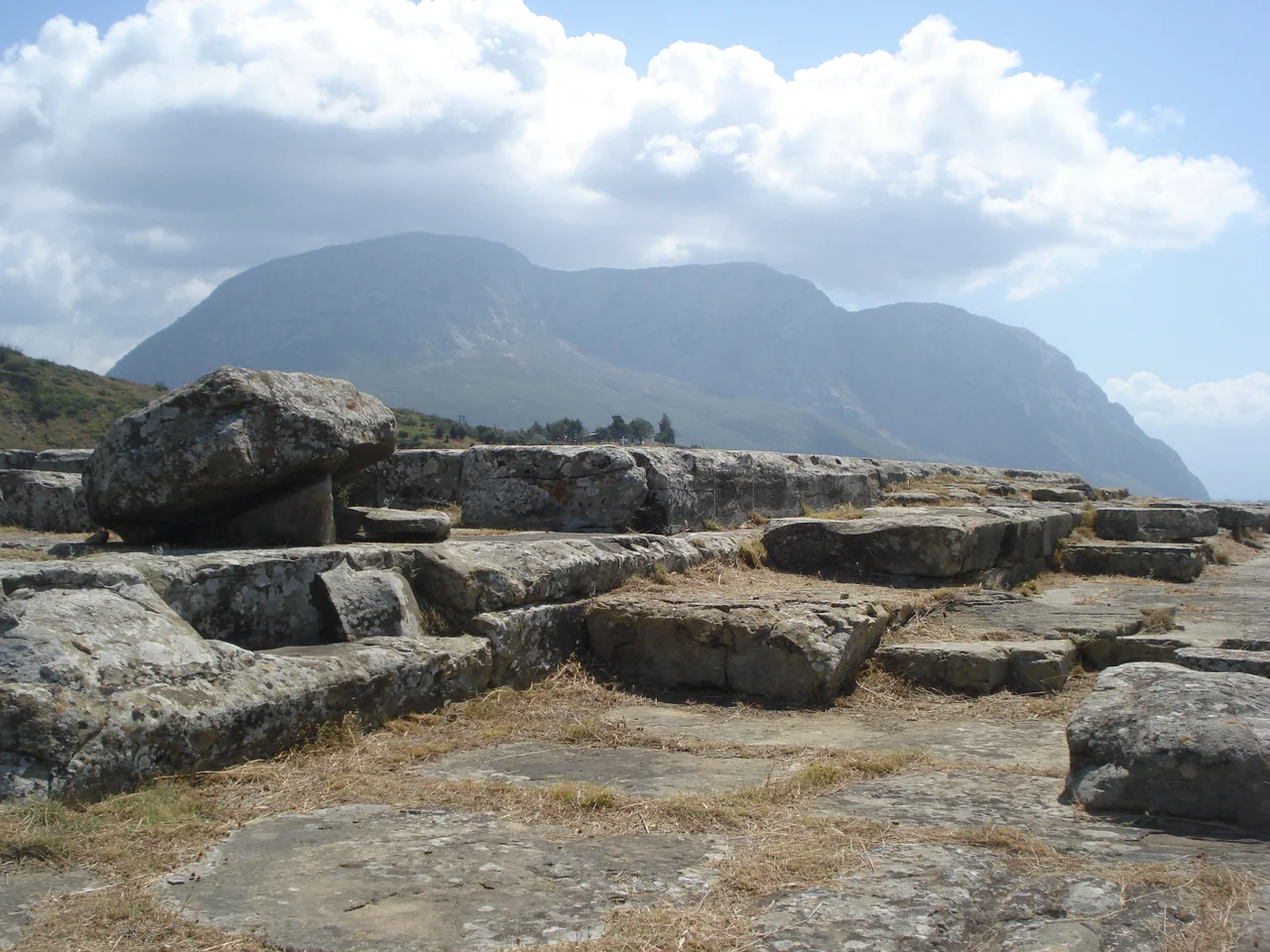

Aetolia
Ancient historians were not kind to the Aetolians. Thucydides claimed the Eurytanian tribes of the interior ate their food completely raw. Polybius doubted they were truly Greek at all. These judgments may say more about the prejudices of city-state culture toward mountain peoples than about the Aetolians themselves — because the same tribes that were dismissed as semi-barbaric went on to build one of the most formidable military confederacies in the ancient world, repel a Gallic invasion that had sacked Delphi, and outlast the Macedonian kings who tried to break them.
Land of Wild Beasts and Hard Men
Aetolia occupies the rugged terrain of what is now western Greece, bounded by the Achelous River to the west (which separates it from Acarnania), the Ozolian Locrians to the east, Epirus and Thessaly to the north, and the Gulf of Corinth along its southern shore. In classical times it was divided into Old Aetolia in the west — from the Achelous to the Evenus River and the ancient city of Calydon — and New Aetolia to the east, lands acquired as the region's power expanded.
The coast has fertile plains, but the interior is unproductive mountain country. The mountains were famous in antiquity for their wild animals — famous enough that Greek mythology set its most celebrated hunt here. The Calydonian Boar, a monstrous beast sent by Artemis to ravage the fields near Calydon, drew heroes from across the Greek world to pursue it: Meleager, Atalanta, Theseus, Jason, and many others. The myth reflects something true about Aetolia — it was a place where wildness was not merely a setting but a defining quality of the people.
Gods of Spoil and Sanctuary
The Aetolians worshipped the same gods as other Greeks, but with a distinct emphasis. Apollo they honored as the god of tame nature; Artemis as the goddess of wilderness. They called both deities "Laphrios gods" — patrons of the spoils and loot of war. Even Athena was venerated not primarily as the goddess of wisdom, but as a warrior counterbalance to Ares. It was a theology shaped by a life of raiding and fighting.
At Thermos, north of Lake Trichonis, a shrine of Apollo Thermios became a major religious center by the 7th century BC and later served as the political heart of the Aetolian League. Philip V of Macedon, when he could not break the Aetolians militarily, took his revenge there in the Social War — destroying the temple and burning the votive offerings. The Aetolians rebuilt.
The earliest inhabitants of Aetolia were the Curetes and the Leleges, tribal peoples who predated the arrival of colonists from Elis led by the mythical hero Aetolus. The mountain tribes of the interior — the Ophioneis, the Apodotoi, and the Eurytanians — retained their distinctive character well into the historical period, speaking dialects that puzzled outside observers and living in ways that made Greek city-state intellectuals uncomfortable.
The League That Outfought Kings
The Aetolians' greatest achievement was political: the Aetolian League, a confederation that by around 340 BC had become one of the leading military powers in ancient Greece. It was organized, in part, in response to the threat from Philip II of Macedon, and it outlasted his successors. The League's structure — a sympoliteia, a genuine sharing of citizenship across member cities — was sophisticated enough to challenge the Macedonian kingdoms for dominance over the Greek peninsula.
In 279 BC, a Gallic force under Brennus swept into Greece and reached Delphi. The Aetolians played a central role in repelling the invasion and protecting the sanctuary. The feat brought them enormous prestige, and they established the Sotiria Games in honor of Zeus the Saviour to commemorate it. Their territory expanded accordingly: Locrians, Phocians, Boeotians, and others joined or were absorbed into the League.
But alliance with Rome proved the League's undoing. The Aetolians fought alongside the Romans at the Battle of Cynoscephalae in 197 BC, helping defeat Philip V. Then, miscalculating, they invited Antiochus III of Syria against Rome. When Antiochus was defeated in 189 BC, the Aetolians became effectively Roman subjects. By 146 BC, when Rome dissolved the Achaean League and absorbed Greece into the province of Achaea, Aetolia was part of the Roman world.
What History Owes Them
Much of what ancient sources say about the Aetolians comes through hostile filters. Polybius, whose history shapes so much of our picture of the Hellenistic period, relied heavily on Aratus of Achaea — the Aetolians' political rival — and came from Megalopolis, a center of the competing Achaean League. Modern scholars treat his anti-Aetolian bias as a significant distortion. The same people Polybius disparaged had refused to join the Persian Wars (a mark of independence, not cowardice), defeated the Athenians in 426 BC under Aegitios, and twice recovered the city of Naupaktos from rivals.
After the Roman period, Aetolia passed into Byzantine hands, then into the Despotate of Epirus, and eventually to the Ottomans. The name itself survived into the modern Greek regional unit of Aetolia-Acarnania, where the ancient boundaries between the two territories are still traced by the Achelous River — the same river the ancient inhabitants called a god, and whose contest with Hercules forms the myth depicted on the city seal of Agrinio to this day.
From the Air
Ancient Aetolia centers roughly on 38.62°N, 21.40°E in western Greece, above the Gulf of Corinth. From the air, the region is unmistakable: a rugged inland spine of mountains giving way to a fertile coastal plain along the gulf. Lake Trichonis, the largest lake in Greece, lies near the center of the old territory and is visible from altitude as a large inland body of water. The Achelous River traces the region's western boundary. Nearest major airport: LGRX (Araxos), approximately 80 km to the south across the Gulf of Corinth. Araxos sits at the mouth of the gulf near Patras, reachable via approach from the south.
Nearby Stories
- Amphilochian Argos 8.3 km away
- Battle of Preveza (1911) 11 km away
- Taphians 12 km away
- Melissani Cave 13 km away
- Battle of Lepanto 14 km away
- Salmeniko Castle 14 km away
- Saint Augustine of Hippo and Seraphim of Sarov Monastery 18 km away
- Greece 24 km away