
Serifos
The myth goes like this: Perseus came home to Serifos carrying the severed head of Medusa, whose gaze turned living things to stone. King Polydectes had sent him on the quest, hoping the boy would die — because the king wanted Perseus's mother, Danaë, for himself. Perseus survived. He walked into the king's hall, told Polydectes to look, and turned him to stone. Serifos has been home to more iron than mythology, but the myth is the one that stuck: this is the island where the hero came back, and where justice, for once, arrived from an unlikely direction.
Iron in the Bones of the Island
Copper and other minerals have been mined on Serifos since Minoan times, but it was iron that defined the island in the modern era. Ore extraction continued well into the 20th century, stopping only in the 1960s. The evidence is still visible across the hillsides: straight roads with railway-like iron tracks, relics of the animal-hauled ore carts that carried the mineral down to the port.
Serifos was a significant city-state in classical Greece, participating in the Persian Wars and the conflicts that followed. The Romans later used the island as a place of political exile — remote enough to contain the troublesome, close enough to the mainland to send them there without excessive effort. That reputation for remoteness was well-earned. Serifos is small — 75 square kilometers — and more barren than most of the Cyclades, though natural springs keep it better watered than it first appears.
The island's population today is around 1,200. It has never been large. The ore carts are gone, the mining is over, and the economy runs on tourism and the quiet rhythms of island life. But in some places, if you look carefully at the hillside paths, you can still see where the iron tracks ran.
Two Towns, One Island
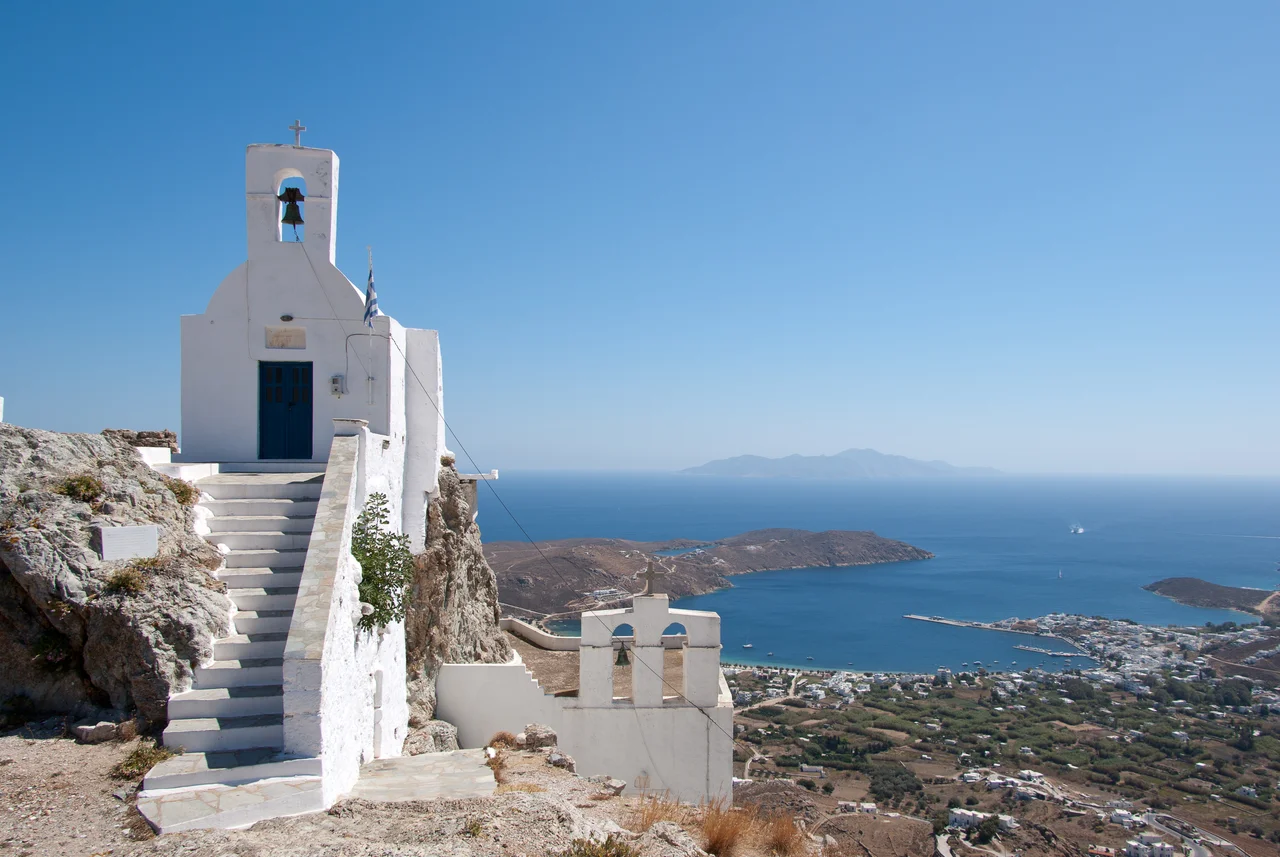
Serifos divides neatly between its harbor and its heights. The port, Livadi, is where ferries arrive and where most visitors stay: accommodation lines the waterfront, boats bob in the bay, and the business of arrivals and departures plays out daily throughout the summer season. It is pleasant without being remarkable. The ferry run from Piraeus, a few hours to the northeast, connects Serifos to the Western Cyclades chain that includes Sifnos and Milos.
A mile above Livadi, visible from the port and from which the port is equally visible, Chora climbs the hillside in the characteristic Cycladic manner: whitewashed walls, blue-domed churches, cubic volumes stacked against each other in the way that has made these islands architecturally iconic. There is nothing spectacular to do in Chora beyond inhabiting it — sitting in a cafe, walking the lanes, looking out over the sea. The bus runs frequently. A donkey path offers the steep ascent on foot and an easier descent, the old stone worn smooth with use.
For those interested in the island's deeper history, the village of Panagia in the interior holds the Church of the Panagia, a well-preserved church dating to the late 10th or early 11th century with frescoes from the 14th and 17th centuries. It keeps no regular hours; you inquire locally, and someone usually knows how to get you in.
Perseus's Island
Myth is a kind of geography. The stories the ancient Greeks told about Serifos — about Danaë and her infant son Perseus washing ashore here in a chest, about King Polydectes and the gorgon's head and the stone that was once a king — gave the island an identity that outlasted its ore deposits and its period as a Roman prison island. Serifos entered the literary tradition as the place where the hero grew up and where he returned in triumph, and that image proved durable.
The island itself, rugged and short of shade and watered by springs, feels like a place where such stories might be set. There is nothing soft about Serifos. It earns its name, which may derive from an ancient word for the island's characteristic rocky terrain. Walking here in summer requires water and a hat; the hills are genuinely steep and the sun is genuinely fierce. But the old footpaths cross the island in ways that reward those who use them, and the views from the heights — the Aegean spreading in every direction, other Cycladic islands dissolving in the haze — remind you of why people chose to live here in the first place.
The Sherry Wine and the Beach
Serifos has practical pleasures alongside its mythological ones. The beach at Livadakia, a short walk from the port by a path across the little Poundi peninsula, is excellent — better than the town beach in Livadi itself. At Livadakia there is a campsite, a swimming pool, and the majority of the island's hotel accommodation.
In some tavernas and shops you can find the local wine of Serifos: a traditional, sherry-like variety, amber-colored and worth trying. It is not widely exported, which means it belongs to the island in the way that the best local things do — available here, almost nowhere else.
Serifos has developed slowly as a tourist destination, and this slowness is part of what makes it appealing. It has the beaches and the Chora and the myth and the iron-track hillsides, without the crowds that have made Santorini or Mykonos into something other than Greek islands. It is, in its unhurried way, the real thing.
From the Air
Serifos sits at 37.15°N, 24.50°E in the western Cyclades, with no airport of its own. The nearest major airport is LGAV (Athens International Eleftherios Venizelos), approximately 130 kilometers to the northeast; the island is reached by ferry from Piraeus, a journey of a few hours on the Western Cyclades route that also serves Sifnos and Milos. From the air at cruising altitude, Serifos is recognizable by its distinctive harbor bay at Livadi and the white Chora visible on the hillside above it. The island is noticeably less vegetated than its neighbors — barren brown-grey rock covers much of the interior. A low pass at 3,000 feet over the harbor reveals the two settlements clearly and, on closer inspection, the linear marks across the hillsides where the ore-cart tracks once ran.
Nearby Stories
- Loutra, Kythnos 0.7 km away
- MS Express Samina 16 km away
- Kimolos 16 km away
- Greek Cruiser Elli (1912) 20 km away
- Hellenic Centre for Marine Research 33 km away
- Panagia Gremniotissa 36 km away
- Hydra: Fire Ships and Stone Mansions 42 km away
- Monemvasia 80 km away