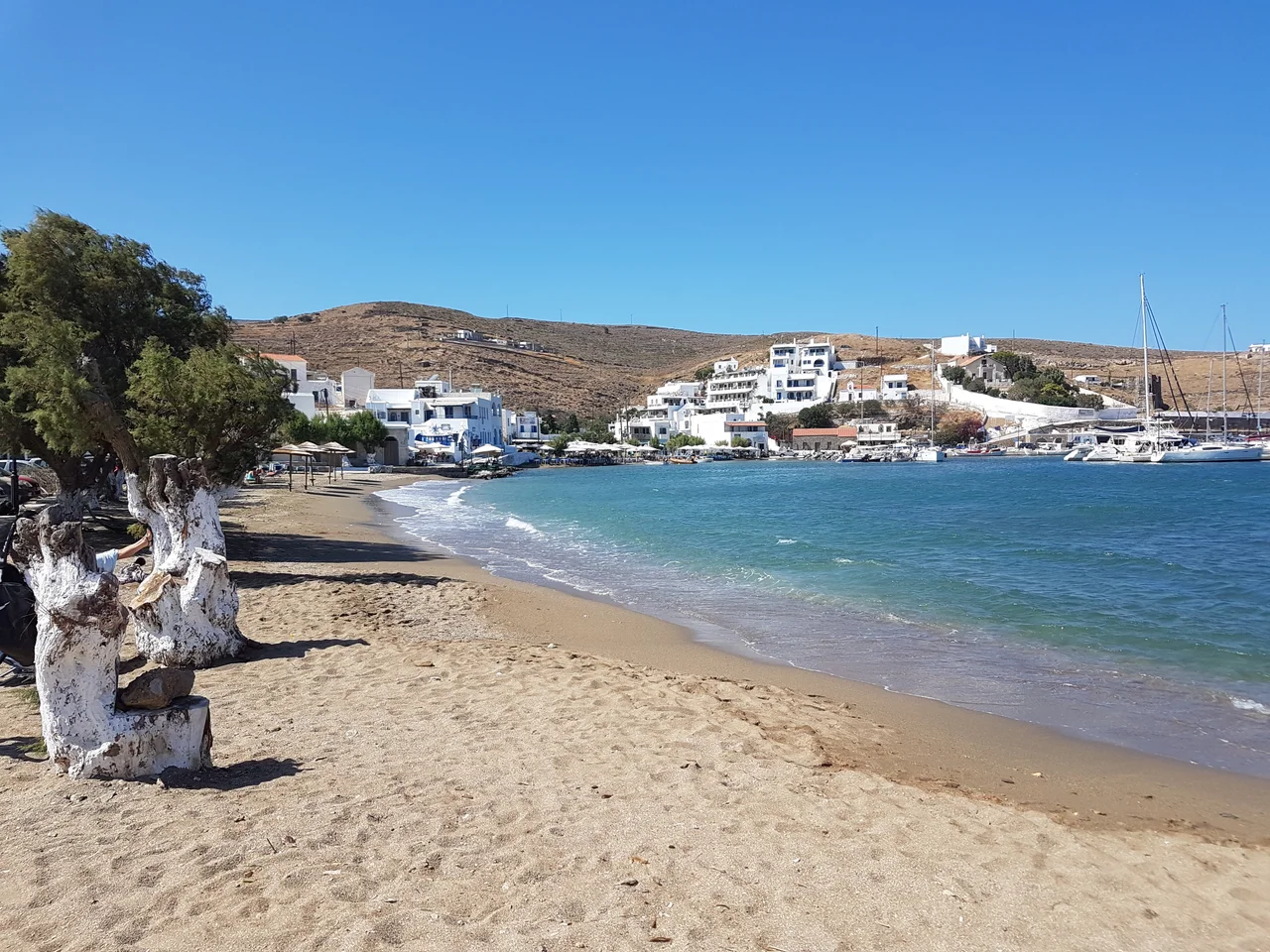

Loutra, Kythnos
Until quite recently, the people of Loutra used the hot springs for washing blankets. That detail, preserved in local memory, says something about the gap between how a place is remembered and what it eventually becomes. The springs at Loutra — on the northeastern coast of Kythnos, the island just south of Kea — have been known since the Roman period. They were used in Ottoman times, improved in the 19th century by some of the most accomplished architects in Greece, and for most of local history they served the practical needs of the village before they served the therapeutic ambitions of visitors. The blanket-washing came first. The spa came later.
The Springs Themselves
Loutra has two thermal springs of volcanic origin, and they are quite different from each other despite sitting only fifty meters apart.
The Agioi Anargyroi spring flows into the village's hydrotherapy center. Its water temperature reaches 36°C, and it carries more than 15,000 milligrams of dissolved solids per liter — primarily chlorine and sodium — making it moderately saline. It is moderately radioactive, at a concentration of 25 Mach units.
The Kakkavos spring, fifty meters away, flows directly to the sea rather than into any enclosed facility. It runs considerably hotter — 52°C — and is a ferruginous alkaline spring carrying sodium iodide, bromide, and chloride. It is weakly radioactive at 4.1 Mach. The two springs together have drawn people seeking relief from arthritis and rheumatic conditions for centuries, though the modern hydrotherapy center operates on a more systematic therapeutic basis.
The name Loutra simply means 'the baths' in Greek. No one thought a more elaborate label was needed.
The Architects of Modern Greece
The story of Loutra's spa buildings is also, unexpectedly, a story about two architects who shaped the physical appearance of modern Athens.
The original thermal baths facility was built in 1782, during the Ottoman occupation, commissioned by Nikolaos Mavrogenis — the dragoman, or official interpreter, of the Ottoman fleet. It was a functional structure that served the island's medicinal needs for decades. In the 1850s, a recommendation from the medical establishment to modernize the facilities led to a more ambitious project. The new spa building was completed in 1857, designed by Christian Hansen — the Danish-born architect who also designed the University of Athens and much of the Athenian neoclassical cityscape.
A few years later, an adjacent tile-roofed neoclassical building was added, this time designed by Ernst Ziller — the German-born architect responsible for some of the most recognizable buildings in Athens, including the Presidential Palace and the Schliemann Mansion. That two of the principal architects of 19th-century Athens designed facilities for a tiny Cycladic spa village of a few dozen residents reflects how seriously Greece took the development of its thermal resort tradition during that era.
Older Than the Buildings
The spa is not the oldest layer at Loutra. The archaeological site of Maroulas, just outside the village, contains finds from the Mesolithic period — among the earliest evidence of human habitation in the Cyclades. Excavations there have uncovered ancient circular dwellings, tombs, a human skeleton, and stone tools made from flint, quartz, and obsidian. The people who used those tools predated the spa buildings by many thousands of years.
Loutra itself has been inhabited since ancient times, drawn by two practical assets: a natural harbor and a reliable supply of drinking water. The borehole drilling conducted in modern times confirms that the water table at Loutra is potable within acceptable limits — unlike most of the rest of Kythnos, where it is not. In an island environment where fresh water was always precious, this made Loutra a natural anchor point for settlement across many different eras.
Village Life Between Eras
Loutra's modern history has its own rhythms. The village received electricity for the first time in 1932, through a donation from the Kanellopoulos family. In May 1941, during the Axis occupation of Greece, Italian troops landed here. The village population, which stood at 142 in the 1991 census, had dropped to 63 by 2001 before recovering to 81 by 2011 — a pattern of decline and partial recovery that mirrors broader trends in small Greek island communities.
Loutra was, until relatively recently, the main port of Kythnos. That role has passed to Merihas on the western coast, leaving Loutra with a marina and a fishing shelter rather than a working commercial port. The transition is not unusual. Small island settlements tend to reorganize around whatever economic function proves most durable, and at Loutra that function is now, as it has been for at least two centuries, the springs.
Coming to Loutra
The village sits on Kythnos's northeastern coast, five kilometers from the island capital of Chora and eleven kilometers from the main port of Merihas. The 81 people who live here year-round work mainly in tourism and fishing. The Xenia Hotel, associated with the historic spa complex, has anchored the village's accommodation offer for decades.
Kythnos is not a major tourist destination by Cycladic standards — it draws visitors who specifically want thermal waters and a quieter pace, rather than the beaches and nightlife of Mykonos or Santorini. Loutra suits that profile. The neoclassical spa buildings face the sea. The springs still run hot. And just outside the village, if you know where to look, you can find the stone tools of people who chose this same spot for the same underlying reasons — water, shelter, and the particular quality of this small bay — ten thousand years before anyone thought to give the village a name.
From the Air
Loutra lies at approximately 37.44°N, 24.43°E on the northeastern coast of Kythnos, the island directly south of Kea in the northwestern Cyclades. From altitude, Kythnos is identifiable as the elongated island between Kea to the north and Serifos to the south. The village of Loutra sits in a small bay on the island's northeast coast, with the town of Chora (the capital) visible a few kilometers inland to the southwest. The nearest major airport is Athens International (LGAV), approximately 90 km to the northwest. At 3,000 feet, the characteristic whitewashed buildings of the neoclassical spa complex are the most prominent structures on the northeastern coast.
Nearby Stories
- Anagyrous 8.9 km away
- Serifos 14 km away
- Greek Cruiser Elli (1912) 17 km away
- Hellenic Centre for Marine Research 23 km away
- Greek Islands 23 km away
- MS Express Samina 24 km away
- Karystos 25 km away
- Spetses 68 km away