
MS Express Samina
On the evening of 26 September 2000, 533 people were aboard the Express Samina — passengers travelling between the Greek islands, heading home or toward a holiday, making an ordinary journey on a familiar route. The ferry was well known in the Aegean. The Portes rocks off Paros were well charted. The sea was calm, with only light winds at force 3 on the Beaufort scale. There was no reason for what happened next. At 22:12, the ship struck the rocks. By 23:02, she was gone. Eighty-one people did not survive.
The People on Board
The 81 people who died on the night of 26 September 2000 were passengers and crew on a routine Greek island ferry crossing. They were travelling in late September, as the summer season wound down — the kind of crossing that hundreds of thousands of people made every year in the Aegean without incident. They had boarded at Piraeus; they were heading for the Cyclades. Among the more than 450 survivors were two American women, Heidi Hart, 26, and Christine Shannon, 32, who were later honoured by the City of Seattle for pulling two men to safety during the chaos of the sinking. Their actions saved lives. The actions of others on the crew that night cost lives: some crew members did not assist passengers in evacuating the ship.
The port officer on duty in Paros died of a heart attack on the night of the sinking, responding to the disaster. His death brought to 82 the total lives lost in direct connection to the event. The CEO of the shipping company died by suicide some weeks later. The weight of what happened on that crossing did not fall only on the 81 who were lost in the water.
What the Investigation Found
The cause of the sinking, as established by investigators and confirmed in criminal proceedings, was negligence by the ship's officers. The Express Samina was on a charted route past well-known rocks when she struck them. According to witnesses, First Officer Tassos Psychoyios had been watching a football match on television rather than attending to navigation. The bridge was not properly manned.
That was one failure. The second, and according to naval experts the more decisive one, was what happened after impact. Nine of the ship's eleven watertight compartment doors were open when she struck the rocks. Maritime safety law required those doors to be closed and locked at sea. Had they been closed, the ship might have remained afloat long enough for a full evacuation. Instead, water flooded through the compartments unchecked. The National Technical University of Athens conducted an in-depth study concluding that the open watertight doors were the primary structural reason the ship sank as rapidly as it did.
Only three of the eight lifeboats were successfully deployed. By the time the list reached 23 degrees, at 22:29, it was no longer possible to launch the remaining boats. The clock on the bridge stopped at 23:02 — the time at which the ship sank, 47 minutes after the first moments of listing.
The Sinking, Minute by Minute
At 22:12, the Express Samina struck the Portes islets. Three minutes later, at 22:15 local time, she was listing five degrees to starboard. The sea was entering through a six-metre gash in her hull. By 22:25 the list had reached fourteen degrees; by 22:29, twenty-three degrees. At that angle the remaining lifeboats could no longer be swung out. At 22:32 she lay at 33 degrees. By 22:50 the ship was on her side. At 23:02 she went under.
The first responders to reach survivors were fishing boats from the nearby port — ordinary working fishermen who turned toward the distress call in the dark. Port authority vessels followed. Royal Navy ships that happened to be operating in the area on a NATO exercise also responded. Rescue in the Aegean in late September means cold water and darkness; the response was fast and the toll would have been higher without it. That 452 people survived a sinking of this speed is partly a testament to those who came.
The Trial and Its Findings
The criminal trial began in late July 2005, five years after the sinking. The verdicts, handed down in early 2006, reflected the gravity of what investigators had found. First Officer Tassos Psychoyios was sentenced to 19 years in prison. Captain Vassilis Giannakis received a 16-year sentence. Three additional crew members received sentences ranging from 15 months to 8 years and 9 months for offences including abandoning ship without the captain's permission.
The convictions turned on demonstrated, documented negligence: an unmanned bridge on a known hazard route, safety doors left open in violation of maritime law, crew members who did not assist passengers during the evacuation. The courts did not find these to be accidents in any meaningful sense. They were failures of duty, and the law treated them accordingly.
In the wider European regulatory context, the disaster prompted a re-examination of cabotage rules — the rights of shipping operators to run domestic ferry services in newly admitted EU member states. A provision restricting those rights in Greece, Spain, and Portugal had been under pressure; after the Paros sinking, arguments that the regulations enabled unsafe operators to remain on routes gained new weight.
The Ship and Its History
The Express Samina was built in 1966 at the Chantiers de l'Atlantique shipyard in Saint-Nazaire, France, under the name MS Corse. She was a RoPax ferry — roll-on, roll-off passenger vessel — designed for the routes of the French Mediterranean. Over 34 years she passed through multiple owners and operated across the Mediterranean under various names before arriving in Greek service as the Express Samina.
The wreck lies in the waters off the Portes islets, near Parikia, in the central Aegean. It has become a dive site — one of the more accessible wrecks in Greek waters, visited by divers who come to see what remains of the ship in the shallow Aegean water. The Portes rocks that sank her are still charted. They are still there. They were always there. They were on every map the ship carried.
From the Air
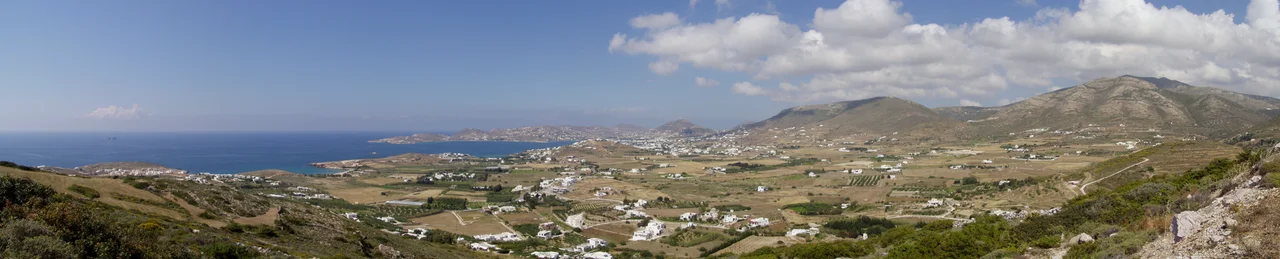
The wreck of the Express Samina lies at approximately 37.08°N, 25.09°E, off the Portes islets in the Bay of Parikia, on the western coast of Paros. From the air, Parikia harbour is clearly visible as the main settlement on Paros's western shore; the Portes islets lie a few kilometres southwest of the harbour entrance, visible at low altitude as small outcroppings. The nearest airport is Paros National Airport (ICAO: LGPA), approximately 10 km to the southeast. Athens Eleftherios Venizelos (LGAV) is the main international gateway, roughly 160 km northwest. Recommended viewing altitude for the Paros coastline is 2,000–3,000 feet on approach from the west.
Nearby Stories
- Panagia Gremniotissa 13 km away
- Milos 17 km away
- Panagia Kanala 18 km away
- Delos 18 km away
- Serifos 19 km away
- Amorgos 27 km away
- 1956 Amorgos Earthquake 27 km away
- Ikaria 57 km away