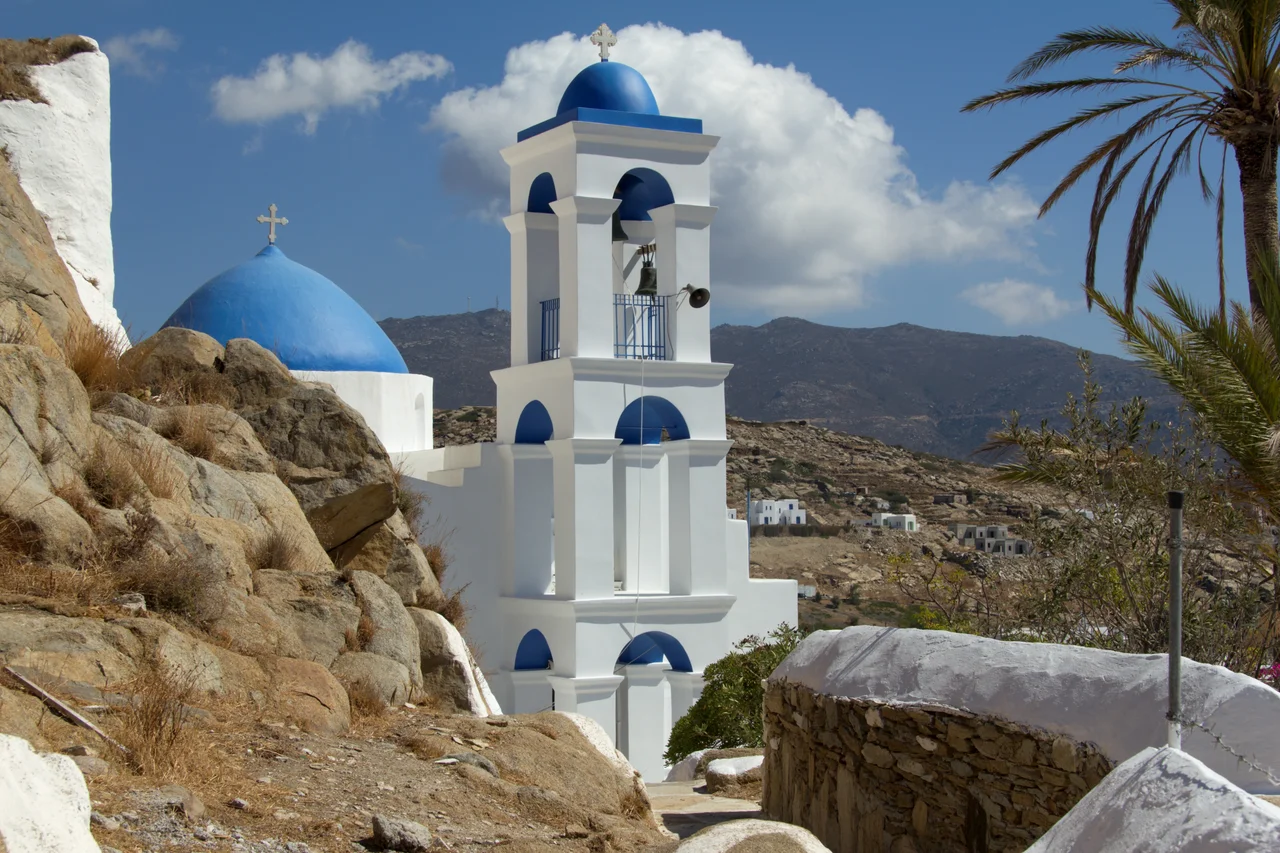

Panagia Gremniotissa
A shepherd noticed a light on Milopota's beach in the middle of the night. He went down to investigate and found a wooden raft carrying a religious icon of the Virgin Mary, a candle burning beside it. The raft had drifted from Crete, where people fearing the Ottoman occupiers had sent it out to sea with the hope that someone — somewhere — would find it and protect what it carried. The shepherd brought the icon to the church of Saint Nikolas. By morning, it was gone. It had moved on its own to the church of Saint Eleftherios in Palaiokastro. Twice more the same thing happened. The people of Ios understood: the icon was choosing its own home.
Virgin Mary of the Cliff
The church the islanders eventually built — constructed in 1797, in the place where the icon seemed most at peace — stands 150 metres above sea level on the very edge of the cliff above Ios Chora. Its name tells you exactly what it is: Gremniotissa means 'of the cliff' in Greek, and Panagia means the All-Holy Virgin, the way Greek Orthodox tradition addresses Mary. The full name, Panagia Gremniotissa, translates simply as the Virgin Mary of the Cliff. From this altitude, on clear days, Crete is visible on the southern horizon — the same island the icon supposedly came from. Whether the builders chose this spot with that view in mind, or whether the legend grew to explain the location, is one of those questions that faith and history don't always agree on.
Ottoman Seas and Drifting Icons
The legend places the icon's origins during the Ottoman occupation of Greece — a long period when Greek Orthodox religious life continued under significant constraint. The practice of hiding or moving sacred objects to protect them from destruction was real, and the idea of entrusting an icon to the sea rather than let it fall into hostile hands speaks to the desperation of that era. Whether this particular icon arrived this particular way matters less, perhaps, than what the story says about the relationship between the people of the Cyclades and their faith: mobile, resilient, carried across water, and always finding its way home.
Island at Work, Together
One detail in the founding legend stands apart from the miraculous elements: when the people of Ios finally understood where the church should be built — in a place from which Crete is visible — they gathered to build it together. Men and women of all ages, from every part of the island, came and worked. This collective effort is worth noticing. The Cycladic islands have long been communities where survival depended on cooperation, where the whitewash on a church wall or the stones of a terrace were maintained by many hands. The Panagia Gremniotissa is not just a church that arrived by sea; it is a church that an entire island built.
The White Chapel on the Hilltop
Today the church is one of the defining silhouettes of Ios. Whitewashed in the Cycladic style — bright against the blue sky, stark against the hill — it catches the eye from the port and from the footpaths below Chora. Inside, the icon the legend describes is still venerated. The church is Greek Orthodox, belonging to the Church of Greece, and remains an active site of worship rather than a heritage monument kept at a distance. For visitors who make the climb from Chora, the view from the cliff edge rewards the effort: south over the Aegean, east toward the open sea, the island's terraced hillsides falling away below.
From the Air
The Panagia Gremniotissa is located at approximately 36.724°N, 25.281°E, on the cliff above Ios Chora. The church sits at roughly 150 metres above sea level and is visible as a white structure on the hilltop from the sea approaches. The nearest major airport is LGAV (Athens International Eleftherios Venizelos); Ios has no airport of its own. The island lies about 200 km southeast of Athens in the central Cyclades. Approaching from the north by air, Ios appears as a compact, hilly island with its whitewashed Chora clearly visible on the northern hillside. The Gremniotissa chapel is among the highest white structures visible at that point. Summer visibility in the Cyclades is typically excellent, with afternoon haze sometimes reducing range.
Nearby Stories
- Cyclades 9.9 km away
- Phylakopi 15 km away
- 1956 Amorgos Earthquake 26 km away
- Serifos 28 km away
- Ikaria 87 km away
- Archaeological Museum of Chania 110 km away
- Heraklion Archaeological Museum 117 km away
- Archaeological Museum of Agios Nikolaos 133 km away