,_Phylakopi_I,_2300%E2%80%932000_BC,_BM,_Cat_Vases_A330,_142712.jpg)
Phylakopi
A flying fish swims through a fresco nearly 3,500 years old — its fins exaggerated into wings, its body turned slightly too graceful to be strictly anatomical. The fresco was found in fragments on a plastered floor at Phylakopi, on the northern coast of Milos, and reassembled piece by patient piece. It now hangs in the National Archaeological Museum in Athens. The fish has been swimming in that fresco since around 1500 BC, through Minoan influence and Mycenaean conquest and the long silence of abandonment, until archaeologists found it and gave it back to light.
Three Cities, One Place
Phylakopi was first excavated between 1896 and 1899 under the British School at Athens. Duncan MacKenzie — later the foreman to Sir Arthur Evans at Knossos — led the work, recording stratigraphic detail with a precision unusual for his era. What he found was a settlement of extraordinary continuity: Bronze Age occupation from the mid-third millennium BC through the 12th century BC, roughly 1,500 years of unbroken habitation on one low promontory above the Aegean.
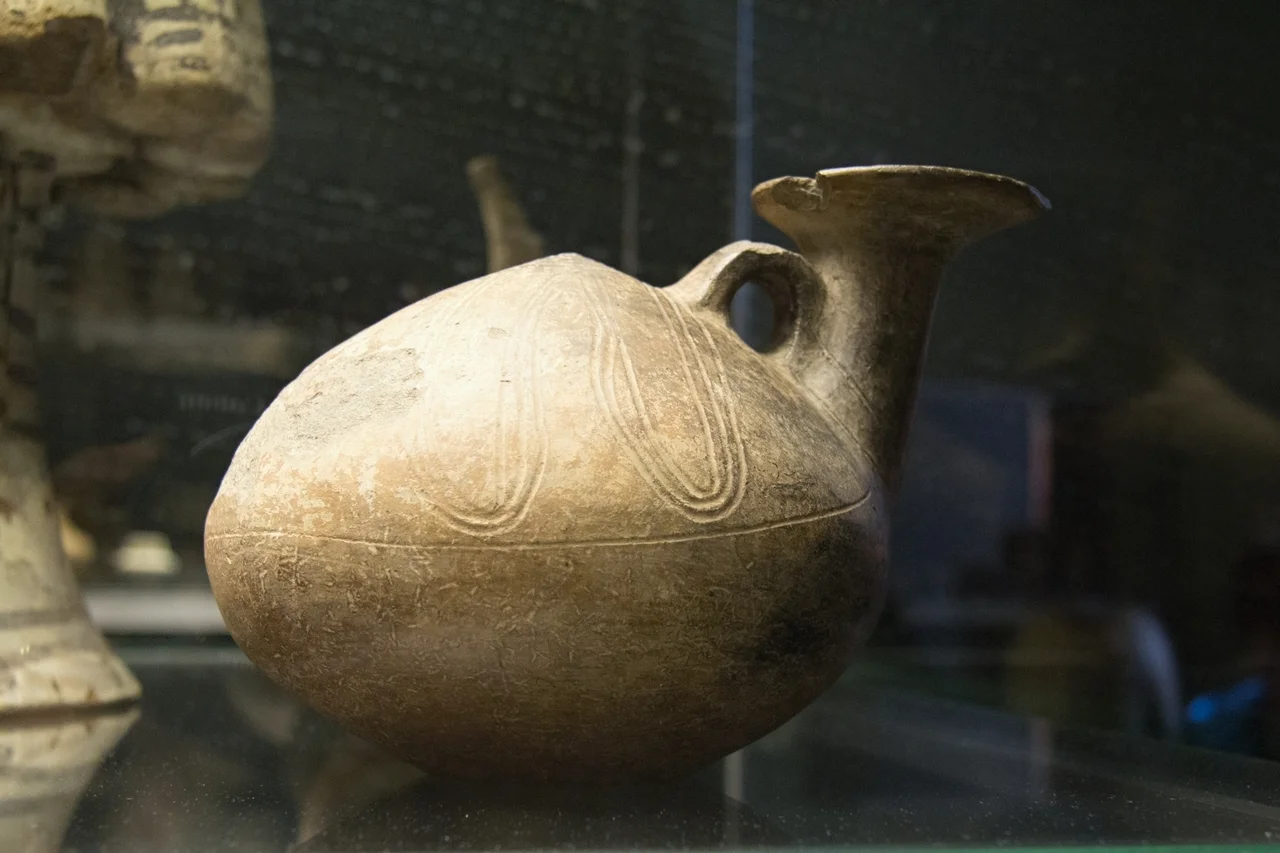
The site is organized into three broad phases. Phylakopi I, corresponding to the Early Bronze Age, was a settlement of modest scale — its pottery shows connections to other Cycladic islands and to western Anatolia. Phylakopi II, from 2000 to 1550 BC, was the city at its height: densely built, with houses separated by long straight streets, and exports — the distinctive "Melian bird jugs" — reaching as far as Knossos on Crete. Then came Phylakopi III, rebuilt after destruction that was probably seismic, running from 1550 to around 1100 BC, when the site was finally abandoned and never reoccupied.
Minoan Shadow, Mycenaean Fist
The middle and later phases of Phylakopi map the shifting powers of the Bronze Age Aegean with unusual clarity. During Phylakopi II, Minoan influence crept steadily northward from Crete — Minoan pottery increasingly displacing local wares, Minoan architectural ideas appearing in the structures. Scholars debate whether this represents political control or cultural prestige: the islanders adopting Cretan fashions as a marker of sophistication, or Crete actually governing the settlement. Either way, by the start of Phylakopi III, the island's culture was deeply Minoanized.
That changed when the Thera volcano erupted around 1500 BC, disrupting Minoan networks across the Aegean. Into the gap came the Mycenaeans. At Phylakopi — uniquely among the Cycladic islands — a megaron was built: the large central hall associated with Mycenaean palatial administration at Tiryns, Pylos, and Mycenae. Its presence suggests that Mycenaean rulers conquered and directly administered Phylakopi, installing an outpost of mainland power on this small volcanic island.
A fragment of a Linear A tablet — the undeciphered Minoan script — was found in the so-called Mansion, suggesting that administrative records were kept there. The Pillar Room contained the flying fish fresco. There was also, found in 1974, something no one expected.
The Lady and Her Shrine
Colin Renfrew resumed excavations at Phylakopi in 1974 after a gap of 63 years, and what he found transformed understanding of Bronze Age religion in the Cyclades. In the Late Bronze Age layers, a sanctuary came to light: two shrine rooms, altars, niches, ritual vessels, and scores of figurines. Nothing like it had been found anywhere else in the Bronze Age Cyclades.
Among the objects was a terracotta figurine approximately 45 centimeters tall, wheel-made, depicting a female figure — a goddess or priestess — dating to around the 14th century BC, in the Late Helladic IIIA period. She became known as the Lady of Phylakopi. She is now in the Archaeological Museum of Milos, the most celebrated object from this remarkable site.
The sanctuary itself is a record of the settlement's final centuries: shrines built, damaged, repaired, used again, then finally abandoned in the collapse of the Late Helladic IIIC period, when the wider Bronze Age world was unraveling. Phylakopi was never reoccupied after that abandonment. The sea has since eroded part of the site, carrying pieces of it away permanently. What remains is still being understood.
What the Stones Remember
Phylakopi sits on a low cliff at the northern tip of Milos, overlooking the strait toward Kimolos. The site is not large by the standards of great Bronze Age cities, but its significance is proportional to its continuity rather than its size. It is the type-site — the reference point — for several phases of Aegean Bronze Age chronology. Scholars still use "Phylakopi I," "Phylakopi II," and "Phylakopi III" as shorthand for broad cultural periods across the region.
The flying fish from the Pillar Room, the Lady from the sanctuary, the bird jugs that traveled to Knossos: these objects are now dispersed across Athens and Milos and London, in the care of institutions that did not exist when the Bronze Age ended. The site itself, gradually giving ground to the sea, is protected but not dramatic to visit — a low ruin on a cliff, easy to underestimate.
But this was a city that traded obsidian when obsidian was currency, that hosted Minoan artists and Mycenaean governors, that maintained a religious sanctuary for centuries and buried a small terracotta goddess in it before the whole civilization collapsed. In that collapse, Phylakopi disappeared. It took 3,000 years for anyone to find it again.
From the Air
Phylakopi is located at 36.755°N, 24.505°E on the northern coast of Milos, near the village of Pollonia. The nearest airport is LGML (Milos Island National Airport), approximately 4 kilometers to the southeast. From the air, the site is a low, grassy promontory on the northern headland of the island, facing the narrow strait that separates Milos from Kimolos. At 2,000-3,000 feet, both islands are visible simultaneously; the strait between them — just 1 kilometer wide — is a distinct blue slash. The site itself is not marked by visible structures from altitude, but the headland's shape is identifiable. Early morning light from the east illuminates the northern coastline.
Nearby Stories
- Serifos 8.9 km away
- Despotiko 15 km away
- Duchy of the Archipelago 36 km away
- The Eruption of Thera: The Volcano That May Have Destroyed Atlantis 45 km away
- Hydra: Fire Ships and Stone Mansions 47 km away
- SS Slamat 69 km away
- Santorini: The Volcano That May Have Destroyed Atlantis 94 km away
- Battle of Cape Spada 98 km away